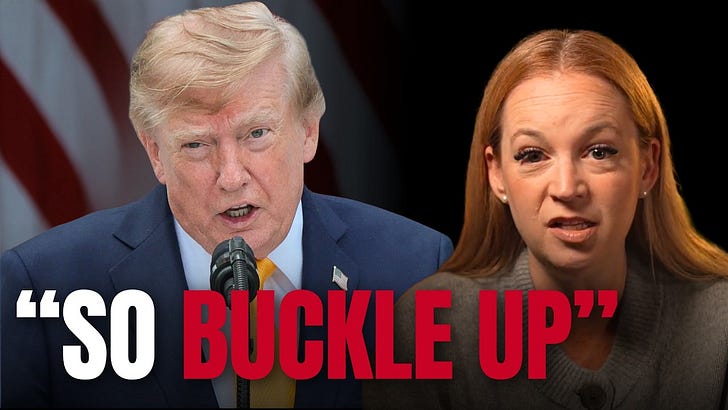

Last Thursday, I had the opportunity to interview Hunter Biden. It was a conversation I never would have imagined having even a year ago. During the hour that I spoke with him, he shared numerous insights into politics in Washington, D.C., and also a devastating health update on his father. We discussed his sobriety, and I challenged him on his recent strategy to sit down with people that I personally would not ever speak to or lend credibility to. There were moments when I agreed with him, moments when I strongly disagreed, and moments that forced me to reconsider some of my own assumptions. But there was one part of our conversation that I haven’t been able to stop thinking about since.
Since Trump has taken office again, I have been trying to understand why the Republican members of Congress have given very little, if any, pushback to Trump and the dangerous path he is taking our country down. I imagined that there had to be a reason they had all immediately surrendered their power to him. What I came to understand through this interview was that for the majority of the Republican politicians currently serving in Congress, it was never about country.
Hunter was remarkably candid, and some of the most revealing moments came in places I wasn’t expecting. At the end, I was left with far more to think about than I had anticipated, including a perspective on Trump, the Biden family and politics in America that I hadn’t fully considered before.
Subscribe to Hunter Biden’s new Substack HERE.
We are living through a pivotal moment for our country, and my goal is to reach as many people as possible with clear, factual information about what is happening. The more people who understand what is unfolding, the better our chances of pushing back against chaos, cruelty, and corruption ahead of the midterms.
Thank you for your continued support. Your paid subscriptions have enabled me to add a video editor and reach more people.
Independent journalism is under attack. You can make a difference with a $5/month paid subscription. Your support allows me to keep telling the truth about the lies and destruction unfolding in our country, defend myself from constant pressure from MAGA extremists, and ultimately spread the message to more people.
I’m fighting to save our country (before it’s too late).
I’ll see you tomorrow,
Heather
*This commentary represents my personal opinions and analysis of matters of public concern, informed by publicly available information. Any references to individuals constitute opinion and commentary protected under the First Amendment.
Full podcast transcript below:
* This is an auto-generated transcript which may contain slight variations or inaccuracies.
A conversation with Heather Delaney Reese on Hope for America
“Donald Trump has effectively instilled a level of fear that I’ve never seen, because of his willingness to do things that no one else would have ever even considered doing.”
“What Elon Musk did to USAID, with the full complicity and direction of Donald Trump, is akin to genocide.”
“I think there’s one existential threat. It’s not the Republican Party and it’s not a movement. It’s Donald Trump. He’s a completely and utterly broken, depraved individual. And I mean that from a clinical perspective.”
HEATHER DELANEY REESE: Thank you, everyone. Welcome. I’m really excited; we’re talking to Hunter Biden today. Hunter, you’re not someone I ever thought I would talk to. I’m actually kind of surprised at myself. This morning I was like, Hunter Biden. But I can’t tell you how excited I am, because I have a bunch of questions.
First: did you happen to see Trump’s hair last night?
HUNTER BIDEN: His hair?
HDR: His hair. Did you see his hair?
HB: No. Did it do something more ridiculous than it usually does?
HDR: Pretty much. There’s speculation he has a wig now. It was fuller. It was more orange. I don’t know. It gave me a laugh, and I need a laugh these days. I take every single opportunity I possibly can.
HB: Oh, my gosh. Me too.
“I’m still figuring it out”
HDR: So my first thought here is that when a lot of people think of you, they hear the absurdity coming from people who used you — and these are my words, not yours — to attack your father. But that’s not who you are. What do you feel is your toughest challenge in getting people to understand who you really are?
HB: Wow, that’s a big question. Here’s the honest answer: I’m still figuring it out.
The narrative that was spun about me was so ubiquitous, so overwhelming. And as much as I can talk about the effort to dehumanize me by certain parts of the media — in particular Fox News and the New York Post and the Daily Mail, kind of the Murdoch empire — the fact of the matter is that at the same time, not many other people stood up for me who we would all kind of expect to slow things down and ask real questions. I’m still trying to figure out why that was the case.
The beautiful part about it, however, is that I — more than maybe anybody in modern days — benefit from the incredible gift of low expectations. As long as I can show up and I’m not drooling, and don’t have a crack pipe in my mouth, and I’m not shirtless coming out of a motel room, they’re amazed at how well put together I am. It doesn’t take much.
So I try to turn everything upside down and see the good that’s come from it. And part of the good is that everybody got to see a little bit of themselves in me, because they got to see all of me. Not all of it was true, but a lot of it was — the parts about addiction, the places you find yourself when you’re deep into an addiction the way that I was. So I’m enjoying reintroducing myself. People may not like it, but this is the real me.
HDR: You are who you are, and it comes across. For me, I was very surprised at how relatable it was — not in the sense that we’ve walked the same path, but that you’re a human being, and that there’s a humanity in each of us.
What’s the most ridiculous or outlandish conspiracy theory or made-up lie about you? Which one really shocked you?
HB: We only have an hour.
HDR: I know. Right.
HB: It’s hard to pick. Rachel Maddow did a whole show on it, and I always forget what it’s called. But the one that, when it’s first said, just blows a hole through your chest, is the pedophile thing. My wife, Melissa, says, “Stop, don’t even say that.” It’s probably the most overused, other than crackhead. It’s the underlying thing you see from trolls on X when I’m sifting through to find the beautiful comments from people I’ve reached about recovery.
And it didn’t come out of nowhere. It was a concerted effort by Rudy Giuliani and Steve Bannon and Miles Guo and Bernie Kerik. It was the first thing they tried to do — conflate my addiction and the photographs of me engaged in my drug addiction, and everything that comes along with it, with that.
The laptop
HB: People forget what Rudy Giuliani actually did. When he got this hard drive from what I believe was a guy named Dmytro Firtash, they held onto it for about a year and a half. And I know for certain, based on years of trying to untangle this, that their original intent was to do an October surprise about my drug addiction. That was going to be the thing: not only is Joe Biden the father of a drug addict, he’s the father of a crack addict. All those pictures the New York Post put up were going to be their real October surprise.
But I scooped them a year before, because I didn’t have any idea what they were doing. When I got clean and sober in June of 2019, I decided to sit down with a guy named Adam Entous of The New Yorker and do a profile piece. I was completely transparent about everything. Adam is an incredible writer, and I didn’t like everything he wrote, but everything he wrote was true. That took the wind out of their sails.
So what Bernie Kerik and Rudy Giuliani did — literally the first thing they did — is they went to New Castle County, Delaware, stood on the courthouse steps, held a press conference, and implied that this device, which was not my laptop but which they called my laptop, contained images of minor children and things like that. Which was 100 percent verifiably, completely a lie.
But if you can get people to believe the worst possible thing about you, even a small percentage of people, you gain the ability to get a larger percentage to believe the other things you say. That it’s evidence of bribery. Or corruption. Or influence peddling.
And at the end of the day, what the laptop was evidence of was 22 years of my entire digital existence revealed to the entire world — and still out there for everybody to see. Every photograph, every video, every deleted photograph or video, every text message, even all my voicemails going back almost a decade. Every communication I’d had in 20 years.
And not one single communication were they ever able to point to from me to my father, or to somebody on my father’s staff, saying, “Hey, I have this client that needs X, Y and Z, can you get it done for me?” That’s lost in all of this. What’s lost is that the laptop was actually exculpatory for me.
HDR: What you’re saying is that it’s not what was there, it’s what wasn’t there — that’s the whole story right there. It reminded me, because your sister’s diary, they stole that too. And they’ve gone after Fauci’s diary. I don’t even want to say they’re not fighting fair, because this isn’t about a fight and it’s not about fair. To them there are no depths to the level of depravity.
HB: Yeah. Heather, I always say this, because everybody asks me the question — or what they say is, “You must have been used to it. You grew up with your dad as a senator, then vice president. At least you were kind of prepared for it.”
There has never been anything like this that I know of. And I’m a student of history. I’m a student of presidential history. I don’t know of anything like these guys. They’re absolutely depraved. Their willingness to go to depths that no other — not Richard Nixon, not James Buchanan, not Andrew Johnson. I’m trying to think of the list of presidents at the very bottom. No, I can’t think of anything that has been like this.
And by the way, it doesn’t just apply to me. Look at the way they go after the families of people like Dr. Fauci, or the families of people who stand in their way. And now with the full force of the power of the Justice Department.
I always remind people: the process alone can kill you. The process alone can bankrupt you. Even if at the end of the day you’re vindicated, just having to go through it. I think of people like Don Lemon. He’ll be fine on the charge — but he’s going to end up spending millions of dollars defending an insanely ridiculous charge.
HDR: And it was reporting. I’m not a journalist, I don’t claim to be a journalist — I’m a writer, and I like to share what’s happening right now. I truly feel this won’t turn into jail time or anything crazy for him. But it doesn’t matter, because he’s going to be dragged through hell defending himself and spending that money.
“It’s fear”
HDR: Something you said that I think about constantly: it’s not what happened, it’s what didn’t happen, and the people who didn’t defend you. Your dad — you talk to so many people and they say he’s a stellar person, a decent man, that he served our country. He made a lot of friends on both sides of the aisle. And when this happened, I keep wondering: where were these people? Where were the people saying, this man’s been through enough, his children have been through enough?
The question I ask myself every single night is, what has happened to Republicans in Congress? Why are they being blackmailed? Like you said, they had your sister’s diary, they had this laptop thing. Is it blackmail? Is it closeness to power? Is it concentration of wealth? Are there any decent ones left? I gave you a lot, but what do you think is going on here?
HB: Some of it can be answered by the irresistible draw of proximity to power — wanting to be in the club, wanting to have access. If you’re a Republican congressman or senator, you want to be a part of it. You don’t want to have to stand alone like a guy like Thomas Massie and see what happens.
And part of it is pure fear. And let me say this: this is Donald Trump, and everything that has spawned from him. Donald Trump has effectively instilled a level of fear that I’ve never seen, because of his willingness to do things that no one else would have ever even considered doing. Not because they didn’t have the power or the nerve or the gumption, but because I don’t know of any person in the history of this country who has attained his level of leadership who is more purely depraved than he is.
He’s a completely and utterly broken, depraved individual. And I mean that from a clinical perspective. He has absolutely zero empathy. But more than that, his level of malignant narcissism is so deep, so sociopathic, so psychologically warped. And everybody knows it. This will get clipped and people will go, “Oh, Trump derangement syndrome.” Everybody knows it. There are stories that go back to when he was a child, over and over again. As Rosie O’Donnell says, everybody in New York knew he was a liar and a cheat and a crook and a braggart.
And so we sit here and watch this man fill a room that 45 other people before him sat in, and decide it wasn’t enough. Fill it with gold and with baubles from the gifts that people come and place at his feet like he was a king. Tear down the Rose Garden, tear down the East Wing, gold-plate the statues.
I say to people: forget about how gaudy it is. What does it say about a human being? It’s literally like something out of fiction, but we’re living through it. And the other thing I say is — with all the issues, go to your community. I bet you could use five million dollars for the re-beautification of your park before the thirty million he’s spending to paint the reflecting pool blue. What a waste.
So, fear. I think they’re scared to death because they watched what happened to their colleagues. You take somebody like Adam Kinzinger. Liz Cheney. Massie. I mean, there could not have been anyone more pro-MAGA than Marjorie Taylor Greene — and he cut her out, and she’s persona non grata no matter how much she’s on the outside screaming back in.
He learned from Roy Cohn that it is better to be feared. And he’s taken it to a level I don’t think any of us could have imagined.
HDR: Do you think it’s just the fear of losing power and their position? I tend to think there have to be some who wouldn’t bow down to him like this. Maybe I’m wrong. Is it really that simple?
HB: I think part of it is that simple, and part of it is the more complex explanation you’re hinting at. It’s a balance. Some are just scared to death because their daughter is an alcoholic and she’s been in and out of rehab, and they know that will be used against them. Or you’re in the Republican Party and you’re a closeted homosexual, and they’ll use that against you — or your child is. Whatever the case may be, everybody has something they want to keep private. Some of it is stuff that’s not fair for them to have to keep private, but everybody has something.
And the beautiful thing about me is that doesn’t exist for me anymore. This isn’t bravery on my part — me telling Donald Trump to go F himself, those are just words. It’s that I have a luxury very few people have, which is that he took it all. He took every bit of my privacy. He took every secret that any normal person would want to be able to deal with within the four walls of their bedroom, with their wife and their family. He took that from me.
And in that complete and utter destruction of any sense of privacy, what he gave me is a freedom I never imagined possible: I have no shame. I know the things I take ownership of, and I can talk about them as much as I’m willing to, and address them as directly as I’d address anything.
Who stood up
HDR: Were there certain members of Congress — you don’t have to name them — who disappointed you the most, either by not standing with your dad and you by extension, or since Trump’s second term?
HB: I don’t necessarily want to name names. There are some with these gigantic egos driven by greed and sense of self. Joe Manchin was a complete pain in the ass and, I think, a total fraud — and now he’s out talking about creating a third party. But I don’t want to start naming names, not because I’m concerned about naming names, but because I think I’ll leave somebody out.
HDR: But were there some where you were like, I can’t believe you’re not standing up — with my dad, and also in this moment, where you just completely bowed down to Trump when he took back office?
HB: Yeah. Chuck Schumer.
HDR: Yeah.
HB: But I really didn’t look at it that way, and I’m not trying to skate the question. I have truly focused on the people who did.
I think of somebody like Bennie Thompson, and the Congressional Black Caucus. The Black Caucus stood up for my dad and for me every single time. Every single time — and actively sought a microphone to defend me and my dad in the worst of times.
One of the reasons is that I think there’s no more important association my dad has than his relationship, not just with the Black Caucus, but with the extension of the civil rights movement past 1972, when he got elected — and the realization that he would not have been a United States senator, and would not have been vice president, and would not have been president, if it wasn’t for the Black community. And not just the Black community, but in particular Black women.
If you’ve spent any time around Democratic politics — as long as I have, 54 years of my life, more chicken dinners than I can possibly count — you know that the central core, the spine of the Democratic Party, is Black women. They organize the party almost everywhere I’ve ever been. It’s astounding.
And I have my reasons for why I think that is, and why historically that is. Part of it has to do with the remaining vestiges of how critical participation is if you want change, and how critical it is to never give up and never believe there’s no hope that anything will change. If you’re a Black woman in 1961, as compared to — I always think back to the civil rights movement and think, how did they not give up? How could they face Bull Connor’s dogs, or the Edmund Pettus Bridge, or getting the hell beaten out of them, and killed and murdered and shot in the Deep South, and the Freedom Rides — riders who were both Black and almost largely Black, but some white people joined — and not give up? I think about that today.
So there were 50 years of my life in which people in the Black community, from South Carolina to Mississippi to the Deep South and all over this country, had a relationship with my brother, myself, through my dad. That’s what I focused on. That loyalty that went both ways.
HDR: Who are some of the people in Congress today who you think still embody that — who are in it for the right reasons? Or do you think there are people?
HB: I do. It’s going to surprise you. I don’t agree with 98 percent of what he votes on, but I think Thomas Massie is in it for that reason.
The other person I think is in it for that reason is AOC. I look at her and I see the future of the Democratic Party in every way — not only as a communicator, but as someone who has an instinct to find common ground, and who believes we do have to have some kind of radical change. And that’s not a radical thing to say. It’s not a radical thing to say that the system is completely broken. It doesn’t work.
The idea that 80 percent of Americans could believe healthcare is a fundamental right, and we still don’t have universal healthcare in one way or another, by whatever means necessary — it’s crazy. The idea that 80 percent of Americans believe there should be some accountability for the corporations poisoning our children’s minds, literally leading to suicide, in the form of social media companies — and we have no way to hold them accountable because of Section 230.
I also believe Ro Khanna is a really effective communicator, and has shown he can reach across the aisle and sit down with people who don’t believe anything he says.
And I hate these labels. Democratic socialist — what’s a democratic socialist? All a democratic socialist is, is somebody who believes the same thing Teddy Roosevelt believed, and his cousin FDR believed. The same thing Lyndon Johnson believed and JFK believed. The same thing George Herbert Walker Bush believed, to some extent.
I look at democratic socialism as meaning we should have a safety net in this country, that we should take care of the vulnerable when they can’t fully take care of themselves, and that it’s all of our responsibility to make certain we provide for the safety and security of our neighbors. That’s the socialism that I — I don’t know why we have to label it within the party.
HDR: I think it’s also seeping over from the Republicans, who like to label. Their new thing is communism and Marxism. They’re kind of forcing these things.
You know, what you said sounded very presidential. You’ve said you don’t have any ambitions to run.
HB: No, I don’t. I really don’t. I joke with people — and I don’t fully mean this — but if I announce for something, somebody should check to see if I relapsed.
HDR: That’s the sign. Funny, not funny.
HB: Exactly. But I care about this enormously. I care who our next leader is. I care about leadership. I think politics is one of the most noble things you can do if you practice it the same way my dad practiced it for 55 years. That means putting his constituency first — whether it was the people of Delaware, or the American people, or just humans. He cared about humans.
I’ve become very simple about it. I think there’s one existential threat. It’s not the Republican Party and it’s not a movement. It’s Donald Trump. I believe he has so infected everything. He’s a singular force.
Can I tell one story? There’s a psychologist who got semi-famous in 2015 — board-certified, Harvard-educated. He went on TV, and I think he wrote an article, and he diagnosed Donald Trump, which I don’t think is always fair, but in this case I think it was. He diagnosed him as a malignant narcissist, which is very different from a sociopath or a psychopath or a narcissist. Everybody listening to this, go look up the literal medical definition of a malignant narcissist.
And he said if Donald Trump were ever elected president of the United States, it would be like an asteroid hitting North America. Everybody at the time thought that was a vast exaggeration, hyperbole to a degree that was completely unfair to Donald Trump. Does anybody not feel like we got hit by an asteroid? Twice?
HDR: I just looked it up — a malignant narcissist, according to the Google overview, is an extreme, severe form of narcissistic personality disorder mixed with antisocial, aggressive and sadistic traits.
HB: Kind of fits, right?
Bo, and what addiction really is
HDR: I want to flip it, because I have a question for you. Had you not gone through this period of turmoil and addiction, and if your brother were still alive today — and I’m very sorry for your loss — could either of you have been president of the United States?
HB: Oh, my brother, 100 percent. I don’t think my dad would have run if my brother were still alive. My brother made him promise before he died that he would run.
Bo was an extraordinary human being. I know it’s easy to say that when someone’s gone, but I don’t know of literally anyone who ever got to know Bo who didn’t recognize in him not just an extraordinary talent, but an extraordinary human being. He would have been great at whatever he decided to do. And I would have asked him to be president.
HDR: Really? Everything I’ve ever read says he was extraordinary. I also read that toward the end, you sat by his hospital bed for months. Is that true?
HB: Yeah.
HDR: And I think that’s also left out of it — addiction doesn’t come out of nowhere. Did yours come out of nowhere? Is that a false —
HB: No, no. And you’re right about that. I don’t know your personal experience with addiction, but everybody has some personal experience. And I don’t mean they themselves — I mean everybody I’ve ever talked to has someone they love deeply who suffered from addiction. It doesn’t always have to be as cinematic and dramatic as what I went through. But it’s kind of a universal condition.
Addiction is a family disease. The addict has an impact in concentric circles, going out in degrees of separation, and everybody in some way ends up collateral damage.
HDR: Right. And maybe the takeaway is that we need better services. We need to help people more than we isolate them and scapegoat them.
HB: Yeah. There’s an enormous amount that can be done as it relates to policy — the way we treat addiction, the way we treat drug use, whether it’s criminalization of drugs as compared to the need for recovery and rehabilitation. Nine out of ten people who could use rehab can’t get one.
I work with a rehab called Peak Path Health here in LA, and I’m responsible for setting up a foundation for aftercare. Because one of the things I deeply believe is that the 30 days — if you can get it, which very few people can, if they have insurance to pay for it — it doesn’t end there. After that, you’ve distanced yourself from your last drink or drug, but you still go back to the same exact situation you were in. If you have a situation to go back to at all: a home, a place to live, people to help you.
I always say that no matter whether you have an enormous support system or not, it’s really important that you get a whole new way of doing things. And that is aftercare. There are a lot of great models out there, and a lot of amazing things people are doing. But we have to start having a really honest discussion about something that 50 million Americans are dealing with every day, which is their addiction. And if there are 50 million people dealing with their addiction or recovery, or still sick and suffering out there, then the entirety of the 350 million population is feeling it.
The obsession
HDR: Another question. Yesterday, Trump said that everyone took advantage of your dad, including his family.
HB: Who said this?
HDR: Trump. He said it in Las Vegas yesterday. I’m paraphrasing — I don’t have the exact quote — but pretty much: everyone took advantage of your dad, including his family.
HB: He’s such an asshole. I swear to God. He’s obsessed.
HDR: That’s exactly what I wrote. He’s still obsessed with Biden. Obsessed.
HB: It is unbelievable. And here’s the thing: his obsession is rooted in his inferiority complex. He is absolutely certain that Joe Biden is everything he wishes he could be. He is loved. He is capable of love. He loves his family. His family adores him genuinely and deeply. He has deep human connections. He’s smart. He’s good-looking. He’s athletic, and people like him. Not so much with Trump.
I wrote this thing on Substack about what was really upsetting about the White House Correspondents’ Dinner — remember watching that? It was just sad. And the sadness that came over me is that we are held captive by this madman. You watch him up on that stage for an hour and a half, and he’s supposed to be self-deprecating, like every single president before him. He’s supposed to be funny — but not in a way that’s mean and cruel. He’s supposed to show he has a little bit of a sense of humor.
Because what a sense of humor shows is the ability to look inward. The ability to put yourself in somebody else’s shoes. It shows you’re not a malignant narcissist. It shows you’re not a sociopath. The one thing that people who are severely psychologically impaired in that way all have in common — and I’m not making this up, I’m not even joking around — is humor. The ability to laugh with others and at themselves.
And what’s the one trait he doesn’t have? Have you ever heard him tell a joke about himself? Have you ever heard him make anybody laugh? I got a lot of comments back like, “Oh, he’s the funniest guy out there, what are you talking about.” No, he’s not. He really is not. I know people laugh at him because they think it’s the absurdity of it — this confusion between being authentic and being absurd. Like the absurdity of calling himself six foot three, 225 pounds, while he stands in front of us and he’s clearly 285 and maybe six foot. It’s insane, right?
But then he says things like: Joe Biden was taken advantage of. The one person in the world I know who has never, ever been taken advantage of — not because people didn’t try, and I can say this with absolute certainty — is Joe Biden, by his family.
HDR: Right. Do you guys even pay attention to that anymore? Do you just ignore it? Do you laugh?
HB: Heather, it’s impossible to keep up with it. The Washington Post did a thing on the first hundred days of this second term: Donald Trump spoke about, invoked, my dad’s name six times a day. Six times a day. Think about how — I hate this word because it’s so overused — how completely, utterly unhinged that is. You’d say about anyone, that’s insane. I don’t say Donald Trump’s name six times a day.
HDR: I unfortunately do. But I know. That’s his personality, right? He can’t let go. He fixates until he meets some sort of need that’s unmeetable. He just keeps spewing this stuff out there.
“Cancer is awful”
HDR: By the way, how are your parents doing?
HB: My initial reaction is, oh, they’re great. But they’re not. I mean, Mom’s great. Mom’s out there. She’s telling her book, which is an incredible book, and I’m so proud of her and of what she wrote — her defense of my dad when she needs to be, but also just her story. So she’s all over the country. And Dad is too.
But cancer is awful. It’s just awful. He has stage four metastatic bone cancer, and he’s 83 years old, and it beats the hell out of you. The only thing I worry about is that he doesn’t complain enough. And I don’t mean that like — he just never complains about stuff like that, and I don’t think that’s good for him. When you have stage four prostate cancer and stage four metastatic bone cancer, it’s incumbent upon you to let people know when things are too much. I just worry about him. I was just with him for the last two weeks. He’s not complaining, but it takes it out of you, man.
HDR: He’s feeling it.
HB: Yeah, the treatment is. And the only reason I talk about this as openly as I do is because it’s all public. And also because it’s like everything else, and it’s the lesson I learned in recovery: name a family that doesn’t have somebody who has cancer. Anybody. So why do we pretend we can’t talk about it, like it’s something private? How is it private? Everybody has it. My brother died of brain cancer. You know how I know everybody has it? Because everybody comes up to me and says, “Yeah, my sister died.” It’s the same way they come up to me about addiction.
And the thing I think is really important about that is that one of the things that makes it such an awful experience — beyond just the obvious — is the feeling that you’re alone. The feeling that your pain is unique. The feeling that your grief or your anxiety is unnatural and yours alone.
What I learned through losing my mom and my sister, and my brother, and my own addiction, and all the traumas of this exposure, is: you know what, you’re not alone. It’s the universal condition. Everybody’s lost somebody they love deeply. Everybody has someone in their family suffering from cancer, or addiction, or who just can’t get out of their own way. That’s why I talk about my dad’s health so openly. I want people to know they’re not going through it alone. All they’ve got to do is look over their shoulder and talk to the nearest person.
HDR: My father has an incurable cancer, so he’s living with it too. My mom just had lymphoma, and I lost my brother-in-law just last year. It’s one of those things we don’t talk about because it opens us up — it makes you raw. And your dad was pivotal in getting that research funded, too.
Anytime I go down this path where maybe this could connect us all, where we could all agree to do better and do more research on cancer and treatments, then I’m reminded that RFK Jr. is — anyway. I won’t go down that path.
USAID
HB: Oh, you can go down that path. They’re crazy. They’re absolutely insane. DOGE — what they did, and they cut NIH to spite Fauci. These people.
Listen to this, Heather. I was the chairman of the board of World Food Program USA, the largest humanitarian organization in the world. For ten years I was on the U.S. board, and for five of those I was the chairman. We were responsible for $2.6 billion of the funding that went to it — 60 percent of the funding. We fed over 75 million people in 80 countries globally. We did all the airlift for the entirety of the UN, and all the telecommunications and connectivity for the UN. We went to every man-made disaster and every natural disaster. First people on the ground.
And what Elon Musk did to USAID, with the full complicity and direction of Donald Trump — and I know this gets clipped — is akin to genocide.
Look at every single study. Just take this one: by 2030, in the next four years, four million children under the age of five will be dead. Not because we couldn’t find the funding, or couldn’t figure out how to get them the help, or because there wasn’t enough will on the part of the global community. They will be dead because we took away from them what we had found the funding for, what we had found the political will for, what we had built in alliance with the global community. Four million children under the age of five.
And Elon Musk says no one can find a single case. Go look. Every single expert. I show pictures. I’m going back to South Africa in December, and I’m going to record all of it and show it.
But here we are, talking about the insane speech Donald Trump gave someplace else. And I’m not criticizing you for bringing it up, because I do it like everybody else. We do it because it’s almost necessary. How do you get through the day except to laugh at his hair?
HDR: I feel like we have to keep talking about it. Some nights I just shut down — I don’t want to talk about it. But then I realize that if we stop, that’s kind of the goal, right? The worst moments in the past hundred years happened when people stopped. They gave up their power. And unless we keep using our voices, we’ll lose them.
I agree 100 percent. USAID is disastrous. All of these things — the medication for HIV/AIDS. It’s because he put the worst people in these positions. I can’t imagine any other president who could have gotten away with that.
Fuentes, Carlson, and the fine line
HDR: I have one more thing I want to ask you about, and I’m going to push back a little. My daughter and I were talking about this — you went on Nick Fuentes’ podcast.
HB: No, no. I didn’t go on Nick Fuentes’. Andrew Callaghan asked me to come on with Nick Fuentes, on his podcast.
HDR: Thank you for clarifying that. Because I think there’s a real issue with so many young men who see those people as who they aspire to be these days. And I liked that you went on there and admitted, hey, I’ve made mistakes, and you can be better, you can do better. I like all of that. But where’s the fine line?
HB: It’s a great question, and a really fair one. Here’s the conclusion I’ve come to — and I may be being stupid about it, I don’t know. The honest answer is that I’m making a judgment call and I may be wrong.
If I think the singular existential threat to our existence right now is Donald Trump — and I’m not exaggerating for political purposes or whatever, and you can agree with me or not — and everything that comes from Trumpism, all of it, then anyone who has come to that same conclusion, I’m willing to sit down with. Even if it means they believe and espouse horrible things.
Forget about what he says he was joking about, about Jews. Nick Fuentes — my own family, as I pointed out to Nick: my wife, who is Jewish, and my son, who is Jewish, and my brother-in-law, who is Jewish, did not find him comparing people who perished in the Holocaust to cookies in an oven even remotely funny. What it does — and I believe in these things — is trigger a true ancestral trauma that doesn’t even go back just to the Holocaust. We’re going back 2,000 years of persecution of the Jewish people.
And I’m not supposed to say these things, because then, does that mean you’re pro-Israel, or — forget all of that.
What I’ve decided is that we made a huge mistake in underestimating the level of influence of these supposedly alternative, right-wing, niche people. It’s not true that they’re niche. I’ve been out there. If you’re a man between the ages of 18 and 35, one of the people you get fed on your algorithm is Nick Fuentes.
I wanted to confront him. I wanted to be able to say to him exactly the things I said on that show: it’s wrong. You’re wrong. And I wanted to be able to actually face someone instead of being told what to think about them. Like I just did Tucker Carlson’s show. You know the shit Tucker Carlson has said about me? And I’ve known Tucker for 30 years. It’s not like we were best buddies, but I’ve known him for 30 years.
That’s the other part of it. I think I get a little bit of a pass, because Tucker Carlson and Candace Owens — I’ve been their target. I want to see if they really have changed. And what I mean is: can they see the humanity in me? In both instances, I’ve been right. And if we could find any common ground in this moment in time, I think it will be hugely useful in finding the political solution to getting rid of the greatest threat that I hope I’ll ever experience in my lifetime to this country.
HDR: You talked about meeting with them. Do you think what we see is who they really are? Is it just a show? Is it a performance?
HB: It’s a performance. A vast majority of it. Which is one of the reasons I’m so glad I did it.
That is not Nick Fuentes. The things he says — he even says it in the show. He was edgelording. I didn’t know what edgelording meant. But he said that in his generation, it was about trying to say the most outrageous thing, because you know it gets you eyeballs and it gets you attention and it’s funny. He learned that a long time ago, not just online but in his personal life, because I think he’s a really conflicted kid. And I don’t want to denigrate him as a human being — not that he has any problem denigrating whole categories of people for just being — but that’s just not me.
But I know this: I’ve come to the conclusion that an enormous part of it is just for show. And we’ve got to figure out a way, because those other 75 million people — not all of them, but a good chunk of them — those are who they listen to. And each one of them has kind of come to the same conclusion you and I have: that the guy in charge is a complete nut, a fraud and a liar. Let’s get past that, and then we can get back to the way we used to fight.
HDR: That’s kind of my whole thing. I truly believe Donald Trump is the existential threat. He can create all these other things and these enablers, but if we can move past this, we can build back a better country.
Hope for America
HDR: One last question. Do you still have hope for America? Do you actually see a path?
HB: Yeah, I do. For this reason alone: because of my dad. That’s why. I have hope because if I didn’t, I feel like I’d be letting down the person I owe the most to in the world. And I don’t mean because there’s some expectation.
The singular thing outside of his family in my father’s life was his deep, deep belief in the American experiment, in this democracy — with full knowledge of its capacity for making the wrong choice for the past 250 years, on so many important things. At the end of the day, we have an opportunity to be such an incredible force for good. And in many instances, we have been. We’ve steered the ship back on course. I just hope we’re able to do that.
I think this time is a little different. I think maybe the favor Donald Trump has done is that he’s so broken everything that maybe we get a chance — just like me. I got so broken by my addiction, and then so completely exposed, that what rose from those ashes was, at least from my perspective, something much healthier and more resilient and more capable of recovery and redemption.
And maybe — not to kill this metaphor completely — maybe Donald Trump is the end of our addiction to this kind of crass cruelty. Maybe he’ll force the change that we needed.
HDR: And we’ll get back. I believe it’s true. When your dad won, however many years ago now, I remember it coming across the TV —
HB: You wrote about this on Substack.
HDR: Yeah. My girls were sitting on the couch, and it was that moment where it was just like, okay, we have a decent, kind, good person. That’s all I needed. That’s all I needed.
So again — thank you. Thank you for talking to me. You answered a lot of questions and I learned a lot. And for everyone watching, please: he has a new Substack, and I highly recommend it.
HB: I recommend yours.
HDR: I appreciate that. I hope everyone can hop on over there and get to know you better, because I think that’s where we take back the truth from the propaganda that’s being put out there, and where we get to understand the people behind these stories and why it matters so much.
HB: Thanks for giving me the hour and the time, and anytime, to tell my stories, Heather. Thank you.