


At 4:11 p.m. this afternoon, the President of the United States stood in the press cabin aboard Air Force One. With a tight grip on the door frame to keep himself upright as the plane rocked beneath him, he responded to a reporter’s question in the most callous way imaginable. He had just come from Dover Air Force Base, where he stood as flag-draped caskets bearing American service members were carefully, one by one, carried past their families, and returned to American soil for the last time. And even after just experiencing such a gut-wrenching moment, the president had the audacity to say the war is going “unbelievably. As good as it can be.”
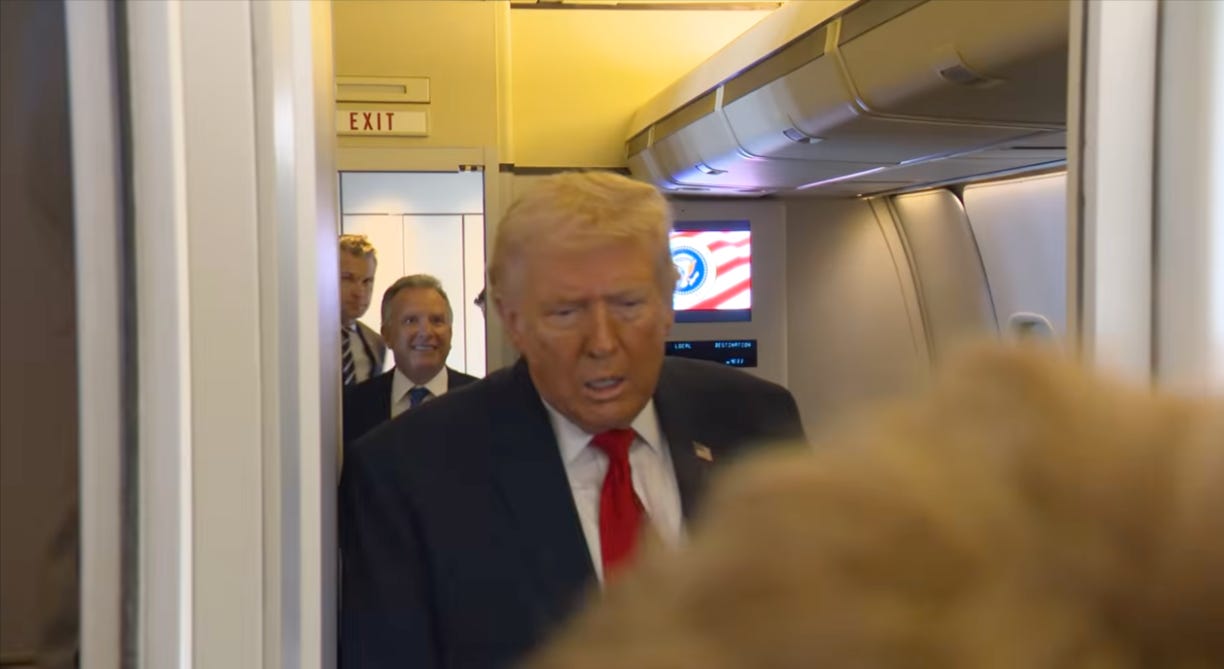


While he stood braced in that doorway, a reporter had asked him directly: “Did what you just witnessed make you think differently about going ahead with this war or even putting troops on the ground in the Middle East?” And as he leaned in to answer, his eyes went glassy and distant, his gaze drifting past the press corps. For a moment, it would be easy to imagine he was thinking back to where he had just stood. To the parents who called their children “my boy.” To the silence that falls over a tarmac when a nation receives its dead.
Instead, Trump didn’t pause. He didn’t show even an ounce of grief or pain. He said how he really feels: “We’re winning the war by a lot,” he said. “We’ve decimated their whole evil empire.” And then: “We’ve accomplished more in one week than anyone thought possible.” Then he started listing numbers. We’ve wiped out their air force, every plane. We’ve wiped out their navy, 44 ships. Wiped out most of their missiles. He read off his unverified accomplishments as if the value of war could be tallied in equipment destroyed rather than in lives lost.
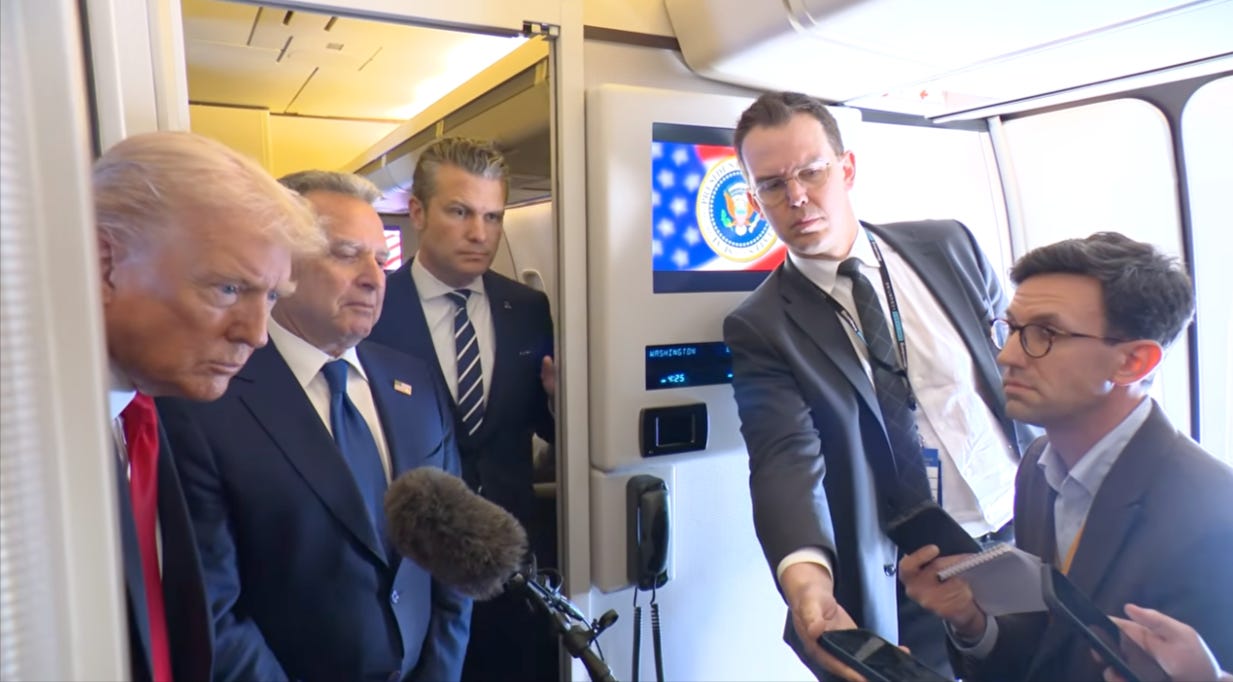
Then came the most chilling exchange. A reporter asked if he was worried about coming back to Dover for more dignified transfers. “I hate to do it, but it’s a part of war, isn’t it?” Trump said. Then he stopped. “Who are you with?” His eyebrows went up, like he thought he’d caught something. “The Washington Post,” the reporter answered. Trump’s face shifted. He looked almost disappointed, as if he’d been ready with a sharper reply and decided to let it go. “Wouldn’t you say it’s a part of war?” he continued. “Deaths are a part of war, yeah. It’s a part of war. It’s a sad part of war. It’s the bad part of war.”
He never mentioned trying to limit casualties. Never talked about protecting American lives. Never said a single word about bringing our service members home safely. Just accepted death as inevitable.
And then a reporter asked about the Shajareh Tayyebeh elementary school in Minab, in southern Iran, that was bombed on the first day of the war. Children sitting in classrooms when the building collapsed on top of them. “Did the United States bomb a girls’ elementary school in southern Iran on the first day of the war and kill 175 people?” the reporter asked.
“No, based on my opinion, and what I’ve seen, that was done by Iran,” Trump said. The reporter turned to Pete Hegseth. “Is that true, Mr. Hegseth? It was Iran who did that?” “We’re certainly investigating,” Hegseth replied. “But the only side that targets civilians is Iran.”
Hegseth knew exactly what he was doing with that reply. He could see the writing on the wall, and he took the diplomatic way out with his double talk. That careful, rehearsed non-denial was the answer of a man who knows what really happened and is choosing self-preservation over the truth. “We think it was done by Iran,” Trump repeated. “They’re very inaccurate, as you know, with their munitions. They have no accuracy whatsoever. Was done by Iran.”
But multiple independent investigations tell a very different story. The Washington Post reported yesterday that satellite images, expert analysis, and a U.S. official all suggest the explosion was likely caused by an American airstrike. The New York Times, CBC, NPR, and the Associated Press reached similar conclusions. Human Rights Watch called for the strike to be investigated as a potential war crime. An Al Jazeera investigation found that missiles hit the adjacent military base and the school but bypassed a medical clinic located between the two, a strike pattern that cannot be explained as coincidence and strongly indicates the school was hit by a direct, separate strike. Trump said it was Iran. The evidence says it was us.
And then, just as abruptly as he had started, Trump was done. A reporter was mid-question when he cut them off. “When this ends, we’re going to have a much safer world,” he said. “This is a minor excursion.” And then he turned and walked out of the press cabin, leaving reporters still reaching for follow-ups that would never be answered.
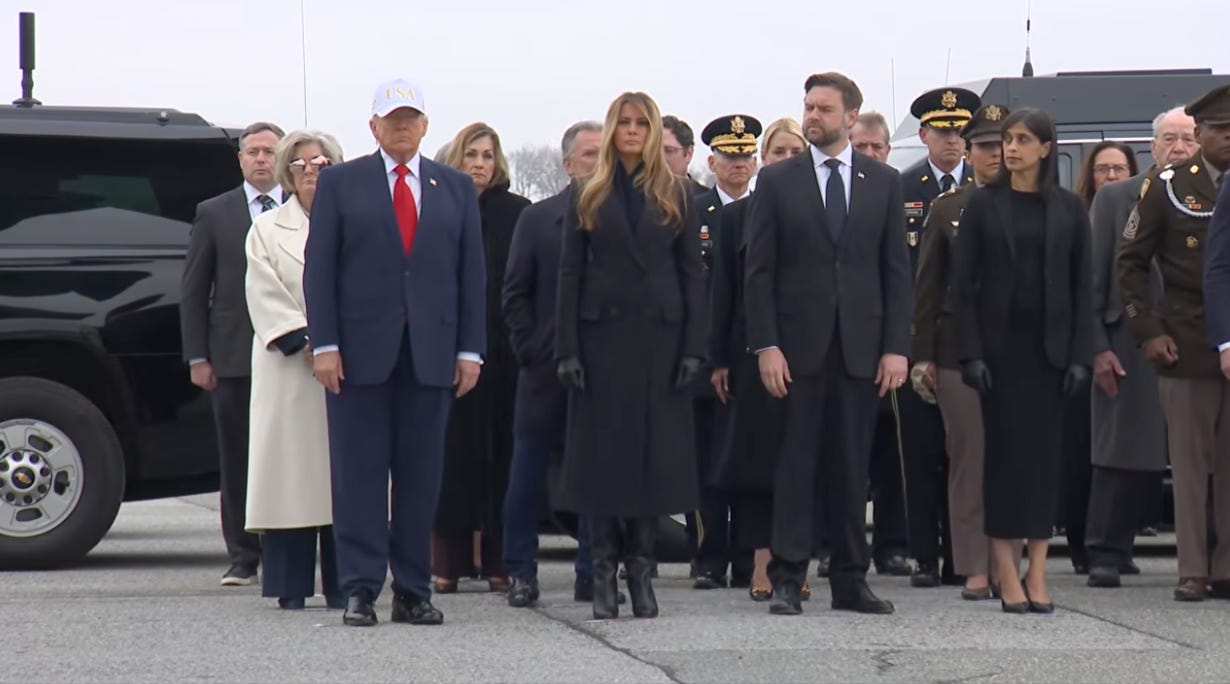
But his final remark said it all. The President of the United States is calling it “a minor excursion.” A war that has already cost at least six American service members and countless innocent civilians their lives is a “minor excursion.”
And that wasn’t even the most dangerous thing he said on that flight. When a reporter asked Trump whether Russia was supporting Iran in this war, he brushed it off without hesitation. “I have no indications,” he said. “We don’t have any indication of that whatsoever. If they are, they’re not doing a very good job, because Iran is not doing too well.”
But try as he might to wave it away, it was another blatant lie. That very same day, The Washington Post reported that Russia has been providing Iran with targeting intelligence to strike American forces in the Middle East, including the locations of U.S. warships and aircraft. Three officials familiar with the intelligence confirmed the details. One called it “a pretty comprehensive effort.” CNN, NBC News, and the Associated Press all independently verified the same thing: since the war began on February 28th, Russia has been sharing satellite imagery and tactical data with Iran. NBC noted that Iran’s recent attacks are far more precise than in previous conflicts, using battlefield tactics that mirror Russia’s air campaign in Ukraine, with drone swarms followed by ballistic missile strikes on command and control systems.
What this really means is that Russia is helping Iran kill Americans. And on the same day that reporting became public, the Trump administration announced it would lift sanctions on Russian oil, allowing them to sell more crude on the global market. Treasury Secretary Scott Bessent said on Fox Business that he’d authorized India to begin buying Russian oil again, framing it as a temporary measure to ease supply pressure caused by the war. He issued a 30-day waiver to let India resume purchases of stranded Russian oil. But the people this benefits aren’t American families. The people it benefits are in Russia. The same Russia whose president’s photograph hangs, framed and displayed, on the wall of the White House.
We can never forget that a photograph of Trump standing with Putin hangs in the people’s house because Trump put it there. The man in that photograph, the one Trump defends, protects, and aligns himself with, is helping our enemies target our people. And we are rewarding him for it, easing sanctions so he can make more money while he’s still waging war on Ukraine. And when a Fox News reporter, Peter Doocy, asked Trump about it the day before, at an event supposedly meant to “save college sports,” he snapped. “What a stupid question that is to be asking at this time,” he said. “We’re talking about something else.” He didn’t want to talk about it. Because the answer ties everything together.
But the Air Force One press gaggle wasn’t the only performance Trump gave today. Hours earlier, at 10:00 a.m. Eastern, he had walked onto the stage at his private golf club, Trump National Doral in Miami, for the ‘Shield of the Americas’ summit, where leaders from a dozen conservative-allied Latin American nations had gathered to discuss cartel violence, border security, and countering Chinese influence in the hemisphere.
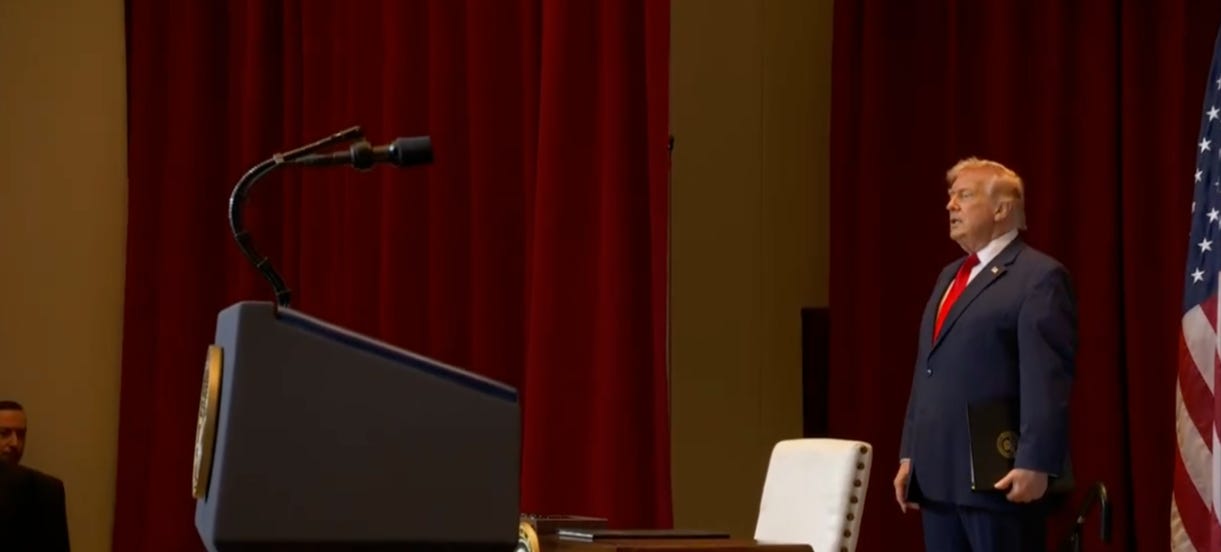
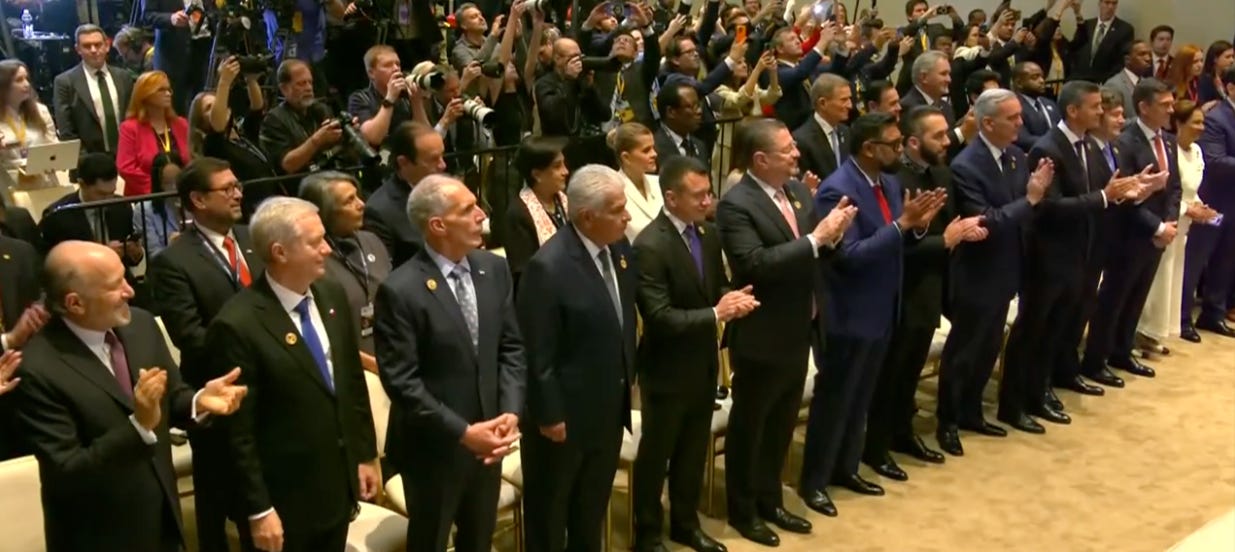
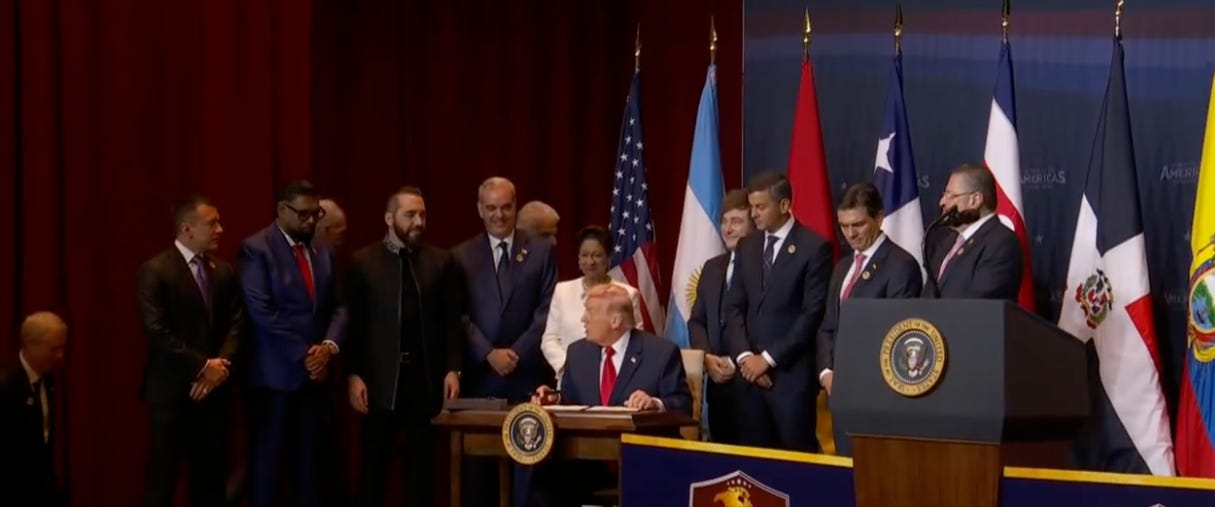
What followed was a rambling, low-energy speech in which Trump, standing in front of a dozen Latin American heads of state, casually admitted he had spent his years out of office planning his return to power. “We had a rigged election,” he said, “so it gave me four years to contemplate and stage my comeback. I staged. Big comeback.” He said it proudly. The Big Lie, repeated to world leaders as if it were a biographical fun fact.
And then he went further. He talked openly about using his political endorsement to meddle in foreign elections, and seemed genuinely frustrated that he couldn’t find a way to profit from it. “I guess it would be illegal,” he said. “Could you imagine? They spend millions and millions on a campaign. They’re losing and they beg me for an endorsement. I give it, they win by 30 points. And I get nothing. If I could sell that, is there a way? Is there a way I can get paid for that, Marco?” He turned to his Secretary of State and asked, in front of Latin American heads of state, whether there was a legal way for him to monetize his influence over their elections. That’s not diplomacy. That’s a shakedown.
He offered missiles to the leaders in the room the way you’d offer someone a drink. “We’ll use missiles if you want us to use a missile,” he said. “They’re extremely accurate, right into the living room. That’s the end of that cartel person.” He told them some of them were “actually in danger” and that the U.S. would conduct military operations in their countries if they wanted. Just let us know.
He lavished praise on Treasury Secretary Scott Bessent, saying he went on television to “soothe everybody” about rising prices, before calling Bessent “actually a killer.” And in this administration, I honestly don’t know if he means that figuratively or literally.
And then came the moment that captured the full absurdity of where we are. Trump went on a tangent about watching “Victory at Sea,” the old documentary about World War II battleships. He talked about how he wanted to bring the big ships back, and how he was told the new ones are 100 times more powerful, and how he’s building 10 of them. “Not to use them,” he said. “We don’t want to use them. They’ll say, ‘Oh, he’s very militaristic.’ I’m the one that ended 8 wars.”
But he has not ended 8 wars. That is a lie he repeats so often that he may actually believe it. But right now, hours after he said those words, Tehran is burning. Flames are shooting from fuel depots and infrastructure across Iran as U.S. and Israeli strikes continue to pound the country. Entire neighborhoods look like the end of days. He started this war one week ago without congressional authorization, and it has already destroyed lives. And he stood in that room and called himself a peacemaker.
And for those of us who look back to history as a warning for the future, the parallels just keep mounting. In 1935, Benito Mussolini’s domestic support was collapsing. The Italian economy was struggling, unemployment was climbing, and his grip on power was slipping. So he invaded Ethiopia, a country that couldn’t fight back. He declared it a civilizing mission, used the war to silence critics and rally nationalism, and bought himself time. The international community condemned it, but nobody stopped him.
Hitler followed the same playbook. His military escalations were often timed to moments of domestic pressure. When dissent grew and the economy faltered, he launched bold military actions designed to make himself look strong enough that no one would question what was falling apart at home.
Trump is running the same play. His approval is sinking. Prices are climbing. Employment numbers are down. The midterms are approaching, and his party can feel the ground shifting beneath them. So he launches a war, threatens our elections, creates global instability, and further divides us back at home. He keeps the chaos spinning fast enough that nobody can focus on any one failure long enough to hold him accountable.
Authoritarians don’t start wars because they’re strong. They start wars because they’re losing. And the war becomes the thing that justifies everything else: emergency powers, silencing dissent, delaying elections, demanding loyalty. The war isn’t the distraction. The war is the infrastructure.
I spent the better part of the day at the veterinary hospital with my dear cat and had a lot of time to sit and think about the limited time we all have on this planet, and how devastating it is that we’ve had to waste so much precious time on a man and his enablers who value neither truth nor humanity. Who increasingly value war over peace. And yet, in that moment, I also thought about how most of us do care. And that what we are fighting for isn’t limited to better days for just ourselves; it’s for the generations that follow. Because this year we have an opportunity to choose, for ourselves and for those who come next, in an election that will determine whether we continue to evolve as a society, toward greater justice, freedom, and dignity for all, or whether we regress, and watch hard-won progress slip away to empower the very people who seek to destroy it.
My mind today went to our ancestors. The ones who crossed oceans with only the clothes on their backs, some by choice, many by force. Who sacrificed their own time on earth to build a future they would never get to live in, so that we could have the rights we do. I think about how it wasn’t that long ago that women couldn’t vote or hold credit in their own name. How Black Americans were denied their personhood, their votes, their lives. How LGBTQIA+ people were criminalized. How so many were told they did not belong.
None of that changed on its own. It changed because ordinary people made extraordinary choices. They fought. They endured. They insisted on better. It was still a work in progress. So many were still being targeted, but the momentum was there. We were moving forward, imperfectly, unevenly, but forward. And I think about what we’re up against now, and how, because of them, we have a real chance, but it’s going to take us making our own extraordinary choices and taking our own extraordinary action.
And how we do that is up to each of us. We all have our place in the fight. From sharing the truth, to supporting the truth tellers, to championing the candidates who will fight for us, to voting, to choosing every day where we spend our money and who we give our attention to. None of it is too small. All of it matters.
And I also thought about how every single day, even in the midst of cruelty and chaos, there are glimmers of progress all around us. Like this week in Virginia, where the state legislature passed a first-of-its-kind bill that prohibits public schools from teaching that January 6th was a peaceful protest. The bill requires that if schools teach about that day, they must describe it as “an unprecedented, violent attack on United States democratic institutions.” They cannot present claims of widespread election fraud as credible. The bill’s sponsor, Delegate Dan Helmer, put it plainly: “The White House has tried to rewrite history. I don’t want to celebrate traitors in our public schools,” he told CBS.
Governor Abigail Spanberger is expected to sign it. It will be the first law of its kind in the country. And New York is already considering similar legislation. Hopefully, other states will follow, to counter the disinformation Trump is still selling from the White House website. Because when you protect the truth for the next generation, you protect everything. That is why I still have hope for America. And you should, too.
I’ll see you tomorrow,
Heather
PS. You can make a significant difference right now by subscribing to my Substack. Your support helps me cover more ground and keep telling the truth about the lies and destruction unfolding in this country

This commentary represents my personal opinions and analysis of matters of public concern, informed by publicly available information. Any references to individuals constitute opinion and commentary protected under the First Amendment.

Picture of the day: Hard to get any writing done when your seat is “stolen”.
Links:
President Trump and The First Lady Participate in a Dignified Transfer Ceremony, Video
President Trump Participates in Shield of the Americas Summit Video
President Trump Gaggles with Press on Air Force One En Route Miami
Hi Heather,
Natanyahu is the evil puppetmaster, and has been for a long time. Earlier presidents told him to take a hike, but In Trump he finally found a useful, gullible idiot that he can control.
Thanks Heather. I hope your cat is ok.