

At 7:15 this evening, the President of the United States gripped the handrails as he stepped off Marine One and onto the South Lawn of the White House. His body moved slowly across the lawn, his legs stiff and wide, planting each step deliberately, like a man bracing against his own weight. He kept his head down, sucking in air between pursed lips. He looked bewildered and expressionless as he paused for the waiting press pool to capture photos. And as he approached, they shouted questions about Iran. About the war. And most importantly, about the three American service members who were killed. A male reporter asked directly, “Mr. President, what’s your message to the families of the fallen?” He didn’t answer a single question, not even one as serious as that. He just kept walking. Because he didn’t have even a moment more to talk about our fallen heroes. He had shiny new statues to see.


After brushing past the press, he made his way to the Rose Garden, where two new additions stood: large statues of Benjamin Franklin and Thomas Jefferson. The press tried again. “Mr. President, will you talk to us about Iran?” “What’s your main objective?” they shouted. Instead of responding, the President pointed at the statues and invited the press pool to “come take a look,” calling them “unbelievable.” And just as he turned to walk away, one final question rang out: “Mr. President, what’s your message to the families of the service members who were killed?” He didn’t stop or even look back. He just continued wobbling off toward the West Wing.
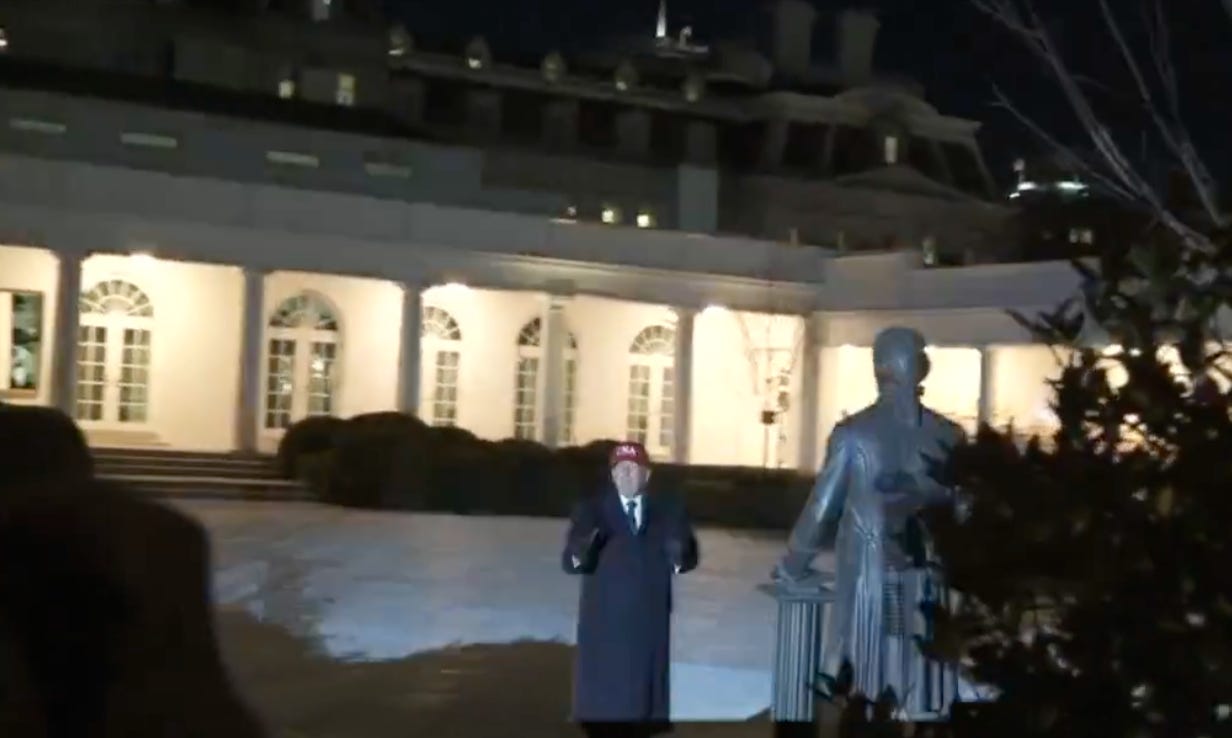


And it wasn’t that he needed to make another formal statement; we did hear from him as he was leaving Florida. He said, “The nation sends its immense love and gratitude to the families of the fallen.” But when he had the chance to face the press, to speak directly and publicly from the White House lawn, and to show those families that their grief was not just a soundbite, he walked away. He chose his statues over their suffering. It’s a continued reminder that this President would rather marvel at statues than face the consequences of the lives his war has taken. And the greater questions deserve answers, too. How long will this last? What is the actual strategy? How far is he planning to take this? The reporters shouting at him were doing their jobs. They were asking the questions the rest of us deserve to know. But he just turned his back, waved them off, and walked inside.
And that tells you everything about this President’s understanding of war. Because in just two days since he started it, this is what it has already cost.
“Operation Epic Fury” has already cost three American service members their lives. Five more were seriously wounded. Untold numbers of Iranian civilians have also been killed and wounded. In just 48 hours, the war has spread from Iran to the entire Gulf, to Israel, to Lebanon, and now to a British military base. Hezbollah has entered the fight. The Strait of Hormuz is disrupted. And a drone has struck NATO-allied territory in Cyprus.
And I want to be honest about something when we continue to talk about the cost of war, because two things continue to be true at the same time. The Iranian people have suffered under this regime for 47 years. They have been tortured, silenced, murdered in the streets for protesting, and denied the basic freedoms and dignity that every human being deserves. Iranian Americans and Iranians still living under that government have every right to feel relief, even joy, that Khamenei is gone. I hold that for them. Their pain is real, and their hope matters.
But holding that truth does not require us to ignore what’s unfolding around it. Because so far, this looks like most things Trump does: impulsive, chaotic, and executed without any real understanding of what comes after. I don’t believe that a man with zero experience in war, who has never served, who has never sent his own children to serve, who spent the weekend at his resort instead of in the situation room, took into consideration the complete destabilization of a massive part of the world that his actions would cause. Or maybe he did, and he just doesn’t care. Either answer is terrifying.
And while all of this unfolds, I keep thinking about those three American families. The knock on the door. The phone call. The moment everything stops. They were alive on Friday. They had plans, and futures, and people who loved them waiting at home. And now they’re gone because a man who has never sacrificed anything started a war and never once asked Congress for permission.
Few of us can understand that kind of pain. Certainly not a president who never served. The man who dodged the draft with bone spurs now tells us to expect more casualties. He said it before a single American had been killed: “That often happens in war.” He said it again after their deaths were confirmed: “Sadly, there will likely be more before it ends.” He is conditioning this country to shrug at the body count before the bodies are even cold.
And it’s easy to accept that when it’s not your family. When you’ve never watched someone you love come home different. When you’ve never had to explain to a child why their parent isn’t coming back. Every new country he targets means more families paying a price that he and his circle will never pay. We had military injuries in Venezuela. Iran is costing lives right now. And he’s already told us what’s next.
Because while we try to see a path out of our latest Middle East war, we need to start asking ourselves: when does Trump’s violent campaign end? When does he stop invading, attacking, and threatening countries?
The answer isn’t pretty. He doesn’t have a plan to start or stop. He’s impulsive. He likes the rush. And he saw an opportunity with both Venezuela and Iran that most leaders would never have taken, not because the regimes didn’t deserve to fall, but because he knew he could get away with it precisely because they were evil. He figured he could test it out on both of them with little resistance. And for the most part, it worked. Because most of us do want those regimes gone. We want the people living under them to have better lives. And that makes it incredibly hard to push back, even when you can see that his intentions were never about liberation. They were about testing how far he could go. He threw test balloons at two countries with brutal governments and waited to see if anyone would stop him. Nobody did.
And with that comes a truth we have to sit with: what he did in both Venezuela and Iran was unconstitutional. He never asked Congress for authorization. He never presented a plan for what comes after. He got away with it because the targets were easy to justify, and now both countries face deeply destabilized and dangerous futures because of how he did it, not what he did. Venezuela still has the same regime in place minus one man. Iran has a shattered chain of command and 90 million people who were told to “figure it out.” There is no framework for stability or reconstruction. There is no plan. There never was.
And when he gets bored with Iran, and he will, he’ll move to Cuba. He’s already told us. Another government that’s hard to defend. Another regime most of the world agrees shouldn’t be there. And once he gets away with that, he’s already setting the stage for Greenland, an allied territory, a constitutional part of Denmark. Each target gets a little harder to justify. Each one pushes the line a little further. And nobody is pulling him back.
The Iranian people deserved a president who took that responsibility seriously enough to be in the situation room when the bombs started falling. Instead, he was in Florida. He spent the entire weekend at Mar-a-Lago, managing a war in a makeshift command center with curtains thrown up and a camera pointed at his face. This is not a man taking war seriously. This is a man performing one.
And the people advising him are not the people who should be making decisions of this magnitude. These are not seasoned diplomats, experienced military strategists, or foreign policy experts who have spent decades studying the region. His Secretary of Defense (War) is Pete Hegseth, a former Fox News host. His National Security team is stacked with loyalists chosen for their obedience, not their expertise. And the results are exactly what you’d expect. And we are seeing the consequences of all of their incompetence.
Our allies, if we can even still call them that, are being dragged into a war they never asked for, were never consulted about, and never wanted. The UK is now a target because it allowed U.S. forces to use its bases. The entire Gulf Cooperation Council is scrambling. NATO is exposed. The Strait of Hormuz, through which a fifth of the world’s oil passes, is disrupted.
Trump continues to take his cues from Israel, not from Congress, and not from anyone with a plan for the day after. Netanyahu called this “Operation Roaring Lion” and explicitly called for regime change. Trump eerily echoed him. They are operating in lockstep, and Congress was never consulted. And the press, the only people in a position to demand answers on our behalf, were told to go look at statues.
And beyond missiles dropping, countries that are not in the direct path of this war are also noticing. Planning their own defenses and opening us all up to potential escalating danger. Especially Cuba. Because just hours before the first bombs fell on Iran, standing outside the White House on Friday afternoon, Trump said: “The Cuban government is talking with us. They have no money. They have no anything right now. But they’re talking to us, and maybe we’ll have a friendly takeover of Cuba.” He repeated it: “We could very well end up having a friendly takeover of Cuba.” And he confirmed that Marco Rubio is leading those discussions “at a very high level.”
He hadn’t even started one war yet, and he was already teeing up the next one. And the Rubio piece is the key to understanding why Cuba is next. Marco Rubio built his entire political career on the story of being the son of Cuban exiles who fled Castro’s communist takeover. He told audiences for years that he was the “son of exiles,” that “the exile experience is different than the immigrant experience.” But in 2011, the Washington Post revealed that his parents actually left Cuba in 1956, during the Batista regime, not after Castro’s revolution in 1959. Immigration records showed they had always planned to stay permanently. The story Rubio built his identity on was embellished. He rewrote his own family’s history for political power.
Cuba isn’t just a foreign policy target for Rubio. It’s personal. It’s the foundation of his entire political identity. And Trump almost certainly used that to get him fully on board. You want Cuba? Here. It’s yours. Just fall in line on everything else. And that’s exactly what happened. Rubio is now personally running the Cuba operation at the highest level. That was the deal.
And if he was willing to rewrite his own family’s history for political advantage, why would we trust him to tell the truth about what’s really happening in those negotiations? Venezuela wasn’t really about democracy. Iran wasn’t really about nuclear weapons. And Cuba won’t really be about freeing the Cuban people. It’s about empire. It’s about deals. It’s about personal ambition.
And maybe one of the most telling parts of everything that is happening is that none of this is Trump’s original thought. He is taking cues from his enablers. They are all using him. Everyone is using this man. The Heritage Foundation is using him for Project 2025. Stephen Miller is using him for immigration. Peter Thiel is using him for contracts and deregulation. Netanyahu used him for Iran. Rubio is using him for Cuba. And nobody has an off switch for him. The problem is that once you let a man like this loose on the world, you can’t control where it ends. Because there is no end. And not one of them has a plan for when it goes too far, because they all benefit from the chaos.
So what do we do? The same thing we’ve been doing. But louder. We call our representatives and demand they support the War Powers Resolution. Not as a gesture but as a line in the sand. The War Powers Act exists for exactly this kind of abuse, when a president bypasses Congress and sends Americans into combat without authorization.
We demand they don’t let the Epstein files get buried under this war. Because that’s the strategy. First, it was Venezuela. Now it’s Iran, and the allegations against him by the then 13-year-old. And Cuba will bury whatever comes to light next. Every new crisis isn’t just a crisis. It’s a cover story. He is counting on us being too overwhelmed to hold more than one thing in our heads at a time. We can’t let that work. We hold all of it. All at once. Because that is the only way to beat a man who governs by distraction.
And we keep sharing the truth. Even when it’s exhausting. Because people are listening and shifting. And the proof is already showing. Like how last night, Saturday Night Live opened with a quickly rewritten skit about Trump’s war on Iran. If you’ve been watching SNL over the past several months, you may have noticed they’d softened. That their edge on Trump material had dulled. Whether it was the pressure of the administration’s crackdown on media or just the exhaustion of it all, the show had pulled back from the kind of sharp, fearless commentary it’s still capable of. But something shifted last night. They came out swinging with the strongest sketch they’ve done in a long time. James Austin Johnson, playing Trump, delivered a line I haven’t been able to stop thinking about: “I watched this attack after me and my Board of Peace decided that we were bored of peace.” Bored of peace. That’s the title of tonight’s post, because it’s the truth. In the same sketch, Trump’s character admitted he needed help “distracting from the Epstein files.” When upset MAGA voters said, “This is not what I voted for,” he responded: “Well, you did it. Don’t you know who I am?” And Colin Jost, playing Pete Hegseth, said what the rest of us have been thinking: “I’m scared and I don’t know what I’m doing.”
Every word of that sketch was more honest than anything the White House has said in 48 hours. And the fact that even a show that had gone quiet found its voice again on this tells you something important. The truth is getting harder and harder to suppress. It’s breaking through the cracks, even on the stages where people had been afraid to say it.
And it wasn’t just SNL saying they’ve had enough. A new Reuters/Ipsos poll conducted this weekend found that only 27% of Americans approve of the strikes. Just 27%. For context, when we invaded Afghanistan in 2001, approval was at 92%. When we went into Iraq in 2003, it was 71%. Trump is starting at 27%, and it’s only been two days. This is the ceiling. It only goes down from here. Even 31% of his own Republicans said they were “not sure.” That’s not a rally-around-the-flag moment. That’s a fracture inside his own base. The American people did not want this war. He started it anyway. And that is the clearest proof we could ask for that his grip is slipping. If we keep up the pressure, the end of his unchecked power is near. That’s why I still have hope for America. And you should, too.
I’ll see you tomorrow,
Heather
PS. You can make a significant difference right now by subscribing to my Substack. Your support helps me cover more ground and keep telling the truth about the lies and destruction unfolding in this country

This commentary represents my personal opinions and analysis of matters of public concern, informed by publicly available information. Any references to individuals constitute opinion and commentary protected under the First Amendment.
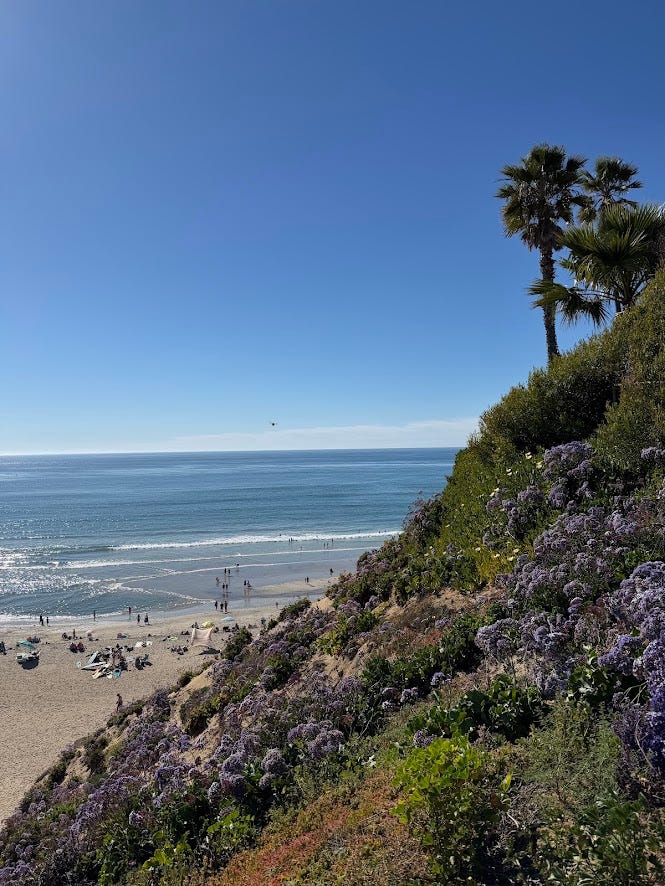
Picture of the day: A perfect day in San Diego. On our walk this afternoon, we were able to watch a pod of dolphins just off the coast.
Trump's in Iran for money. But him walking like that and ignoring questions? He's either very sick or very medicated. Or both.
Ms. Reese, what concerns me the most is the lack of outcry about the legality of this action. The War Powers Act allows the President to use the military in the instance of imminent attack. It also requires justification under terms of the Act within 48 hours with a requirement to notify Congress. Unhappiness with a vicious regime is not cause for war. If it is, the war must be authorized by Congress. Similarly, what is the legal basis for the capture of the President of Venezuela? And for the assault on alleged drug shippers? And for the killing of citizens who have protested ICE actions? And for the skipping of due process for illegal aliens? And on and on. Why have we given up on applying the rule of law to this president, and this ruling party?