

Early this morning, during what his official schedule called “executive time,” the President of the United States stopped what he was doing inside 1600 Pennsylvania Avenue to take an unscripted phone call about the war in Iran. In a moment of escalating tension like this, when a president should be the stabilizing force, the one bringing clarity, lowering tensions, and making it clear that every effort is being made to prevent further escalation and more chaos, Donald Trump once again defaulted to violence. When asked what happens if the ceasefire expires tomorrow evening, he said, “Then lots of bombs start going off.”
That is what American foreign policy sounds like right now. Not measured, strategic, or reassuring. Threats of violence delivered like a metaphorical shrug from the man who holds the most powerful military on earth in his hands.
The interview was with PBS News White House correspondent Liz Landers, and it only got worse from there. When she asked whether Iran would still be participating in the talks scheduled for Islamabad, the President of the United States said this: “I don’t know. I mean, they’re supposed to be there. We agreed to be there, although they say we didn’t. But no, it was set up. And we’ll see whether or not it’s there. If they’re not there, that’s fine too.” That is not a man in command of a diplomatic situation. That is a man who does not know what is happening in his own negotiations. He said, “I don’t know” about active peace talks that his own negotiators were preparing to fly to Pakistan to conduct. Talks that, if they fail, he just told us would be followed by bombs going off.
When Liz pressed him on Jared Kushner’s enormous financial interests in Saudi Arabia and the broader Middle East region, and whether it was appropriate for him to be negotiating on behalf of the United States, Trump couldn’t answer the question. He talked around it, over it, and through it, never once addressing the conflict of interest sitting at the center of his so-called A-team. “He has a business but he doesn’t participate now,” Trump said, as though that settled it. It did not.
And when she asked about his own Energy Secretary’s admission on CNN that gas prices may not drop below three dollars until later this year or next, Trump dismissed him completely. “I disagree with him totally. I think it’ll come roaring down if it ends.” His own cabinet is telling the truth about what’s coming. And he sat there, contradicting him on a phone call with a reporter, as if it were a disagreement about what to have for lunch.
This is the fatal vanity of the performative strongman that so many before him have succumbed to. Mussolini spent the years of World War II overruling his own generals, inserting himself into military strategy he didn’t understand, making public pronouncements that boxed Italy into positions it could not hold, all because he could not afford to appear anything less than decisive and dominant. His need to perform strength was the very thing that guaranteed failure. Every time the war required humility, flexibility, or the willingness to hear bad news, he chose the performance instead. Trump contradicting his own Energy Secretary is the same instinct. The ego is not a side effect of the problem. The ego is the problem.
But the phone call was only the beginning of his day. Because while the ceasefire ticked toward its deadline, Donald Trump was what those much hipper than me call “crashing out” on Truth Social. And the words were something.
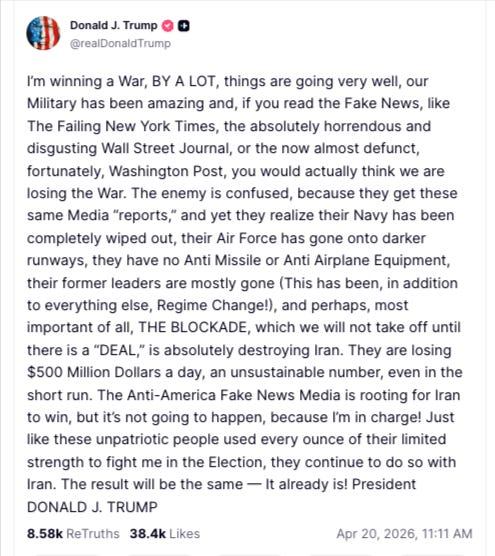
And then he listed the exact duration of every major American conflict of the last century to the month and the day, before landing on his point: “Despite World War I lasting 4 years, 3 months, and 14 days, World War II lasting 6 years and 1 day, the Korean War lasting 3 years, 1 month, and 2 days, the Vietnam War lasting 19 years, 5 months, and 29 days, and Iraq lasting 8 years, 8 months, and 28 days, they like to say that I promised 6 weeks to defeat Iran.”
Before saying, “This is being perfectly executed, on the scale of Venezuela, just a bigger, more complex operation. The result will be the same.”
There is a lot wrong with what he said, the most glaring being his carefully constructed timeline. The United States entered World War I on April 6, 1917, and the armistice was signed November 11, 1918. American involvement lasted 19 months. The 4 years, 3 months, and 14 days Trump cited is the total length of the entire war, including the years before a single American soldier set foot in Europe. He is retroactively conscripting America into a fight we weren’t part of, claiming credit for years of sacrifice that belonged to France, Britain, and Belgium, whose young men were dying in trenches by the hundreds of thousands while America was still on the sidelines. To count those years as American endurance is not just bad math, it is a rewriting of history to make his own war look more efficient by comparison. And it is exactly what you do when the truth of what you have actually accomplished isn’t enough. He inflated the comparison by more than two years. But none of that matters to Trump.
And his comparison to Venezuela, the country he bombed, declared victory over, and largely moved on from, is how he saw Iran playing out. A performance, a trophy, and a scorecard entry. Not a war with real people dying on both sides. Not a conflict that has shut down 20 percent of the world’s oil supply, or a crisis pushing families here at home past the breaking point.
There is a name for the space between what a government says about a war and what is actually happening. Journalists covering Lyndon Johnson’s Vietnam coined it: the credibility gap. Johnson’s administration kept telling the public the war was going well, that they were winning, that it would be over soon. His own officials knew otherwise. The gap between the public messaging and the private reality grew so wide that Americans eventually stopped believing anything the White House said, and it destroyed his presidency. Trump posting “I’m winning a War, BY A LOT” while his own officials privately tell reporters his posts are blowing up the negotiations is the same gap.
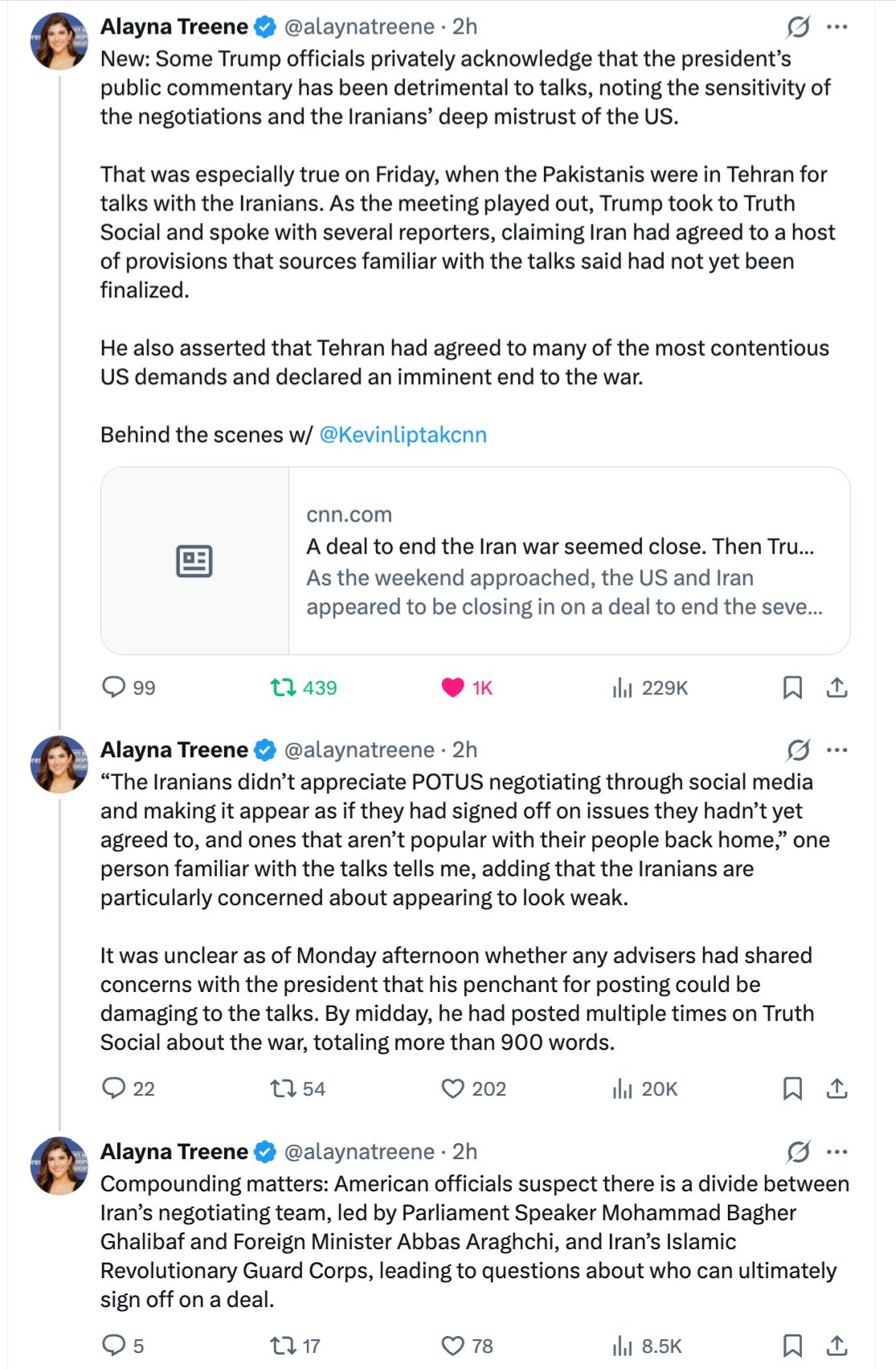
His own officials knew it. CNN reported that Trump’s people were privately acknowledging his posts were actively damaging the talks. The Iranians couldn’t afford to look weak to their own people after Trump publicly claimed concessions they had never made. One person familiar with the negotiations said the Iranians didn’t appreciate him negotiating through social media and making it appear as if they had signed off on issues they hadn’t yet agreed to. And while that story broke, he kept doing it and then added a new spin. Blaming the Democrats for his war failures when he posted this: “The Democrats are doing everything possible to hurt the very strong position we are in with respect to Iran.”
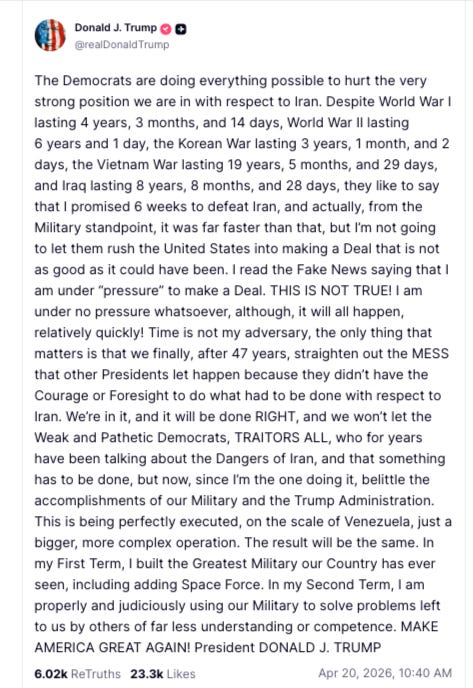
He is sabotaging his own negotiations and blaming Democrats for it in the same breath. The man whose posts his own officials are privately calling damaging to the talks is pointing the finger at the opposition party. There was no Democratic vote to start this war. There was no Democratic hand on the controls. This war belongs entirely to him, and his Republican congressional enablers. And the moment it stops going the way he imagined it would, he continues building the story of who to blame.
This is what a cornered man looks like. Trump has never in his life had someone say no to him and not been able to find a way out. He thought Iran would be Venezuela. He thought they would fold; that he could declare a win, lose interest, and move on. They did not fold. The war is now on the verge of a whole new level of terror. His approval numbers back home keep sliding. The midterms are getting closer. And he cannot get out of this. So he does what he always does when he feels the walls moving: he fills the air with noise and calls it powerful leadership.
We have to understand what the stakes actually are, because “then lots of bombs start going off” is not an abstraction, and it is not just about the human cost with loss of life and infrastructure. It’s also about the loss of what could have been. Or, in this case, what good could have come from the wasted billions funding this war. It is heartbreaking to think about what a billion dollars a day could do instead of paying for bombs and death. It could house the unhoused living on the streets of America. It could fund cancer research and cures. It could feed hungry children in this country and beyond our borders. Instead, we are spending it to end lives in a war that was started without a vote of Congress, prosecuted through social media posts, and is now being negotiated by a man with undisclosed financial interests in the region, while the president tells a reporter he doesn’t know if the other side will show up.
When I stop and look at everything that is happening, not just here in the States, but throughout the world, there is a voice I carry in my mind that maybe many of us hear. The one that says he will fizzle out, that someone will stop him, that it won’t really go to the worst-case scenario. I have been telling myself versions of that since before he was first elected. It is not naivety. It is survival. It is what you do when you live in a constant state of fight-or-flight, when your blood pressure won’t settle, and you are just trying to get through the news without losing your footing.
I remember what it felt like between the 2020 election and January 20, 2021. That stretch of weeks when we walked on the thinnest ice, holding our breath, wondering if he would leave, wondering what he might do on the way out. And then I remember the moment Biden was inaugurated. I remember breathing. Really breathing, for the first time in years. Not because Biden was a perfect president. Because I did not wake up afraid of what that day would bring anymore.
I am back in that place now. And I caught myself today using the voice again. “He’ll fizzle out like Venezuela.” And I stopped. Because here is the truth I keep sidestepping: for the people in those detention centers right now, for the civilians caught in this war, for the families of the 13 American service members already lost, there is no “it could have been worse.” This is already the worst case. And we can’t forget this. It’s not about reaching worst-case scenarios anymore. It’s about limiting how many people have to live through them.
And at the heart of all of this is that Trump does not care about this war the way we do. He cares about holding onto power, looking powerful, and having the kind of money that can buy both of those things. And the BBC published a report this morning that proves all three.
Their reporting reminded us of how this all works. When a war in the Middle East starts or stops, oil prices move dramatically because so much of the world’s oil supply runs through that region. Traders can place bets, called futures, on whether the price of oil is about to go up or down. If you know in advance which way it’s going, before anyone else does, you can make an enormous amount of money very quickly. That kind of advance knowledge is called insider information. Using it to trade is a federal crime, and it has been since 1934.
Yet something extremely concerning has been happening since Trump’s second term started: the BBC found a consistent pattern of traders placing enormous bets on oil prices just before Trump made major war announcements, announcements that moved the markets exactly the way those bets predicted. Here are two examples.
On March 9, Trump told CBS News the Iran conflict was “very complete, pretty much.” When that news hit, oil prices dropped 25%, because traders assumed the war was ending and oil would start flowing normally again. But the BBC found that a massive surge of bets on oil prices falling had been placed 47 minutes before the reporter even posted Trump’s words publicly. The interview wasn’t public yet. It hadn’t been reported. The only people who could have known what Trump said were the people in that conversation. And 47 minutes before the rest of the world found out, somebody bet millions of dollars that oil was about to drop, and those people made millions more when it did.
And then on April 7, hours before Trump announced a two-week ceasefire with Iran, traders placed bets estimated at around $950 million on falling crude oil prices. Not a few thousand dollars. Nearly a billion dollars, positioned perfectly, before the public knew a ceasefire was coming. When the announcement hit, oil dropped 15%, and whoever placed those bets made a fortune.
The CFTC, the federal agency that oversees this kind of trading, has now launched a formal probe. Democratic Congressman Ritchie Torres called it potentially “one of the largest instances of insider trading in history.” And here is the detail that makes this all that much worse: the White House sent an internal email to its own staff warning them not to use insider information to place bets on prediction markets. They knew it was happening. From inside their own walls. They sent a memo about it.
We’ve seen what happens when people trade on inside information before. In 2004, Martha Stewart went to federal prison for five months after lying to federal investigators about a stock trade she made based on insider information. She avoided losses of about $45,000. That is what it took to send someone to prison. The people who appear to be trading on Trump’s war announcements are making hundreds of millions of dollars on the same kind of information. And the agencies that should be investigating them answer to the man at the center of it all.
At some point, we have to ask what this war is actually serving. Because it’s not about security or nuclear nonproliferation. And it’s certainly not the safety of our allies or our own people. But what it really seems to be is this: someone in or around this administration has turned the Iran war into a personal ATM. Every announcement, every ceasefire, every pause in strikes is a chance to get richer. No wonder his administration doesn’t seem to be serious about a ceasefire. It’s too lucrative for his inner circle, while the rest of us are paying four dollars a gallon for the privilege of funding it.
And maybe Trump and his sycophants are right. Maybe we, too, should be focusing more on money, since that is all they truly seem to care about. I often think of that graphic of a shark eating a small fish, and then the small fish all join together to form a larger shark that then eats the shark. That can be us. Individually, we are just one person. Together, we are an insurmountable force. So I encourage us to join together not just with our words, but with our dollars too, if we are comfortably able to. Not just with my own paid memberships, but with as many of the voices we trust as we can support.
We have to create a wide-reaching system where, whenever Trump attacks the press or the media, we stand with those pushing back. When he attacks a politician or endorses their opponent, we support them with donations. When someone is hurting in our community, we show up for them and help them in their time of need. Today, as part of my ongoing economic protest, I added five more paid subscriptions to independent writers and journalists on Substack. For the people doing this work without corporate backing, without advertisers, or a safety net, it is the difference between Americans having access to what is factually happening in our country and the propaganda coming out of the White House. If you want to see who I recommend, you can find the full list on my Substack page. I am also working on a separate list of those I support on Patreon, YouTube, Facebook, and Instagram as well. If Trump wants to make his presidency all about money, we will support each other financially. And if he wants to make it all about power, we will vote out his Congressional enablers in November. We are not powerless. We are just getting started.
Because here is what I keep coming back to tonight. While Trump was on Truth Social bragging about winning a war that is costing us a billion dollars a day, and while the ceasefire ticked toward a deadline that could mean more bombs, more deaths, more families shattered on both sides of the world, dozens of veterans walked into the United States Capitol and were arrested inside the Cannon House Office Building as they protested this unjust war.
They came to Congress with red tulips and burial flags. They stood in the rotunda and chanted “End the war on Iran” and “We can’t afford another war,” and Capitol Police handcuffed them and took them away one by one. Disabled veterans, military family members, people who know what the word “bombs” actually means. Many were there because they understood the real cost of war. They were there when bombs went off. They carried people out, and they came home changed in ways that don’t always show on the outside. And yet, they are the ones who stood there today and said: not this. Not again.
They didn’t go there because they thought it would work and the war would end. They went because they know something the rest of us are still learning. Courage is contagious. Their act of resistance will inspire others still serving to find their courage. And at the end of the day, this is what it will come down to. Not the oligarchs or the tech billionaires saving us. And certainly not the man who avoided the draft five times, finding his humanity. It will come down to us. Everyday Americans, standing together, refusing to let this be the end of the story. That is why I still have hope for America. And you should, too.
I’ll see you tomorrow,
Heather
PS. You can make a significant difference right now by subscribing to my Substack. Your support helps me cover more ground and keep telling the truth about the lies and destruction unfolding in this country.
This commentary represents my personal opinions and analysis of matters of public concern, informed by publicly available information. Any references to individuals constitute opinion and commentary protected under the First Amendment.

Picture of the Day: The start of a beautiful sunset over San Diego. I'm heading to the East Coast later this week and looking forward to seeing some sunsets on the other side of the country, too.
Sources:
https://www.bbc.com/news/articles/cge0grppe3po
https://news.antiwar.com/2026/04/20/trump-defends-iran-war-in-series-of-posts-on-truth-social/
https://www.cnbc.com/2026/04/20/trump-defense-iran-war-pakistan-vance-witkoff-kushner.html
https://www.cnbc.com/2026/04/20/social-media-posts-trump-iran-deal
https://www.cnbc.com/2026/04/10/iran-war-prediction-markets-white-house.html
Over here in the UK we feel so helpless about what is staring us in the face with this terrible Trump-led chaos in the Middle East. Every morning i read your brilliant analysis of what is really going on and thank heaven there are people like you with the guts and the knowledge to explain the reality of it all. Im sharing your work this side of the pond and praying the Democrats bring this monster down in the mid-terms. All power to you Heather, keep on doing this enormous public service.
Thank you Heather for mentioning the UK investigation on insider trading that many of us had noticed at the very beginning of the war just by how our savings were being affected.
I am just so sad that at the moment there is do much corruption and lack of push back in the White House - where are the good guys ?
Are they all and I mean all lining their pockets with trumps gold, just as he has slapped all over the White House to remind himself how rich he is. There is a need for a small boy to shout but “he isn’t wearing any clothes”- as In The book of the Emperors New Clothes. It is very insightful.