

Today, we caught sight of something hanging inside the White House that no other American president, living or dead, would have dared to display. Something so horrific that any one of them would’ve been sickened to imagine another president actually choosing to glorify an enemy of democracy, inside the People’s House. Whether it was meant for public eyes or not, we saw it. And what it revealed was unmistakable: another brazen window into Donald Trump’s true loyalties, and into the heart of a regime that no longer even pretends to serve or care about the American people.
Back in November, during a tour of the newly remodeled Palm Room, Trump strutted through the hallway with Fox News host Laura Ingraham beside him, lighting up with boyish glee. With gold trim glinting under the ceiling lights and the air still thick with the scent of fresh paint and polish, he moved through the space like a showman on opening night. “I’ve built many ballrooms in many buildings,” he said, nearly bouncing on his heels. “And that’s my greatest strength, actually. I might as well do this.” He gestured around with a sweeping hand and smiled as if he were unveiling a masterpiece. And in his mind, that’s exactly what it was, his masterpiece. Not America’s.
The Palm Room is no ordinary hallway. It is a passage between power and privacy. A formal lobby that connects the West Wing to the Executive Residence. A place that once carried the dignity of its history. It was first redesigned decades ago by Jacqueline Kennedy as part of her effort to honor the White House as a cultural institution. And yet, during his walkthrough, Trump dismissed it all. He even mocked her. “This was done by Jackie Kennedy, Jackie Kennedy Onassis, then Jackie Kennedy, I hope,” he joked, smirking as if making a dig about fidelity to her murdered husband. Then he waved off her work as “cheap” and “broken,” and said, “It was an embarrassment, okay.” To him, her legacy wasn’t worth preserving. It was worth erasing.
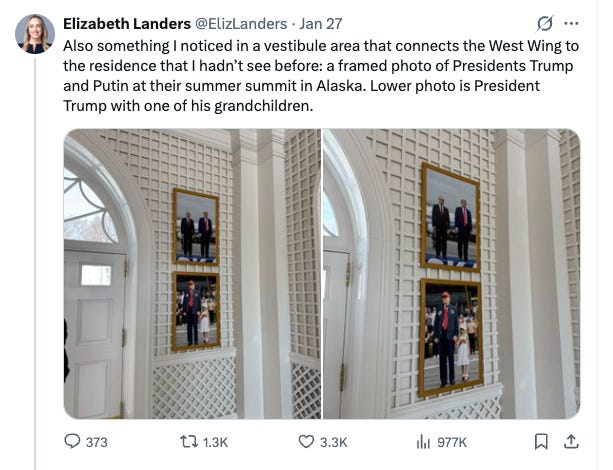
And that’s what he’s doing, not just to rooms, but to memory and meaning, too. To the presidency itself.
Not too far from where he insulted Jackie Kennedy’s vision, Trump showed off his “Presidential Walk of Fame.” He proudly presented a chronological display of every United States president and had stopped for emphasis so the audience would see that, where Joe Biden’s portrait should have been, he had instead hung a gold-framed image of an autopen. That alone would have been disturbing enough.
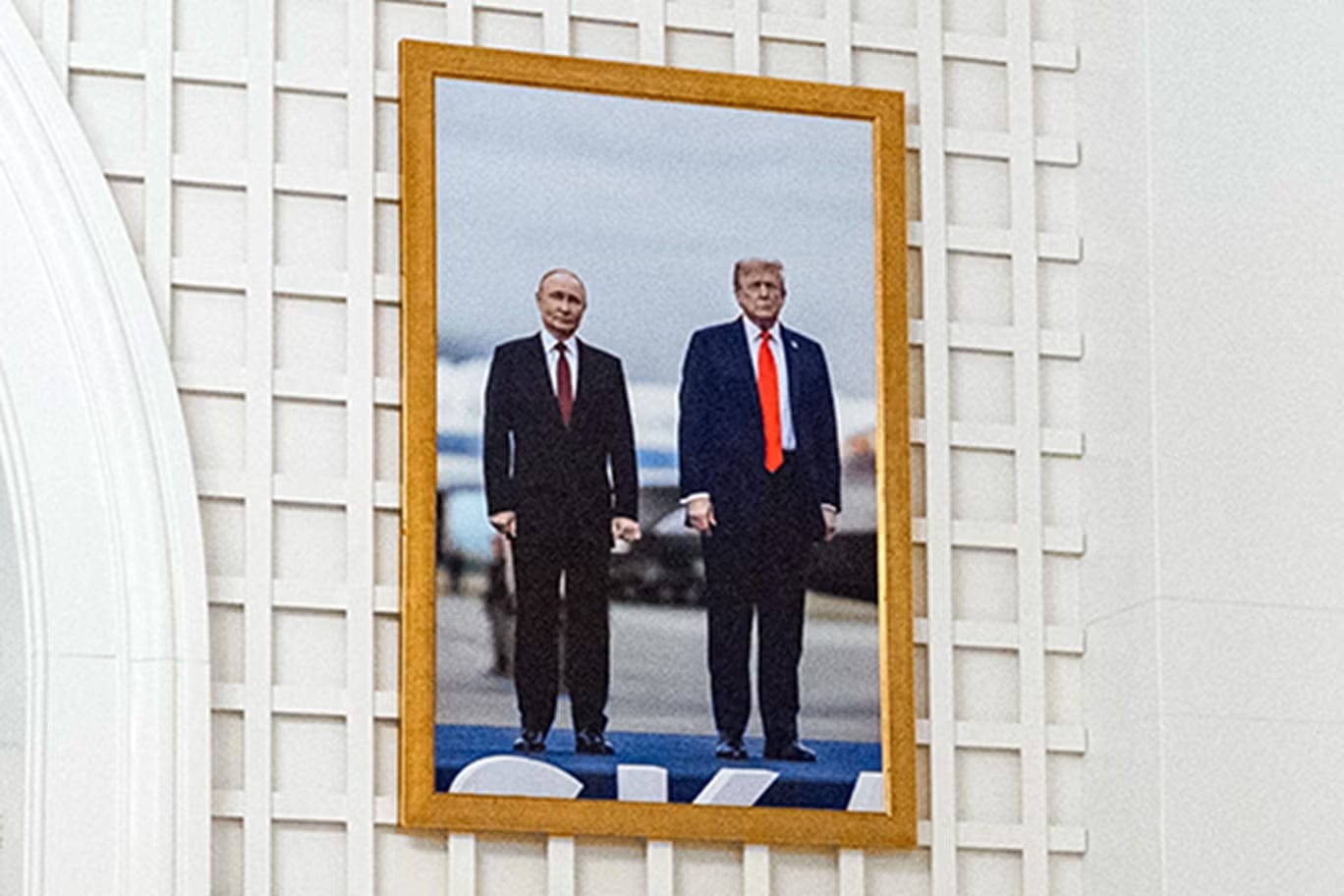
And then today, we saw the finishing touch that must have been added more recently to the Palm Room. Above a photo of one of his grandchildren, hanging where the eye is naturally drawn, was a new centerpiece: a framed photograph of Donald Trump and Vladimir Putin, taken during their August summit in Anchorage. In it, the two men stand shoulder to shoulder on a red carpet rolled out for a dictator whose army is still slaughtering civilians in Ukraine. It wasn’t placed in a secure archive or added to a formal diplomatic gallery. It was hung right there, in the open. In a hallway used daily by White House staff, by visiting dignitaries, by anyone passing between the seat of power and the president’s private quarters. That photo now watches over them as a symbol of alignment.
And what makes this new enhancement even more disgusting is that he made space for Putin. But not for Biden. What kind of leader does that? Only one who believes the White House, and the government it represents, now aligns with a war criminal more than it shares a past of democracy and duty. Only one who thinks this is his house, and not the People’s House.
Trump doesn’t want to serve the country. He wants the country to serve him. That’s the difference. That photo on the wall isn’t just a decoration, it’s a declaration. It tells the world exactly who he admires, who he sees himself reflected in, and what kind of power he believes in. The kind that jails dissent, poisons critics, sends its own armed military to terrorize citizens, and takes other people’s land by force.
This is how he’s always seen the presidency. Not as a duty, but as a tool. And his time in office? He doesn’t see it as a chapter in American history; he sees it as the correction to it. That’s why he keeps tearing things out. Removing portraits. Rewriting traditions. Insulting his predecessors. He doesn’t want to be one of the presidents. He wants to be the only one who mattered. It’s not about improvement. It’s about erasure and domination.
And the people he chooses to glorify say everything about who he is. He doesn’t stand with allies who value human rights and democratic norms. He stands with those who trample them. He bragged he “fell in love” following an exchange of “beautiful letters” with Kim Jong-un. He praised Xi Jinping’s grip on power. He once said he wished Americans would treat him the way North Koreans treat their leader, with fear. Back in 2018, he said: “He speaks and his people sit up at attention,” adding, “I want my people to do the same.”
And according to The Atlantic and reports from his own former Chief of Staff, John Kelly, Trump went even further behind closed doors. During his first term, he said he wanted “the kind of generals that Hitler had,” specifically admiring the “total loyalty” they showed to Hitler. When Kelly pushed back, asking if he meant Kaiser’s generals, Trump reportedly clarified, “No, no, Hitler’s generals.” That wasn’t a joke. It was a confession.
Now, in his second term, he’s not even pretending anymore. That same logic now governs how he sees Americans. To him, there are only two kinds of people left in this country: those who pledge loyalty to him and those who are disposable. The portrait of Putin wasn’t just a nod to a foreign ally. It was a message to the rest of us. The kind of message authoritarian leaders hang in plain sight. Not to inspire, but to warn.
Because the more we see that kind of power praised, the more we internalize its logic. Every one of us moves through life making choices between empathy and escalation. You see someone struggling, you either stop to help or look away. You hear something cruel, you either call it out or stay quiet. Those are the little choices that shape a society. And under normal circumstances, there are moral guardrails in place to help people choose empathy. But Trump removes those guardrails, over and over again. He mocks compassion. He praises cruelty. He treats grievance like virtue and paints decency as a liability. That changes people.
When you elevate a man like Vladimir Putin as a figure of strength, you’re telling Americans that strength means domination. That to win, someone else has to lose. And once that belief settles in, everything becomes easier to justify. Even violence.
We’ve seen this before. After World War I, Germany was reeling, economically devastated, humiliated by the Treaty of Versailles, and filled with fear and instability. People were angry, scared, and disoriented. Then along came a leader who gave them someone to blame. He didn’t fix the economy by building fairness. He redirected fury. He pointed to immigrants. To Jewish people. To queer people. To disabled people. He called them threats. He said they were the reason life was hard. And people listened. They wanted a reason. They wanted control. So they turned their fear into violence. And the world paid the price.
This is how it always begins. Not with death camps, but with the daily erosion of empathy. With symbols that teach people who deserves protection and who deserves punishment. With leaders who normalize cruelty until it becomes routine. Until it becomes policy and acceptable.
That’s what we’re up against now. A president who isn’t just rewriting history. He’s rewiring people’s sense of right and wrong. And unless we break the pattern, the violence will keep escalating. Because cruelty, once unleashed, does not contain itself.
The people Trump chooses to honor tell us everything. But so do the people he chooses to target. Much like fascist regimes of the past, he picks his enemies carefully, and his words are not without consequence. He has an unnatural obsession with Representative Ilhan Omar from Minnesota, making her a prime target of his rhetoric again and again.
Yesterday, during a community town hall in Minneapolis, Rep. Omar was attacked while speaking on stage. A man walked up from the crowd and sprayed a liquid directly into her. Video shows her immediately charging towards the man to defend herself. He was quickly tackled and arrested on site by security.
“I am really OK. What happened to me is not OK, but they picked the wrong person,” Omar said. “I am not one to be intimidated.”
And Donald Trump’s response? Not horror or concern. He accused her of staging it. “I don’t think about her. I think she’s a fraud,” he told ABC News. “She probably had herself sprayed, knowing her.” This is how the cycle works. He names his targets. He strips them of legitimacy. He invites potential harm by framing them as threats. Then, when they are attacked, he mocks them or calls it fake.
Rep. Omar isn’t just a political opponent. She’s a Muslim woman, a Black woman, an immigrant, and one of the most visible symbols of a multiracial democracy that Trump’s movement despises. That’s why they target her. And that’s why they’re trying to normalize this kind of violence.
And one thing I’m really starting to take to heart is the exhaustion of this non-stop violence. The exhaustion of his gaslighting, the constant lies, the parade of terrible decisions, and the worst people being lifted up and handed more power. This is the third night in a row that I haven’t been able to sleep. If you’re feeling that too, if you’re waking up with that heavy weight on your chest, you’re not alone. It’s not that there’s no hope. It’s that our bodies are catching up with what we know: this is real. And it’s not ending anytime soon.
Last night, I tried to figure out why this week feels so uneasy. I think it’s because I’m deeply concerned that by the time the midterms come in nine months, people will just be too tired and worn down to think things could get better. Convinced that this is how things are now. And what worries me even more is what Trump might try next. He’s pushing the economy so hard right now because he knows how bad it is. Could he be setting up a bait and switch. I can already hear it: “I’m going to send everyone $2,000, but Congress won’t let me do it until after the election.” It’s a con. A bribe wrapped in a threat, and he could be desperate enough to try it. He’s going to pull every trick he can. Some of it might backfire and keep people alert to what is happening, but a lot of people are going to get hurt in the process. He is going to push all limits and try to ram through as much as possible, just in case the democrats take back Congress.
And then there’s the raid. The FBI showed up before dawn at the home of Washington Post reporter Hannah Natanson and tore it apart. Not because she was accused of a crime or because she was under investigation. But because she was a journalist doing her job. Agents seized multiple electronic devices, even her watch. The Post said the government made clear she was not the target, yet they still treated her home like a crime scene. That is how authoritarian pressure begins. You do not have to arrest the journalist if you can intimidate them, expose their sources, and send a warning to everyone else watching. But there was pushback. The Washington Post went to court, and a federal judge ordered the Justice Department to halt any review of the seized devices, issuing a standstill order until further arguments can be heard. That matters. It means the courts, at least for now, recognized the danger of allowing the government to rummage through a reporter’s contacts, notes, and communications. Press freedom groups were blunt about what this represents: raids like this are rare in the United States because they chill sources, endanger whistleblowers, and threaten the First Amendment itself. The judge’s order is a small but meaningful reminder that constitutional protections still exist. But the raid itself set a dangerous precedent. Because the message was already sent. To journalists, sources, and to anyone inside the government thinking about speaking up. This administration is willing to cross lines that were once understood to be off limits. And once those lines are crossed, they are very hard to put back
This raid left me unsettled as I’m proud to be part of the new independent media. I don’t have corporate donors. I don’t have a board of directors telling me what I can or can’t say. I’m funded entirely by readers. But I think about how many people still get their news from sources backed by billionaires and hedge funds. How many voices are staying quiet now, not because they don’t care, but because they’re scared. And how many journalists, who we all rely on, are backing off the truth to avoid becoming the story? I depend on publicly reported news for my nightly write-ups, and those are only published because we have journalists who are still brave enough to follow the truth wherever it leads. What happened to Hannah Natanson is how we lose the narrative.
Last night was bad. I actually woke up my husband and asked, “Do you think it’s going to be okay?” He’s an optimist. He said, “Absolutely. We’re doing any and everything we can to be on the right side of history.” And he’s right. We are layering our opposition and resistance, and we keep building it up to meet the moment.
And just before I finally drifted off, I thought to myself: in the early days of Nazi Germany, was there some other family sitting in their house asking the same question, “Do you think it’ll be okay?” And I’m sure they believed it would be. That it wouldn’t go that far. That someone would stop him. But no one did. And now we know how that story ends. That’s our advantage. We’ve seen what happens when you stay silent. We’ve read the books, watched the documentaries, studied the photos of the people who didn’t make it out. And the people who resisted.
That gives us power, knowledge, and time. I’m still writing. You’re still reading. We’re still here. There are still people in the streets, documenting what’s happening, protesting, checking in on their neighbors. They haven’t silenced us yet.
People are talking about it. They are calling it what it is, a fascist takeover, and they are demanding it end. And that’s why I still have hope for America, and you should too.
I’ll see you tomorrow,
Heather
PS. You can help me reach a much larger audience with the truth about the destruction unfolding in our country just by subscribing to my Substack. There’s a free option, and a $5/month subscription that directly supports this work and helps get it in front of more people.
This commentary represents my personal opinions and analysis of matters of public concern, informed by publicly available information. Any references to individuals constitute opinion and commentary protected under the First Amendment.
Stay the course, Heather. Your posts matter, keep the heat on the administration. We resist by doing what you’re doing, putting your good name to the mob violence of the DOJ goons. The big chill on the press is actually the start of an attempt to cyclone bomb, deep freeze the leaks that are necessary in a free society. Putin honored in the White House in this way? Beyond horrifying!
This situation feels so overwhelming. We must take care of each other and keep up the fight no matter how tired we are. Thanks for your consistent message of hope. It will likely get worse before it gets better.