

At 7:26 this morning, East Coast time, Donald J. Trump sat awake inside one of the many gold-accented rooms inside the White House. And before most Americans on the West Coast were even awake, the President of the United States was already posting on Truth Social, calling the war that he started in Iran, which has already spread across the Middle East, a “lovely stay.” He claimed to be in serious discussions with a more reasonable regime while they are actively attacking our military, and in the same breath, he threatened to commit war crimes.
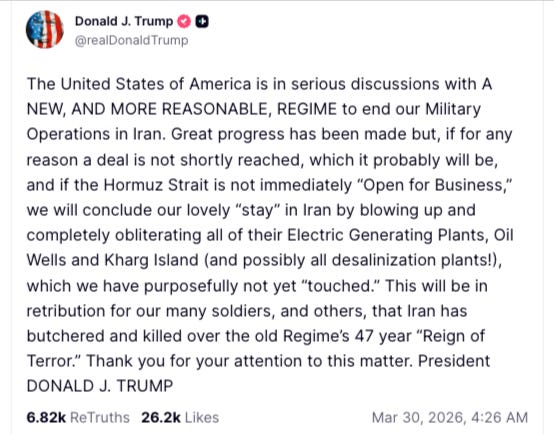
Every word of that post was intentionally chosen, and without a doubt, he had help writing it. “A NEW, AND MORE REASONABLE, REGIME.” He capitalized it. He wanted us to see it in those terms, new, reasonable, a fresh start, progress being made. What he did not put in capital letters is this: the United States and Israel assassinated Iran’s Supreme Leader on February 28th. We killed their top government officials. We helped create the vacuum that this new regime stepped into. And while Trump was posting about how reasonable they are, that same regime was actively firing on American troops in the region. Reasonable is doing a lot of work in that sentence.
“Our lovely stay.” Those three words tell us everything about how this president understands war. Lovely. Stay. As of this morning, more than 1,500 Iranian civilians are dead. Thirteen Americans have been killed in combat. Families across the Middle East are sleeping in rubble. The global oil market is in a crisis that is driving up the cost of everything we buy. And the man who started it called it a lovely stay, the way you might describe a weekend at a bed and breakfast in Vermont. That is not a slip of the tongue. That is how he sees this, and how he wants us to think of it too. Especially when his negotiations fail, or he decides to pretend they were successful, and he just abandons the mess he created.
“Blowing up and completely obliterating all of their Electric Generating Plants, Oil Wells and Kharg Island, and possibly all desalinization plants.” Here is where we have to be precise, because precision matters when we are talking about international law. What he is describing is not a military tactic. It is a war crime according to the Geneva Conventions, which the United States signed, helped write, and has historically held the rest of the world accountable to.
These laws were written out of a moral obligation to the innocent, not to protect any government or specific side. They came out of World War II, and were expanded in 1977 following the wars of decolonization, because the world had watched armies systematically destroy the basic infrastructure of civilian life to break entire populations into submission, and it collectively decided that was a line no military objective could justify crossing. The driving force was humanitarian: to protect people who have no say in the decisions that put them in danger.
But history has since taught us what happens when that line is ignored, and it is a lesson we have already paid for. When you strip a civilian population of everything it needs to survive, you do not create peace. You create the conditions for the next generation of extremism, born not from ideology but from personal loss and desperation, and that has a way of coming back to us. The 9/11 Commission and scholars of radicalization have documented that the suffering of civilian populations under American foreign policy was one of the primary factors Al-Qaeda used to recruit. We lived through the consequences on that horrific September morning in 2001, and 3,000 people paid for it with their lives. And beyond the threat of terrorism, there is a second consequence that history has shown us just as clearly: a civilian population that has been stripped of everything, its infrastructure, its stability, its sense of a livable future, becomes vulnerable to the next leader who walks in with simple answers to impossible problems.
We watched that happen in Weimar Germany after World War I, where the Treaty of Versailles stripped the country of its economic capacity and its dignity, and a generation of ordinary Germans who had lost everything became willing to follow anyone who told them he could restore what had been taken. Germany had started a catastrophic war, and accountability was warranted, but the way that accountability was imposed created the very conditions that allowed Adolf Hitler to come to power. It was not because an entire nation was evil, but because an entire nation was desperate, and he was the one who showed up with someone to blame.
Desperation does not produce wisdom. It produces whoever shows up first with a promise and a scapegoat. Which is exactly why what Donald Trump posted this morning matters as much as it does. What he described is, by the very standards the United States helped build and has enforced for eighty years, a war crime.
And then he named it himself. ‘This will be in retribution.’ Not a military objective. Retribution against a civilian population for the acts of their government is the legal definition of collective punishment, prohibited under Article 33 of the Fourth Geneva Convention. He did not imply it or bury it in diplomatic language. He wrote it plainly, signed his name, and posted it to the world as if daring someone to say otherwise.
A few hours later, inside the James Brady Press Briefing Room at the White House, during a scheduled press briefing, NBC White House correspondent Garrett Haake asked Press Secretary Karoline Leavitt directly: ‘The president posted this morning about his threat that on leaving Iran, he said blowing up and completely obliterating all of their electric generating plants, oil wells, Kharg Island, and possibly all desalination plants. Under international law, striking civilian infrastructure like that is generally prohibited. Why is the president threatening what would amount to potentially a war crime with the U.S. military, and how do you square that with the administration repeatedly saying that the U.S. does not target civilians?’
Leavitt responded: ‘The president has made it quite clear to the Iranian regime at this moment in time, as evidenced by the statement that you just read, that their best move is to make a deal. Or else the United States Armed Forces has capabilities beyond their wildest imagination, and the president is not afraid to use them.’
Haake pressed: ‘Including potential war crimes?’
Leavitt: ‘That’s not what I said, Garrett. Of course, this administration will always act within the confines of the law.’
Haake then asked which of the president’s objectives destroying a desalination plant would actually serve. Karoline Leavitt said, ‘Haley, go ahead,’ called on another reporter, and effectively refused to answer the one question that mattered most.
I’ve been thinking about his post ever since I saw it this morning. It wasn’t just his typical unhinged talk that made me stop, or even the threat of war crimes. It was the callousness and the complete lack of care for the human toll something like this could cause.
I’m a parent. And one of my worst fears, one that has always been with me, is not being able to provide for my children. Not being able to keep them safe, warm, and fed, with a roof over their heads. The basic necessities. I’m not talking about extravagant vacations or anything beyond that. It has always been about that basic promise of keeping them safe. Through Donald Trump’s first term and into this one, he has stretched what that fear even means. During 2020 and 2021, with a then medically fragile child, I lay awake terrified that his catastrophic mismanagement of those years would be what took her from me. That fear was real, and it was shared by millions of parents doing the same math I was doing every single day.
And this morning I thought about the parents in Iran doing that math right now. I thought about what it means to try to keep your child safe when the most powerful military in the world is being directed by a man who has never once had to consider where his child’s next meal would come from, who has never lived anywhere near a war zone, who has never had to calculate whether staying or leaving leads somewhere survivable. That has never been a concern for Donald Trump. Not for a single day of his life. And you can see it in every word of that post, in the complete absence of any acknowledgment that on the other side of what he is threatening are real families, children, and people who are someone’s entire world.
That is what a war crime is at its most human level, before you get to the law and the conventions and the tribunals, which I will leave for the legal experts. It is the decision to make someone else’s child pay for something they had no hand in and no power to stop. And we have a president who announced his willingness to do exactly that before most of this country was awake, and then sent his press secretary out to a podium to change the subject when someone had the courage to ask why.
And while we are sitting with that, trying to find the words for what it means that we are here, that this is the country we are living in right now, the military is already moving.
Because here is what makes that Truth Social post something more than a threat. As Trump was posting about his “lovely stay” this morning, the United States military was already in motion. Thousands of soldiers began arriving in the Middle East today, joining two Marine Units already positioned in the region and specifically trained for the kind of amphibious landing that seizing an island requires. Iran knows exactly what that means. They have been mining the shoreline of Kharg Island in anticipation. According to CNN, retired Admiral James Stavridis, the former NATO Supreme Allied Commander, has called a ground assault on the island a disaster waiting to happen, warning of massive drone attacks, small boats loaded with explosives, and missiles waiting for any force that attempts a landing. And yet yesterday, in an interview with the Financial Times, Trump said his “favorite thing” would be to take Iran’s oil, calling Americans who objected “stupid people.”
Kharg Island handles approximately 90 percent of Iran’s oil exports. It is the valve that controls Iran’s entire oil economy. Whoever controls Kharg controls Iran’s ability to fund itself, to rebuild, to function as a nation. It was always about the oil and what it could fund for Donald Trump. It was never about nuclear weapons or terrorism or the Strait of Hormuz.
And Donald Trump told us as much back in 1988, while promoting his book, The Art of the Deal, in the United Kingdom. He told The Guardian then: “I’d be harsh on Iran. They’ve been beating us psychologically, making us look a bunch of fools. One bullet shot at one of our men or ships, and I’d do a number on Kharg Island. I’d go in and take it. Iran can’t even beat Iraq, yet they push the United States around. It’d be good for the world to take them on.” He was not a politician or the president then. He was a real estate developer promoting a book. And earlier this month, when the subject came up in a meeting with the Irish Prime Minister, he acknowledged those comments himself and said, “I was right.” He has been waiting for this moment nearly his entire adult life. The difference between 1988 and today is that he now has free rein over a powerful army and the knowledge that nobody, not even Congress, will stop him.
While so much of our own government has gone silent, either looking the other way or cheering it on, the world sees exactly what is happening, and they are pushing back.
Today, Spain became the first NATO ally to close its airspace entirely to United States military planes involved in the Iran war, the latest escalation after its earlier refusal to allow American forces to use its jointly operated military bases. Spanish Defense Minister Margarita Robles called the war ‘profoundly illegal and profoundly unjust.’ Economy Minister Carlos Cuerpo called it ‘a unilateral war that violates international law.’ And Prime Minister Pedro Sanchez said something even stronger: “You cannot respond to one illegality with another, because that’s how humanity’s great disasters begin.” When Spain first denied base access earlier this month, Trump’s response was to threaten to cut all trade with them, and he said publicly, ‘We could use their base if we want, we could just fly in and use it, nobody’s going to tell us not to use it.’ That is how the US now talks about our allies.
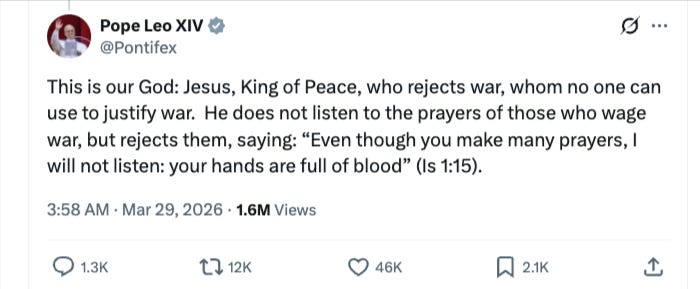
On Palm Sunday, Pope Leo XIV, the first American-born pope, stood in St. Peter’s Square before tens of thousands of people and said: “Brothers and sisters, this is our God: Jesus, King of Peace, who rejects war, whom no one can use to justify war. He does not listen to the prayers of those who wage war, but rejects them, saying: Even though you make many prayers, I will not listen: your hands are full of blood.”
And then there is Israel. On March 28th, the same evening that hundreds of thousands of Americans were in the streets for the No Kings protests, thousands of Israelis were demonstrating in Tel Aviv, Haifa, and Jerusalem under the banner ‘For the lives of all of us.’ Police arrested 18 people. The Israeli people are not their government, any more than we are ours.
This is a very dangerous moment in history, because whenever war breaks out in the Middle East, bad actors on every side try to collapse it into something about religion or ethnicity, and that is already happening now. Being Jewish is not just a religion. It is an ethnicity, a culture, a history, and a people, and none of that is what this war is about. The civilians of Iran did not start this war. The civilians of Israel did not start this war. The civilians of the United States did not start this war. What we are watching, across all three countries and beyond, is what happens when far-right and authoritarian governments capture democracies and drag innocent people into conflicts that serve their leaders’ power and no one else. And the only way through this, the only way any of us gets to the other side of this moment with our humanity intact, is if we refuse to let anyone convince us otherwise. These are not religious wars or ethnic conflicts. They are the wars of men who need enemies to stay in power, and the first casualty of that kind of war is always the truth about who the actual enemy is.
None of this is easy to sit with. And I won’t pretend that writing it, or reading it, doesn’t take something out of you. But we need to remember something. Two days ago, millions of Americans were in the streets, in city after city. The same night, thousands of Israelis were in their streets too, saying the same things we were saying. Spain looked at the most powerful military in the world and said no anyway. None of us was required to do any of that. We all did it because we understood what was at stake and decided that staying quiet was no longer something we were willing to do.
That is where we are. Not at the end of something. We are in the messy middle. The moment when ordinary people are deciding what kind of world they are going to leave behind. We have been here before as a country, where humanity itself is being tested, and the people who held the line then did not do it through extraordinary acts. They were just unwilling to look away. And neither are we. That is why I still have hope for America, and you should too.
I’ll see you tomorrow,
Heather
PS. You can make a significant difference right now by subscribing to my Substack. Your support helps me cover more ground and keep telling the truth about the lies and destruction unfolding in this country.
This commentary represents my personal opinions and analysis of matters of public concern, informed by publicly available information. Any references to individuals constitute opinion and commentary protected under the First Amendment.
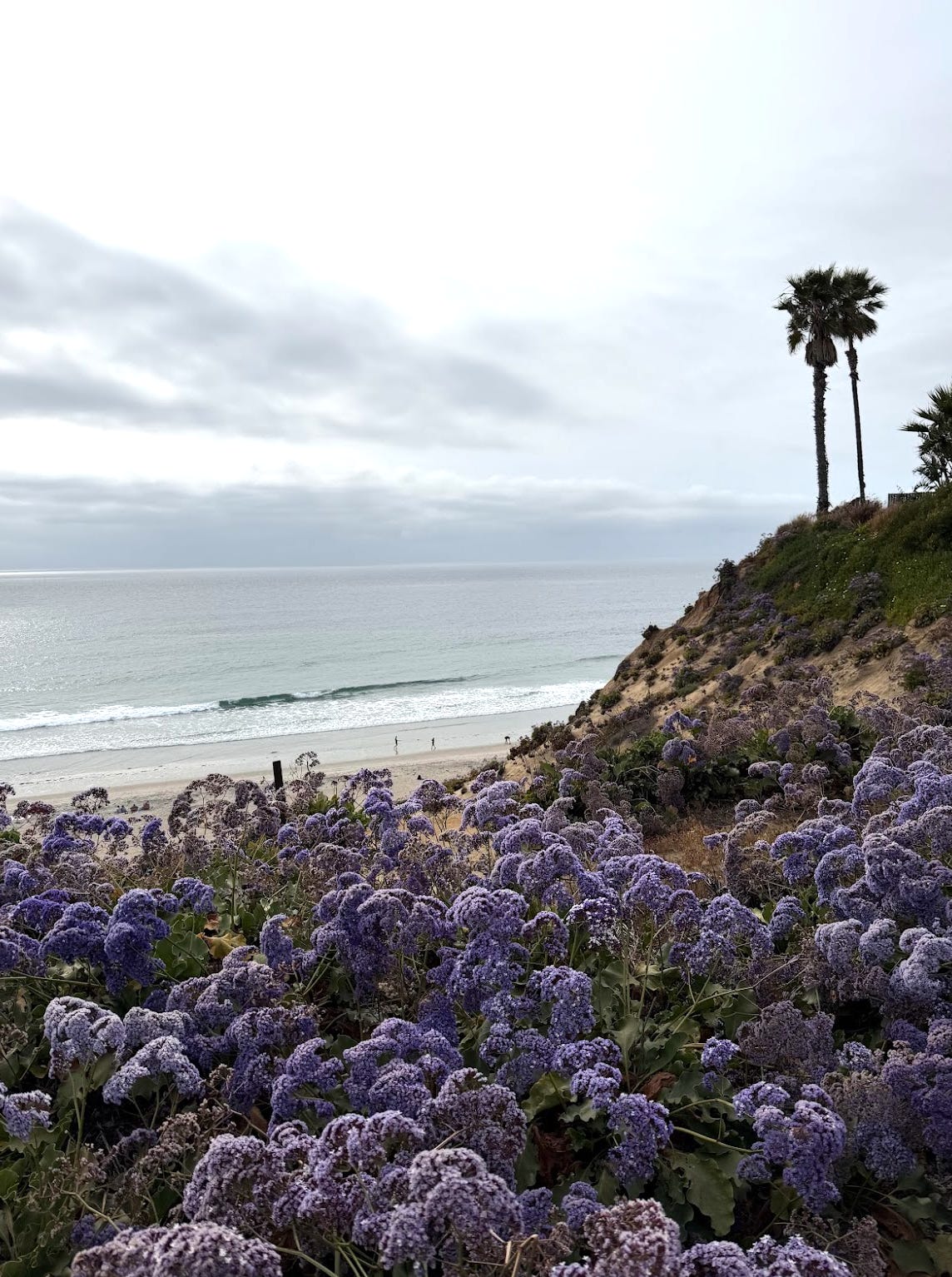
Picture of the day: The clouds have returned, and it has cooled down a bit here in San Diego. It made for perfect “go for a walk” weather.
Sources:
War and casualties:
Washington Post, Iranian civilian deaths: https://www.washingtonpost.com/national-security/2026/03/27/iran-war-civilian-deaths/
Al Jazeera, death toll tracker: https://www.aljazeera.com/news/2026/3/1/us-israel-attacks-on-iran-death-toll-and-injuries-live-tracker
Trump quotes:
Financial Times interview via NBC News: https://www.nbcnews.com/politics/donald-trump/trump-says-preference-take-oil-iran-rcna265747
1988 Guardian quote via TIME: https://time.com/article/2026/03/30/trump-comments-about-seizing-iran-kharg-island-oil-hub/
Kharg Island and military deployment:
CNN on ground assault risks: https://www.cnn.com/2026/03/26/middleeast/kharg-island-us-assault-risk-trump-intl
Spain:
AP via PBS: https://www.pbs.org/newshour/world/spain-closes-airspace-to-u-s-planes-involved-in-iran-war
Pope Leo XIV:
NPR: https://www.npr.org/2026/03/29/nx-s1-5765380/pope-leo-rejects-claims-god-justifies-war-palm-sunday
Israeli protests:
Jerusalem Post: https://www.jpost.com/israel-news/article-891473
UK here: I implore your subscribers to reread your article, then share it. Thank you for its clarity and fundamental humane reasoning. As a general observation, much less articulate than your article ; the Iranian people are not part of this equation, they are collateral damage though! - again, it’s all about ‘follow the (oil)’ and follow the corruption. I am praying that politicians around the world are negotiating a route map out of this catastrophic whirlpool of ever-darkening human , economic and political tragedy! The world order is at extreme risk and unimaginable consequencies could be on our doorsteps.
Another great post Heather. The refusal of that woman Leavitt to answer the question put to her by the NBC reporter says it all. Just like her toxic boss. I had no idea that the the mango Mussolini had this obsession about destroying Iran back in 1988.
On another matter: I hope that King Charles is advised to postpone his visit the US to celebrate the 250th anniversary. I don't think it will be popular with the British public if it goes ahead.