

At 10:00 am this morning, the official social media account of the United States Department of Education posted a video no other living or dead presidential administration would have ever even imagined publishing. While they were attempting to glorify Donald Trump and show the world just how powerful and feared he was, the clip they chose to make that point ended up saying something far darker than they seemed to realize, or more honest than they meant to be. Either way, no one at the agency responsible for educating America’s children appears to have stopped long enough to understand what they were actually posting or the ramifications for doing so.
In the post, they included a scene from a movie and a caption that read, “No one does it like us. 🐅.” They included that tiger emoji. It was a very dramatic scene, showing Gary Oldman, playing Winston Churchill in the 2017 film Darkest Hour, as he pounded on the table before his war cabinet and shouted, “You cannot reason with a tiger when your head is in its mouth!” At first glance, the message they were trying to send seemed obvious. Trump was the tiger. A strong, powerful, and unstoppable leader. A man the rest of the world should fear and respect. Except there was one horrifying problem with that message. The tiger Churchill was talking about, who they were aligning with the President of the United States, was Adolf Hitler.
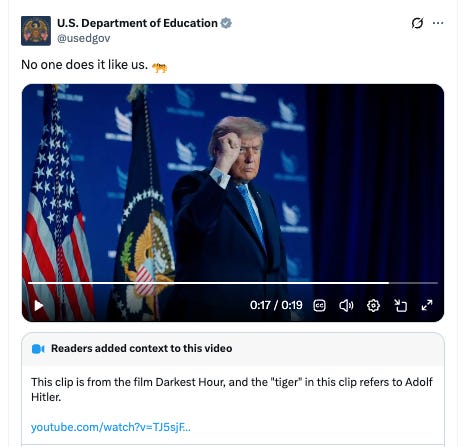
Churchill was not calling Hitler strong. He was calling him dangerous. He was warning his government that negotiating with a fascist is not possible and it certainly is not good-faith diplomacy. It is surrendering to them. The line that follows in the film is even more important than the one they shared because it captures exactly what we are living through: “When will the lesson be learned?” That is the question the United States Department of Education accidentally asked the entire country this morning. When will the lesson be learned?
The answer is not buried in a history book. It is playing out right now, today, in the story of a man not enough Americans know about. A man who learned the lesson, recognized the warning signs, sounded the alarm for the rest of us, and is now being punished for refusing to stay silent.
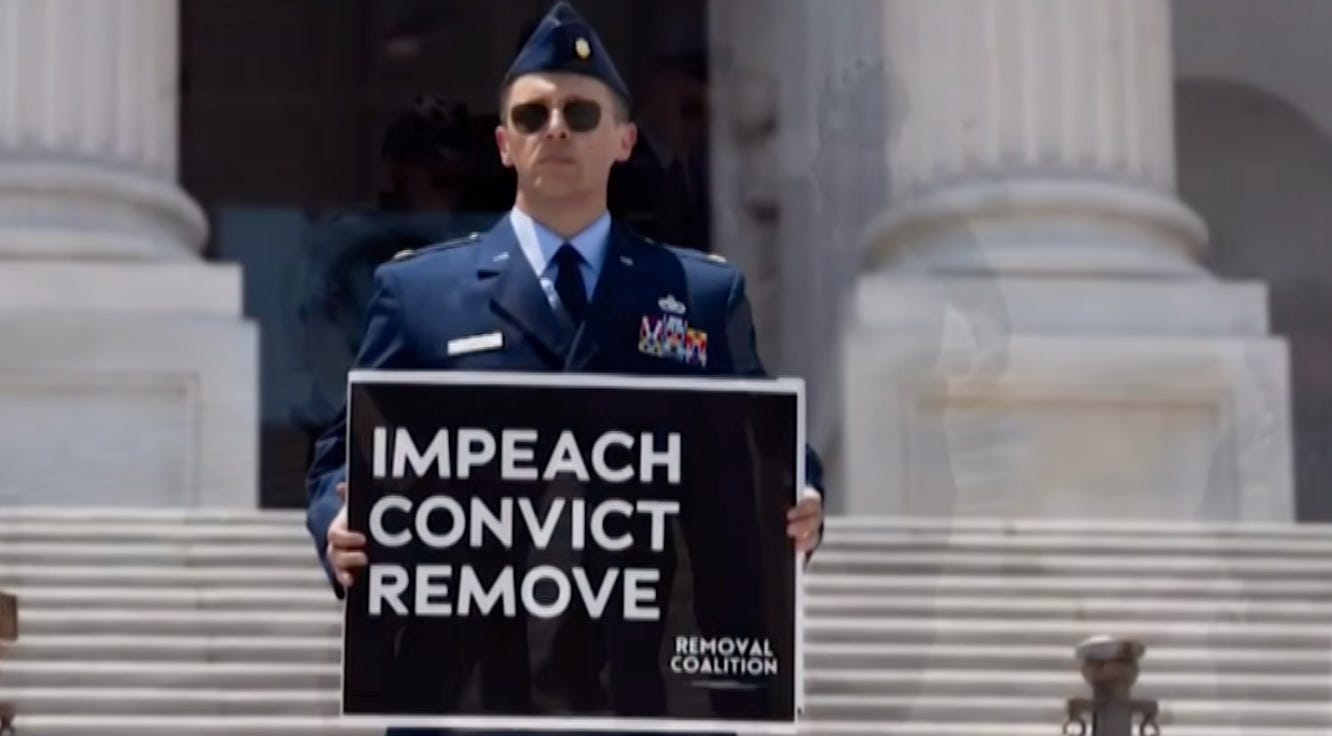
His name is Jason Watson, and he is a Major in the United States Air Force. On July 1st, he put on the uniform of the country he swore an oath to defend, walked to the steps of the United States Capitol, and did something he knew could cost him everything. He called for the impeachment, conviction, and removal of Donald Trump and Vice President J.D. Vance. He cited the war in Iran, launched without congressional authorization, and said he could no longer remain silent while the Constitution he had sworn to defend was being violated. He knew there would be consequences and what speaking publicly in uniform could mean for his career, freedom, and the life he had built in service to this country. He spoke anyway, and he still hasn’t stopped speaking, even after he was arrested that same day.
Last week, Watson spoke publicly again, this time in an interview with CNN’s Erin Burnett, and said, “What is happening with President Trump is not normal. He has failed us. And not only is he a failure as president, he is flagrantly violating the Constitution, breaking the law, engaged in rampant corruption and is killing Americans. And that is unacceptable to me and it should be unacceptable to all of us.”
The morning after that interview aired, Watson told his chain of command he would no longer wear his uniform. He was arrested again. On August 18th, the Air Force ordered him into pretrial confinement, where he was taken into military custody and locked up while the case against him moves forward, before he has been tried or convicted of the charges he now faces. It is hard not to wonder whether the decision to confine him was made, at least in part, to ensure he could not speak publicly again. On Monday, he was formally charged with ten specifications under three articles of the Uniform Code of Military Justice: three counts under Article 88 for using contemptuous words against the president, five counts under Article 92 for disobeying orders, and two counts under Article 133 for conduct unbecoming an officer. Article 88 is a provision so rarely invoked that only two convictions under it have been recorded since 1951. His attorney believes Watson is the first major in the history of the American military to be charged under it.
Watson is now sitting in confinement awaiting what comes next. His attorney, Christopher Mutimer, says the conditions amount to solitary confinement. He could face significant jail time and dismissal from the military, potentially losing the career he built serving the same country he says he was trying to defend by speaking out. Mutimer said of him, “It is my hope that other Americans who feel powerless in this moment will take some measure of courage from his willingness to speak and to stand by his convictions.”
There is a reason the military has rules against officers publicly attacking the president, and we should not pretend those rules do not matter simply because we agree with what Watson said. The chain of command exists for a reason. The military cannot function if service members decide for themselves which commander they will obey based on politics or personal belief. Civilian control of the military, discipline within the ranks, and continuity of command are fundamental to a functioning democracy. Those protections were built for moments of disagreement and instability, and they matter. But those same service members also take an oath to support and defend the Constitution, and military law requires them to obey lawful orders, not unlawful ones. That is not optional. It is a requirement. And that creates an impossible position for anyone in uniform right now, because the rules demand obedience to the chain of command and faithfulness to the Constitution, and Watson believed those two obligations were no longer pointing in the same direction.
That is also what makes Watson’s decision so profound. He knew those rules. He understood the consequences better than most of us ever could. He had spent his career inside the institution he was challenging, and he knew exactly what could happen if he crossed that line. Yet he still reached the conclusion that the greater danger was staying silent. That whatever punishment might come to him personally was less important than warning the country he had sworn to defend.
Watson was not asking for power. He was putting his own at risk. He was not protecting his career. He was jeopardizing it. He was not demanding that the country pledge loyalty to him. He was trying to warn his country about the man to whom the military chain of command ultimately leads. There is something deeply unsettling about an officer deciding that the only way left to honor the deeper meaning of his oath was to risk being punished by the institution he had spent his career serving.
Watson is now sitting in confinement after putting his career and freedom on the line to warn the country he served. Hours ago, Donald Trump posted something that made the contradiction of this moment impossible to ignore. At 12:31 this afternoon, he shared a black-and-white photograph of himself as a young man in a military academy uniform, standing beside his parents. There was no caption or explanation, just the photograph. To anyone who did not know his history, the implication was obvious: it looked like a photograph of a young Donald Trump who had served in the military. That is what made the image so misleading. The truth is that Trump was sent to New York Military Academy as a teenager, reportedly because of disciplinary problems, not because he had enlisted in the United States military or answered any call to serve his country.
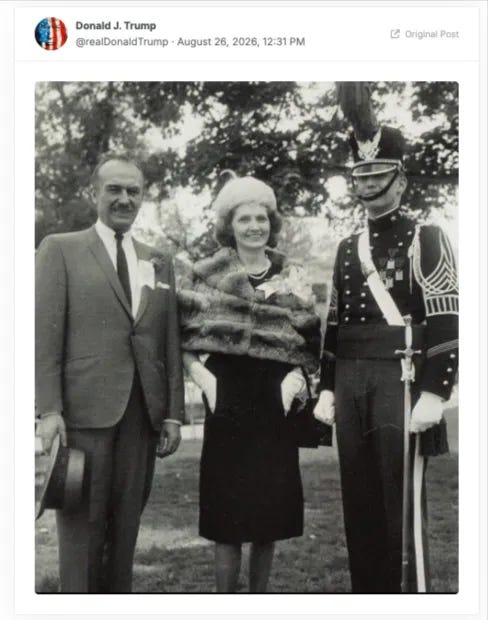
Years later, when his country actually called young men of his generation to serve during the Vietnam War, Trump received five draft deferments, including a medical deferment for bone spurs. This is a man who has reportedly referred to Americans who died in war as “suckers” and who has disparaged prisoners of war. He has never worn the uniform of the United States military in service to this country. Not once, not even for a single day.
Major Watson is not the only one refusing to stay silent. This week, VoteVets, one of the largest veterans’ advocacy organizations in the country, launched nearly one thousand digital billboards near military installations across the United States. The billboards feature Trump and Defense Secretary Pete Hegseth against a backdrop of fire, with a single message: the Iran war means higher prices with no end in sight. The campaign spans ten cities, from Fayetteville to San Antonio to Colorado Springs to Virginia Beach. These billboards are not appearing in liberal enclaves or on cable news panels. They are appearing where military families live. Where they drive to the commissary. Where they fill up their gas tanks and stretch their paychecks. Because these families are the ones paying for a war they did not ask for, not just in service and sacrifice, but also financially.
Alongside VoteVets, Win Without War has been running its own billboards near Fort Bragg and Camp Lejeune, asking service members directly whether domestic deployments and ICE-related duty are what they signed up for.
This is a whole new level of resistance coming from inside the military community itself, from people who understand what that oath means and what it requires of those who take it. They are speaking publicly, at scale, on the roads outside the very bases where service members live, work, and train. These are people close enough to the institution to understand what is at stake, and they are willing to stand outside its gates and say out loud what too many people with power in Washington still will not.
There is something about seeing that resistance come from people who have worn the uniform that makes this even harder to live through. Maybe it is because they understand the weight of that oath in a way most of us never will. They know why the chain of command matters and why discipline matters. They know what could happen if our military loses both. Yet they also know there is something above every commander, general, and even the president. The oath that they took. And they know it was written that way for a reason. It was designed to make loyalty to our Constitution stronger than loyalty to any one man. The authors had learned that lesson through some of the darkest chapters in human history and had made the conscious decision to include that safeguard.
After World War II, after the camps were liberated and the world saw where fascism ultimately leads, we said, “Never again.” We taught generation after generation what happened for a reason. Not just so they would know Hitler’s name or remember the horrors of the Holocaust, but so they would understand how a country gets there. People obey. Institutions fall in line. Those who speak are punished. Everyone else sees what happens to them and learns to stay quiet. Eventually, loyalty to one man matters more than loyalty to the law. “Never again” was supposed to mean we would recognize those signs before it all happened again.
That is why the oath matters so much. Watson understood that. The veterans behind those billboards understand it. Churchill understood the danger, too, in the very scene this administration posted as propaganda without seeming to understand the warning inside it.
Churchill was right about the tiger. You cannot reason with it while your head is already in its mouth. You cannot keep giving it what it wants, hoping that eventually it will be satisfied and leave the rest of us alone. At some point, we have to recognize the danger and refuse to keep feeding it. That is what Americans are beginning to do. Watson refused. The veterans speaking out are refusing. People across this country are refusing to stay quiet, fall in line, or accept that any one man should be more powerful than the Constitution that belongs to all of us. The Department of Education accidentally gave us the question we should all be asking right now: “When will the lesson be learned?” Maybe the answer is right now, while there is still time to do something about it. And if history has taught us that ordinary people have the power to stop extraordinary evil, then the courage and resistance rising across this country is proof that we still have the power to change where this ends. That is why I still have hope for America. And you should, too.
I’ll see you tomorrow,
Heather
PS. You can make a significant difference right now by subscribing to my Substack. Your support helps me cover more ground and keep telling the truth about the lies and destruction unfolding in this country.
This commentary represents my personal opinions and analysis of matters of public concern, informed by publicly available information. Any references to individuals constitute opinion and commentary protected under the First Amendment.

Picture of the day: I was feeling a bit down today, just thinking about how the “bad” guys seem to get away with so much while those who hold strong to the truth suffer. I had to reground my thoughts and remind myself that even when that feels true in the moment, ultimately, good does conquer in the end. When I start to feel overwhelmed by all of it, I try to find beauty in the mundane and ordinary things around us. Doing so normally distracts me long enough that I find my footing again. I’ve walked past this tree and these blooms for days, and every single time I’m in awe of how vibrant the colors are.
Sources used in the writing of this post:
https://www.cnn.com/2026/08/24/politics/us-airman-charged-trump-criticism-article-88
https://www.cbsnews.com/news/jason-watson-charged-trump-criticism-air-force-article-88/
https://edition.cnn.com/2026/08/19/politics/us-airman-arrested-at-capitol-trump-impeachment-detained
Yesterday was a sad day with the Dolly Parton news. It was heavily reported on the news. I spent the day converting my abundant cucumber crop into pickle. Messy and hard work but rewarding.
What James Watson has done is so brave, he stood tall to be counted and my hope for America is many will follow his lead and stand beside him, not just the military but all citizens who believe what is going on in USA is lethally bad and dangerous.
You have concentration camps full of “illegal Immigrants”- have any gone to trial or had a hearing ?
Stand tall and protect the James Watson’s of this world and make sure he is heard and protected in the future.
Heather, this one affected me deeply.
I have tremendous respect for Major Watson’s courage. Whatever one ultimately thinks about the military rules involved—and I appreciate that you did not dismiss their importance—he understood the potential consequences of what he was doing. He put his career, his freedom, and essentially the life he had built on the line because he believed the oath he took to defend the Constitution required him to speak.
It made me think about how much easier it is for the rest of us to speak when the consequences are so much smaller.
I found my voice relatively late in life. I have strong opinions and I write songs about them, but I do so with a degree of anonymity. I can speak loudly while still protecting much of my private life. Major Watson did not have that luxury. He put on his uniform, attached his name and his future to his convictions, and accepted whatever came next. I don’t pretend that what I do requires anything approaching that kind of courage.
But I also want to acknowledge your courage, Heather.
Every day you put your name behind what you believe and help the rest of us understand a world that can sometimes feel almost impossible to make sense of. You don’t put thoughts into my head. More often, you give voice to thoughts that were already there but that I didn’t yet have the facts, context, or understanding to fully articulate.
That distinction matters to me. I often finish one of your essays realizing that an opinion I already held was underinformed, sometimes misinformed, or simply missing important context. You give me facts to test those opinions against. Sometimes they survive. Sometimes they change. Either way, I understand more than I did before I started reading.
Your writing has inspired songs in me, and almost every essay seems to leave another unwritten one behind. But more importantly, reading you has become part of how I educate myself.
You ended this essay with the idea of people refusing to stay quiet and saying what so many of us are thinking. You have an extraordinary ability to do exactly that.
Major Watson reminds us what speaking can cost when the stakes are enormous. Your work reminds me why speaking—and understanding what we’re speaking about—still matters.
I end most days reading your essay. I frequently come away better informed, more thoughtful, and occasionally forced to reconsider something I thought I understood.
For that, and for the courage it takes to keep doing this publicly every day, thank you.