

At 11:26 AM ET in the East Room of the White House, the President of the United States stood before a room full of Navy midshipmen with a scowl on his face. His eyes were swollen, and his breathing was so loud it echoed through the microphone before he even said a word. And over the next half hour, Donald Trump once again showed us exactly how unfit he is to lead, not just our military, but the entire country. Because instead of celebrating the accomplishments of the men standing behind him, he turned the event into yet another chance to talk about himself.


He skipped right past their names, past their impressive playing season, past everything those young men had accomplished and everything they had given up to be standing in that room, and went straight to his war. “I want to begin by just saying we’re doing extremely well in Iran.” That was the first thing he said to them. And when he finally did get around to saying the word “congratulations,” it was sandwiched between a speech about destroying Iran’s navy and a joke about whether we should have kept their ships for ourselves, as if even that one word was too much to give them without pulling it back toward himself. He couldn’t let the moment that they earned, that they won, belong to them. And then he kept going for 36 minutes, turning their trophy presentation into a campaign rally for a war that is collapsing under the weight of its own lies.
Standing behind him as he delivered his war propaganda were young men in pressed dark uniforms, gold anchor insignias on their collars, talented enough to play football anywhere in the country, many of them NFL-caliber athletes, who chose instead to play for the Naval Academy, knowing their commitment to this country would come before any contract or career. In two months, 28 of them will be commissioned as officers in a military that is already at war. Their coach, Brian Newberry, understood what the moment was supposed to be. And when he finally got his turn to speak, he talked about their character, their discipline, and the responsibility that comes with wearing the Navy uniform, a responsibility he said goes beyond football. He called his players “some of the very best our country has to offer.”
He reminded the president that they would soon be officers “under your command.” He said it with pride. Because he meant it. Because those young men earned it. And because that’s what the ceremony was supposed to be for. But maybe it was also something else, a quiet reminder of what’s really at stake. That this isn’t just about cameras and speeches. These are real lives. And in a time of war, their lives are the ones that could be on the line. The choices the president makes won’t stay in briefing rooms. They will follow those men into combat. And if he can’t give them five minutes of respect in a moment like this, what will he give them when it matters even more?
But the Commander-in-Chief had already moved on long before the coach ever reached the microphone. He spent the first several minutes of their ceremony talking about destroying Iran’s navy, about how “nobody wants to be a leader over there anymore” and how “we like it that way.” He praised the FCC chairman for going after the media. He told stories about his electoral college victory. He talked about Venezuela. He brought up transgender athletes and made a joke about putting one of their 465-pound bench-pressing linemen in women’s sports. And then he called on Congressman Ronnie Jackson, the former White House physician who was the subject of a Department of Defense inspector general investigation that found he made sexual and denigrating comments about a female subordinate, and took prescription-strength Ambien while on duty to care for the president. He ran a White House Medical Unit so reckless with controlled substances that his own staff nicknamed him “Candyman.” The very same doctor Trump helped get elected to Congress.
And right there in the East Room, at the ceremony meant for college athletes who had dedicated their lives to discipline and service, Trump told the room that Jackson had once declared him “the healthiest of all three presidents” he had served, and that Jackson said, “If he didn’t eat junk food, he’d live to 200 years old.” Then Trump turned to the midshipmen standing behind him, young men in peak athletic condition who train every single day, and asked Jackson in front of everyone, “Ronnie, am I healthier than these guys back here?” And Jackson, a man who was demoted for misconduct and once described as the White House drug dealer by his own colleagues, looked at the Commander-in-Chief and said, “Yes, sir.” That was the kind of ceremony these young men were given.
And before the Trump War Show was over, and the press left the room, he talked about the executive order he signed preserving the Army-Navy game time slot, banning any other football games to be held at the same time, as if that were an act of patriotism. And this is what he had to say in that moment: “I have much more power in my second term, don’t you think?” He said that standing in front of young men who are about to swear an oath to protect the Constitution, a document designed specifically to prevent any one person from having too much power.
And what happened in the East Room was just one part of a bigger picture about this leader and his incompetence. Because his hand-picked Secretary of “War,” Pete Hegseth, was at the Pentagon today telling the press that the families of service members killed in what they have renamed an “excursion” told him to “finish the job.” His exact words: “What I heard through tears, through hugs, through strength, and through unbreakable resolve was the same from family after family. They said, ‘Finish this. Honor their sacrifice. Do not waver. Do not stop until the job is done.’”
That is what the Secretary of War told the American people. And it was not true. It was not family after family, because Charles Simmons, a 60-year-old music teacher from Columbus, Ohio, lost his son, 28-year-old Tech. Sgt. Tyler H. Simmons. He was one of six crew members killed when their refueling plane crashed in Iraq last week while supporting Operation Epic Fury. Tyler wanted to become a commercial pilot after retiring from the military. His father described him as having a “magnetic personality” who “never met any strangers” and would “walk into a room and immediately illuminate it.” The last time Charles spoke to his only son was the day before the crash. Tyler told him how much he loved him.
When NBC News asked Charles Simmons whether he told Hegseth to finish the job, he said, “No, I didn’t say anything along those lines.” Simmons said he was grateful for the warmth both Hegseth and Trump showed him during their visit. What he actually told the Secretary of War was this: “I understand there’s a lot of peril that goes into making decisions like this, and I just certainly hope the decisions being made are necessary.” A father who just lost his only son didn’t tell the Secretary of War to keep fighting. He told him he hoped the war was worth it. And Hegseth took that grief, that restraint, that quiet dignity of a father standing over his child’s coffin, and turned it into a slogan.
That is what this administration does. They fill the world with spin and propaganda. And the reason they are working this hard to control the narrative is that they know the war is failing. They can feel it slipping away from them, and everything Trump did today was an attempt to rewrite the story before the rest of the country catches up to what he already knows.
And then at 2:13 this afternoon, Trump posted a carefully worded message on Truth Social: ‘We are getting very close to meeting our objectives as we consider winding down our great Military efforts in the Middle East with respect to the Terrorist Regime of Iran.’ He listed his accomplishments in numbered bullet points, the kind of organized, deliberate language that tells you someone else wrote it for him. And buried inside the corporate spin was the real message, the one aimed not at the American people but at our allies: ‘The Hormuz Strait will have to be guarded and policed, as necessary, by other Nations who use it. The United States does not!’
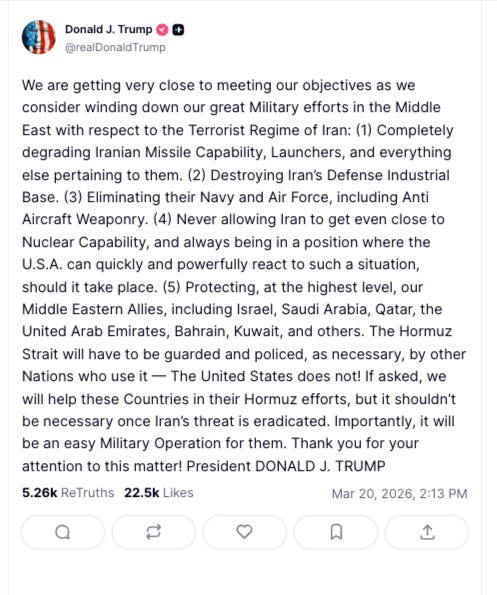
He is preparing to walk away. He bombed a sovereign nation without congressional authorization, destabilized the most critical oil shipping lane on earth, sent more than 50,000 American troops into the region, and now, less than three weeks in, he is already writing his exit narrative, telling the world that the mess he created is now someone else’s problem, while the Strait of Hormuz, through which one-fifth of the world’s oil supply passes every single day, sits unguarded in the wreckage of his decision. And just hours earlier, in a separate Truth Social rant about NATO, he called the very allies he expects to clean it up ‘COWARDS’ and wrote, ‘we will REMEMBER!’ These are the nations that stood beside us after September 11th, that sent their sons and daughters to fight in a war that wasn’t theirs because that is what allies do. More than a thousand coalition soldiers died fighting alongside us. And the man who dragged the world into another Middle Eastern war without asking anyone’s permission is now calling them cowards for not volunteering to fix it.

But the numbers tell the story he cannot rewrite. A Reuters/Ipsos poll released today found that 55% of American households say rising gas prices are hurting their finances, with 87% expecting it to get worse. Gas has surged nearly a dollar a gallon since the strikes began on February 28th. Trump’s approval on cost-of-living issues has cratered to 29%. His overall economic approval has dropped to 35%, down from where it was when he took office. The American people are not buying the exit narrative because they are living inside the consequences.
And then later this afternoon, before starting his journey to Mar-a-Lago for the weekend, he walked out to the South Lawn for a press gaggle with Secretary of State Marco Rubio standing beside him like a babysitter making sure he didn’t wander too far off script. In the span of roughly twelve minutes, the President of the United States showed us everything we need to know about how he sees this war, the people dying in it, and the allies he’s abandoned because of it.


When a reporter asked him point-blank whether he had miscalculated the economic cost of the war, he said, “No, I expected worse, actually. I really thought that oil prices would go much higher when I did this.” And without even pausing, he pivoted to bragging. “We just set every record, every record in the book with Dow, with the S&P. Dow had 50,000.” As if any of that is justification for going to war. He treated the economic pain of millions of Americans as a pleasant surprise that it wasn’t worse, and then held up Wall Street numbers as proof that everything is fine. And then he called the entire war “a little journey.” A little journey that has killed American service members and more than 1,400 Iranian civilians. And then he moved on as if he’d said nothing at all.
When asked about Kharg Island, the Iranian island that holds the country’s largest oil terminal and has been at the center of speculation about a potential ground operation, he smirked and said, “You know, I may have a plan or I may not. But how would I ever say that to a reporter?” That is the comment of a man who watches himself on television and wants the audience to think he’s in control, even as the war spirals further.
And when a reporter asked him directly whether he still expected Israel to be ready to end the war when he is, he said, “I think so. We want more or less similar things. You know what we want? We want victory.” He is still, even now, with the polls cratering and the coalition crumbling and the bodies piling up, performing the role of wartime president as if it were a costume he put on and can’t figure out how to take off. The war has no endgame. It has no congressional authorization. It has no international support. And the man who started it just called it a little journey and flew to Florida to escape the reality of all of this.
And that is what makes this moment so dangerous. Not just the war itself, but the pattern it has already established. Because this is what Trump does when something starts to fail. He doesn’t fix it or recalibrate. He moves on to the next thing, the next spectacle, the next crisis big enough to overshadow the last. And he has already told us what the next thing is. He said it out loud, multiple times this week: ‘I do believe I’ll have the honor of taking Cuba. That’d be good. That’s a big honor. Taking Cuba.’ He talked about it like a real estate acquisition, praising the weather and the tourism potential, as if the island were a foreclosure listing and not a sovereign nation with 11 million people living on it. And today, when a reporter asked Rubio how soon it could happen, Rubio didn’t push back. He didn’t say it wasn’t on the table. He just said Cuba has been a disaster for 67 years. That is not a denial. That is a runway. And we have watched this administration use exactly this kind of language before, floating an idea publicly, letting surrogates normalize it, and then acting as if the decision were inevitable. That is how Iran started. And Iran is still burning.
And if you want to know how the rest of the world sees us right now, here is your answer. During the height of Trump’s Greenland threats, Denmark flew blood bags to Greenland and prepared explosives to blow up their own runways in case of an American attack. Denmark. One of our oldest allies. A country that has stood beside us in every major conflict for decades. They looked at the President of the United States and concluded that the most rational thing they could do was prepare to destroy their own infrastructure to stop us from invading. And this week, the World Health Organization announced that it is planning for the possibility of nuclear fallout from this war. Their regional director for the eastern Mediterranean told Politico they are being ‘vigilant’ for any kind of atomic threat. The global health authority that coordinates the response to pandemics and natural disasters is now preparing for the possibility that this president or a country he provokes might use a nuclear weapon. We are one year into this man’s second term. The entire planet is not watching to see what happens next. They are bracing for it.
This is what happens when a country goes to war on the impulses of a man who never should have been anywhere near the presidency. And whatever comes next, every casualty, every consequence, will be his to answer for.
And what I worry about the most in this moment is what comes after he gets bored and we leave the region. Because we have been here before. The last time America bombed a country in the Middle East, declared victory, and walked away from the wreckage, it radicalized a generation. September 11th didn’t come out of nowhere. It came after decades of American intervention and withdrawal that left behind broken governments, ungoverned spaces, and generations of people who focused their rage directly at us. And now we are watching it happen again, with a president who doesn’t know enough about history to realize he is repeating it, and doesn’t care enough to listen to anyone who does.
This is the world and the country we are leaving to our children, and to the world’s children. We are creating a kind of vulnerability that reaches far beyond our borders. It is spreading inside our alliances, inside the world order, inside the rules and shared expectations that once held nations together. The protections we used to offer each other, the basic lines we agreed not to cross, the quiet understandings that kept the worst from happening, they are breaking. Trump has spent the last year destroying every single thing that kept us, and the rest of the world, safe.
And if China, or Russia, or any number of countries now being led by men who see themselves in Trump, decide to follow his playbook, what happens then? What happens if they strike first? What happens if they target a world leader, the way Trump has been doing? That one decision could push our already strained alliances to the breaking point, and that would make a global war not just possible, but likely. Even beyond the torment we are already seeing, even beyond the suffering that is happening right now, there is something worse still waiting. And we are walking straight toward it.
But even on another day under Trump’s destructive leadership, there were moments that reminded us that resistance is still alive. Because the Oklahoma City Thunder, the reigning NBA champions, were in Washington this weekend for a game against the Wizards. The White House reached out and invited them to visit. And the Thunder said no. They cited a “timing issue.” But when the President of the United States invites you to the White House, you find the time, if you want to be there. Every time a high-profile team or organization declines, it sends the same message to millions of Americans: you are not alone in how you’re feeling. It is a reminder that they haven’t won, that public loyalty can’t be forced, and that the American people, in every corner of culture and community, are still refusing to fall in line.
On March 28th, the next No Kings rally will take place across this country. And we need to start organizing now. Reach out to your friends and plan to march together. Start working on your signs. Because Coach Newberry stood in that room today and talked about character, about commitment, about a responsibility greater than football. He was talking about what it means to show up for something bigger than yourself, even when the man at the podium has forgotten what that looks like. And that is exactly what March 28th is. It is civilians doing what those midshipmen have already promised to do: standing in formation, showing up with discipline, and refusing to let this country become something it was never supposed to be. These rallies are not just symbolic. They are a show of numbers, and numbers matter. They make it harder to pretend we’re divided. They make it harder to lie. They remind Trump and the people enabling him that we are not okay with what’s happening to this country, and we’re not going to stop pushing back.
But just as importantly, these rallies are for us. They remind us that we’re not alone. That there is a community of people who see the same thing, who feel the same fear and the same outrage, and who still believe this country is worth fighting for. You might run into someone you never expected. You might realize your neighbor has been feeling the same way. These rallies are just as essential as any other kind of resistance because they help us find each other. And we are going to need each other in the months ahead.
And I keep thinking about Coach Newberry tonight. About what he said in that room with the players standing behind him. He talked about character. About commitment. About a responsibility greater than football. He looked at those young men and saw what the rest of us see: the best of this country. And he was right. They are the best of this country. Not the man at the podium. Not the enablers behind him. Not the loyalists with their playbook to destroy our country. The best of this country is standing quietly in the back of the room, in pressed uniforms, waiting for its turn to lead. And its turn is coming. That is why I still have hope for America. And you should, too.
I’ll see you tomorrow,
Heather
PS. You can make a significant difference right now by subscribing to my Substack. Your support helps me cover more ground and keep telling the truth about the lies and destruction unfolding in this country.

This commentary represents my personal opinions and analysis of matters of public concern, informed by publicly available information. Any references to individuals constitute opinion and commentary protected under the First Amendment.
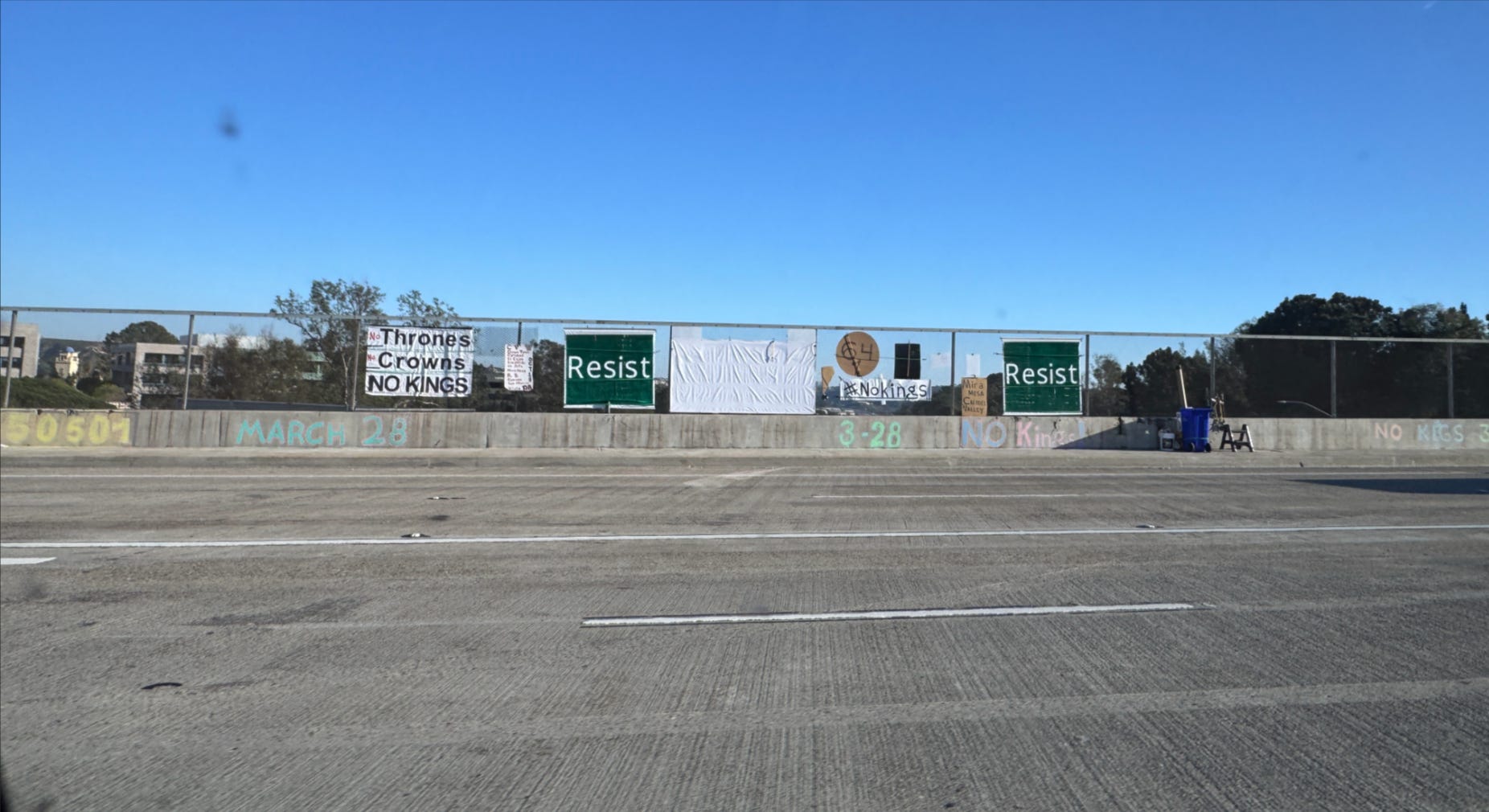
Picture of the day: Someone woke up this morning and decided to be part of the resistance.
SOURCES:
South Lawn Press Gaggle (White House YouTube)
https://media.defense.gov/2021/Mar/03/2002592287/-1/-1/1/DODIG-2021-057.PDF
https://www.axios.com/2026/03/20/trump-winding-down-iran-war-hormuz-strait
Thanks again for illuminating the widespreading damage our malignant tumor of a president is causing, and why he must be removed for any salutary effect. The worse it gets, the clearer it becomes that his removal is the only way to recovery.
Just from the title, Heather, he gives me a big headache. More like a weed whacker going off in my head 24/7,