

At 2:50 PM Friday afternoon, the President of the United States completely lost control on camera. While being asked questions for an interview released this morning, Donald Trump lost his temper multiple times. For more than 40 minutes, he told lie after lie while his anger became impossible to hide. And when Trump could no longer tolerate being fact-checked and asked for evidence supporting his many false claims, he ripped off his microphone, stood up and stepped on it while leaning into the journalist’s face and continuing to berate her. This was one of the most disastrous interviews of his entire political career. And what happened next confirmed one of my worst fears.
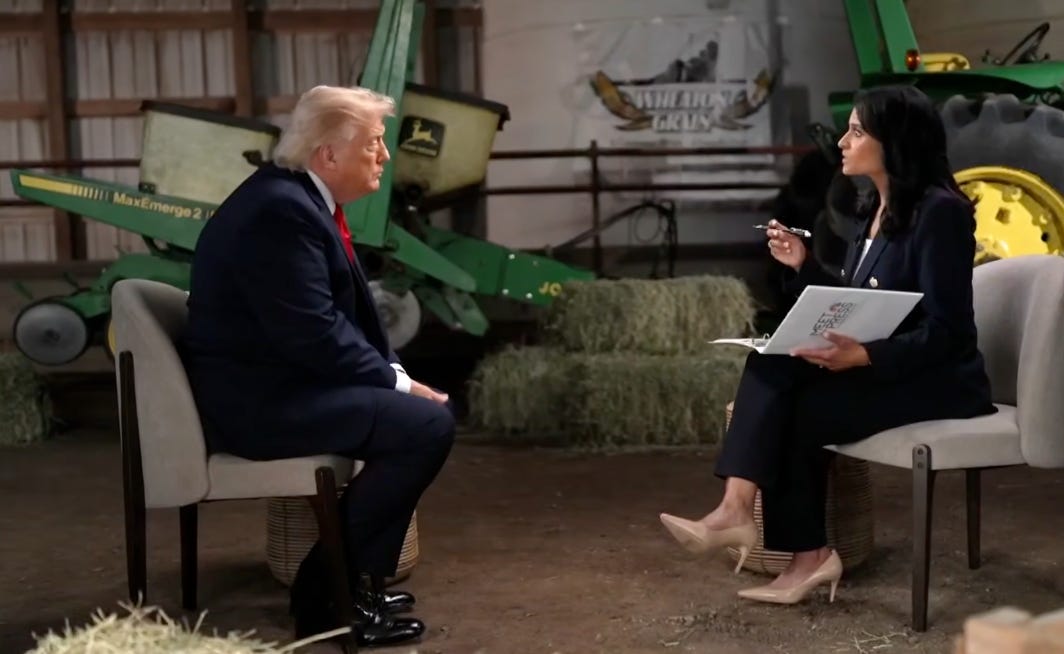
The journalist was Kristen Welker of NBC’s Meet the Press, and the interview was taped Friday ahead of Trump’s event at Custer Farms in Chippewa Falls, Wisconsin, inside a barn the White House itself had requested for the setting. He had flown to this swing state to sell the country on the economy and the war. What the country got instead was more than 40 minutes of a man incapable of sitting through a difficult question. A man who could not tolerate having his claims challenged, his statements fact-checked, or being asked to provide evidence for what he was saying.
She started with Iran. As Sunday would mark 100 days since the first strikes. His own Secretary of State had already declared the war concluded. And yet, just this week, Iran had attacked American allies in the region.
So Welker asked a simple, direct question. “Is the United States at war with Iran?” And Trump responded: “Well, they’ve been largely decapitated. And I call it a military exercise because people would rather have it called that. It’s not a big war for us.” That answer may seem strange on its own, but it was one of several moments in the interview where Trump revealed far more than he intended.
He calls it a military exercise because people would rather he call it that. So my question is simple: who are these people who get to decide what the President of the United States is allowed to call his own war? He is supposed to be the one who decides. He is supposed to be the end of the line. The last word. The person the entire structure answers to. And instead, he sat in a barn in Wisconsin and admitted, out loud and on camera, that other people tell him what to call the thing he ordered.
This is the pattern we keep seeing, over and over again, in ways both large and small. He is the face of a movement that is being run from somewhere behind him. No doubt he is still involved. No one is saying he is innocent of any of it. But Friday’s interview reinforced many of my deepest concerns, including that, for better or worse, he is not the one calling the shots.
She pressed him on the blockade, on whether that alone made it a war under international law. And he would not even commit to an answer about his own war: “I don’t consider that a war, but if you want to define it as such, I guess you can.” So she asked him how he defines it. And he said: “I don’t define it at all. I don’t think about it. I just do what I have to do.”
The President of the United States, asked whether his country is at war, says he does not think about it. He just does what he has to do, and other people can call it whatever they like. Then he reached for the line he has been selling for nearly a decade now, the one where whatever deal or plan he is being pressed to explain is always just around the corner. Iran is no different. A deal is supposedly close. Progress is supposedly being made. And yet, in the same breath, he says that if there is no deal, “we’ll do it one way or the other. Either way, we win.”
That is not the language of strength. It is the language of a man who has no idea what he is doing and is hoping nobody in the room is paying close enough attention to notice.
It is the same trick he has been running since the day he came down that escalator ten years ago. Everything is two weeks away. Everything is a concept of a plan. Gas prices come down the moment the war ends. The war ends the moment the deal is signed. The deal is always, always just about to be signed. He has been showing us who he is for ten years. All we have to do is look back. He does not deliver what he promises. He never has.
Then came one of the oddest stretches, the one where he forced himself to look like he cared. He talked about the thirteen Americans who have been killed, and he said it the way someone says what they know they are supposed to say. Thirteen is too many. He does not want to lose anyone. And in nearly the same breath, he insisted our troops are not in any danger. He is trying to walk a line he cannot walk. He wants us to believe he is a tough, detached wartime leader floating above it all, but he also knows a president is supposed to mourn the dead. So he performs both at once and somehow means neither.
When she asked who is even leading Iran now, he answered about the country’s new supreme leader like this: “Younger. I think more rational. Injured. He’s pretty badly injured. So there’s a certain bravery there.”
It was one of the strangest moments of the entire interview. The new leader is Mojtaba Khamenei. And according to Iranian state media, during the strikes Trump himself ordered on February 28, Khamenei lost his father, his mother, his wife, and his son. He was reportedly so badly wounded that our own Defense Secretary later said he was likely disfigured. Yet Trump sat there describing him as rational, brave, and someone he believes he can work with. The disconnect was staggering. This is not some distant political rival or negotiating partner sitting across a conference table. This is a man who, according to those reports, watched his family be wiped out in an attack that Trump himself authorized and survived with severe injuries. Whether Trump fully understands that reality or not, it is the reality.
And that gets to something that surfaced again and again throughout this interview. Trump talks about war as though it exists on paper. As though it is a negotiation, a headline, a television segment, or a talking point that can be reshaped whenever it becomes inconvenient. But wars create consequences. They create enemies. They create grief. They create people who spend the rest of their lives carrying the scars of decisions made by powerful men thousands of miles away. Throughout the interview, he seemed detached from that reality. He spoke about events he helped set in motion as though they were happening somewhere outside of him, disconnected from his choices and responsibility. It was another reminder that one of Trump’s defining traits has always been his inability to reckon with the consequences of his own actions. He moves on to the next promise, the next grievance, the next performance.
She kept pressing, because that is her job. She reminded him that he has been saying for months that Iran is desperate to make a deal, and she asked the obvious question: if they are so desperate, why have they not made one? And that was when you could see the interview begin to turn. His answers grew shorter. His irritation became harder to hide. His face flushed. Every so often, he glanced away from the cameras, as if he was looking for reassurance, direction, or a way out of the conversation. Then he would turn back and keep talking, trying to regain control of the exchange. It was a remarkable thing to watch because the question itself was not unfair, hostile, or complicated. It was the natural follow-up to a claim he has been making for months. But that is often the problem for Trump. He knew the truth was about to catch up to him with a camera rolling.
For her part, Kristen Welker was extraordinary. She showed us why journalism is so important, and why it is not just about the questions themselves. It is about the delivery, the patience, the steadiness, and the basic humanity required to sit across from someone like this and refuse to let go of the truth. She walked into that interview knowing she was not going to get the truth the way most of us think about it. She was going to get the truth the way Donald Trump tells it, which is to say she was going to get him, on the record, being exactly who he is. Her job was to keep him talking, to keep pressing, and to keep asking the questions that millions of Americans would ask if they had the chance. She did it brilliantly. Without journalists like her, we lose our ability to hold power accountable. It is the reason a free press is written into the First Amendment alongside the freedoms to speak, worship, and assemble. The founders understood something we are in danger of forgetting: if no one is allowed to question those in power, freedom becomes little more than a slogan. That protection appears at the very beginning of the Bill of Rights for a reason.
She asked him how long he is willing to give Iran. He would not answer that either. He just kept reaching for comparisons that do not hold, telling her, “you were in Vietnam for 19 years, and you’re telling me about three months.” He is desperate to measure this against wars that lasted decades so that his looks brief and brilliant, and he does not want anyone doing the simple work of noticing that the comparison makes no sense. He does not want to admit what this actually was. Because the whole thing was a distraction. This was the war he thought would turn him into a wartime president, the one who saved the world from a nuclear weapon. And it did not work, because the truth came out, and the truth was never what he said it was. He is the one who tore up the agreement that was actually working. This is on him. All of it.
Then she pulled the camera back to the big picture, and asked the question that began the unraveling. She reminded him that one of his most consistent promises, going all the way back to 2015, was no new wars, and she asked him directly whether he had broken that promise. He said: “No.”
And here is the thing. Earlier in the very same conversation, he had counted the dead and said the number “includes two wars. That’s Venezuela, and that’s Iran.” He named them himself. Two wars. Out of his own mouth. And now, asked if he broke his promise of no new wars, he says no. “First of all, I didn’t guarantee no war. Why would I have built the strongest military in the world?”
She told him, correctly, that he had said it over and over. And this is where he started to lose himself, because the anger was rising and he does not handle being pushed back. He does not want a journalist. He wants someone who will go in there and flatter him, tell him whatever he wants to hear, walk him gently through the questions, and lead him when he cannot get there on his own. He did not have that on Friday, and it showed. He told her: “I know you, you’re a big liberal, a big progressive.” “No,” she said. “I’m just a journalist.”
This is exactly how he wants all of us to think about the press. She asks him questions, so she must be the enemy. She must be a partisan. She cannot simply be a reporter doing her job, because in his world there is no such thing. And then he went off on the country itself, insisting we were finished before he arrived. “We were a dead country,” he said. “A year ago, couple of years ago, we were a dead country. Now we have the hottest country anywhere in the world.” He used it to justify the war, to justify everything, and then he added: “So when you say I promised, I didn’t promise anything.”
And then he became even more agitated and reached for what may have been the ugliest moment of the entire interview, a threat disguised as a warning about Iran: “There will be no Kristen. There will be no NBC. There will be no Meet the Press. You will end the Meet the Press string.”
By this point, he was visibly angry. His frustration was no longer something he was trying very hard to hide. She tried to move him to the economy, to the seventy percent of farmers who say they cannot afford fertilizer, and he cut her off and snapped: “Are you ready? Are you ready? Am I allowed to talk? You keep asking questions, and you don’t listen to the answers.” He insisted the farmers are doing great, that they all love him. It was just more spin, and performance, and not one real answer for the people he claims adore him.
Then she asked about the weaponization fund, the one his own people have said is effectively dead, and whether he was backing away from it. He would not answer directly. Instead, he did what he always does when cornered: he made himself the victim. Within moments he was defending the January 6 attackers, arguing they should be compensated, blaming crooked cops, dirty cops, maybe the FBI, and eventually circling back to his old obsession with James Comey. Welker kept reminding him there was no evidence for what he was claiming. He did not care. He insisted the rioters were “being ushered into the building,” describing an attack that millions of us watched unfold in real time, wondering whether the country would survive the day. “Try looking at the tapes one time,” he told her. We have looked at the tapes. We watched the windows shatter, the officers attacked, and lawmakers flee for safety. And as the interview went on, one thing became impossible to miss: every time Welker mentioned evidence, he grew angrier. Facts were not something he was engaging with. They were something he was trying to overpower.
And that is what finally broke him, because she kept saying it, calmly, accurately. There is no evidence. It has not been presented in a court of law. And that is when he detonated, and arrived at the one thing he cannot survive being questioned about, which is elections. “The election was rigged,” he said. “It was a dirty election. And it’s happening again right now in California.”
She told him he had never presented evidence that 2020 was rigged. She asked where the evidence was. “It’s four days,” he said. She pointed out that Republicans are actually doing well in California. “No they’re not,” he said. “They’re dropping fast because it’s a rigged election.” She told him that is simply how California counts its votes. “Do you know why they’re doing that?” he said. “Because they’re cheating on the election.” She asked him, directly, if he had any evidence to support that. And his entire answer, the whole of it, was this: “All I have to do is look. All I have to do is look.”
She said, again, that is not evidence. And then he turned the whole thing on her. “They’re crooked just like you’re crooked, your press is crooked. And Meet the Press is crooked.” She said, evenly, “To be fair, I’m not crooked. But let’s continue.” And he said, “You’re either crooked or you’re stupid.” She said, again, “Let’s continue.” He told her, “You know that these elections are rigged. Your network knows that they’re rigged. Do you know that I won an election in a landslide and I got 94% bad press.” He told her she had no credibility. He said, “We’re like a third world country.” And then, finally:
“Your elections are crooked and you’re crooked, and Meet the Press is crooked. And so is ABC and CBS and CNN. You’re a one-sided crooked network. Sorry. Let’s call it quits because I’ve had enough. Thank you, darling. Have a good time.”
She did not give up, even then. “Mr. President, let’s, please, I traveled all the way to Wisconsin,” she said. He was unmoved. “I sat in the rain with you for an hour,” he told her. “On and off in the rain, and I’ve given you enough time. You ought to straighten out your press, because you know what?” And then he left her, and left the country, with this: “A country can never be great with a dishonest press.”


I want to be very clear about that last line, because it is the hinge of the whole interview. It was not just something he said on his way out. It was the point. He could not answer the questions, so he attacked the person asking them. He could not prove what he was saying, so he blamed the press for pointing that out. Over and over again, that is where he went. The problem was never his lie. The problem was the person who would not let him get away with it.
And that is the part that confirmed one of my worst fears. Because he is not just saying this in interviews anymore. He is not just angry in front of cameras. He is using the power of the presidency to act on it. The words matter because they show us what he believes. And what he believes is that any press that challenges him is dishonest, and any person who fact-checks him is the enemy. The clearest example may be what the White House is doing. They now have an expanded section on their official website called Media Offenders with a rotating Media Offender of the Week and an Offender Hall of Shame. There is even a form inviting the public to report journalists, and an email list supporters can join to receive alerts about the next ones. The government even has categories such as “Conspiracy Theories” and “Left-Wing Lunacy.”
And what struck me was how familiar that language sounded. In the very same interview, Trump used nearly identical language himself, calling the people who investigated him “radical left lunatics.” And that is why I keep coming back to the same concern. The interview was not simply a man losing his temper because a journalist would not stop asking questions. It was a glimpse into how this administration sees criticism itself. Not as something to answer or to debate. But as something to discredit, isolate, and eventually silence. The anger we watched in that barn was not separate from what is happening elsewhere.
And they are not just coming for the mainstream media. They now have a category called Leftist Influencers, and the names on it are independent voices. David Pakman. Ed Krassenstein. Brian Tyler Cohen. These are not networks with billion-dollar parent companies. These are people, individuals, reader-supported, sitting where I sit, doing what I do every night. The government of the United States has put their names on a public website and pointed at them. There is no charge or trial. There is no law attached to any of it. The only purpose of putting a private citizen’s name on a government enemies list is to mark them, and to tell the people who take their cues from this administration exactly who is fair game.
We know where this is heading. It never stops at the first target. That is the one lesson history refuses to stop teaching us. They start with the people who are easiest to isolate, the loudest critics. And once that is tolerated, once the country shrugs and scrolls past, the list grows. It always grows. The press becomes the enemy, then the professors, then the judges who rule the wrong way, then the election officials who count the votes honestly, then anyone who says a single word out of line. You do not have to write a post like this every night to end up on the wrong side of a government that has decided dissent is a crime. You do not have to do anything at all. Eventually the circle widens until it reaches the people who were sure it never would, the ones who kept their heads down and assumed silence would keep them safe. It will not. It never has. These movements do not stop until they have total control, and they do not get there by coming for everyone at once. They get there by coming for us one group at a time, while the rest of us convince ourselves it is not our turn yet.
So what do we do? We do the thing he is most afraid of, which is refuse to be isolated. The whole point of an enemies list is to make each name on it feel alone, to make the rest of us decide it is safer to look away. So we do the opposite of what he wants. We get louder. When he attacks a journalist for doing her job, that is our call to support her, to tell her network, her producers, and her advertisers that this is the work we want. And when he hands us a list of the voices he wants silenced, he hands us, without meaning to, a list of the people worth paying attention to. When we see a name on that list, we support it if we are able. Because money and attention are the only two things this movement truly understands, and both are still in our hands. There are far more of us than there are of them, and the moment we stop letting them pick people off one at a time is the moment this strategy starts to fail.
That is also why I keep this work free and reader-funded, and why I am so grateful to those of you whose paid subscriptions make it possible. You are the reason I can be here every night writing these posts and reaching people who may not hear this perspective anywhere else. But tonight I am asking you to think beyond my voice. Think about the journalists, independent publications, local newspapers, writers, and creators who are still doing the difficult work of telling the truth. If you already support this work, thank you. Truly. But if you are able, consider supporting some of the other voices doing this work as well, especially the ones being singled out and targeted. A free press survives because ordinary people decide it matters enough to sustain. That has always been true. It is true now. And it is going to matter even more in the months ahead.
We are in the fight of our lives for our country. The next five months are going to test us. There will be days when it feels overwhelming. There will be days when the headlines make it seem like the people abusing power are winning. But if we are paying attention, there are signs almost every day that the American people are not giving up.
Just a few hours ago in Los Angeles, news outlets reported that Spencer Pratt will not be on the ballot for mayor in November. Enough people looked past the noise, recognized him for what he was offering, and said no to putting another gravely unqualified politician in government. It was one election in one city, but it was also a reminder that we are not powerless. We still have choices. We still have a voice. And when enough of us use it, we can still change the outcome. That is why I still have hope for America. And you should, too.
I’ll see you tomorrow,
Heather
PS. You can make a significant difference right now by subscribing to my Substack. Your support helps me cover more ground and keep telling the truth about the lies and destruction unfolding in this country.
This commentary represents my personal opinions and analysis of matters of public concern, informed by publicly available information. Any references to individuals constitute opinion and commentary protected under the First Amendment.

Picture of the day: So thankful for this little piece of joy in my life. She brings so much happiness to our home.
Sources:
Meet the Press Full Episode: YouTube video
https://www.nbcnews.com/meet-the-press/transcripts/meet-press-june-7-2026-rcna348859
https://www.whitehouse.gov/media-bias-reporter/david-pakman/
https://www.jpost.com/middle-east/iran-news/article-890173
https://thehill.com/homenews/campaign/5905647-bass-raman-faceoff-november/
Excellent analysis. Thank you for reminding us that we need to stay vigilant and to push back. Kudos to Kristen Welker and to you. (And thanks for the cute puppy photo!)
So grateful for you HDR. You are the voice I’ve been longing for. Keep going. We are listening and sharing your spot on, irrefutable and powerful analyses.