


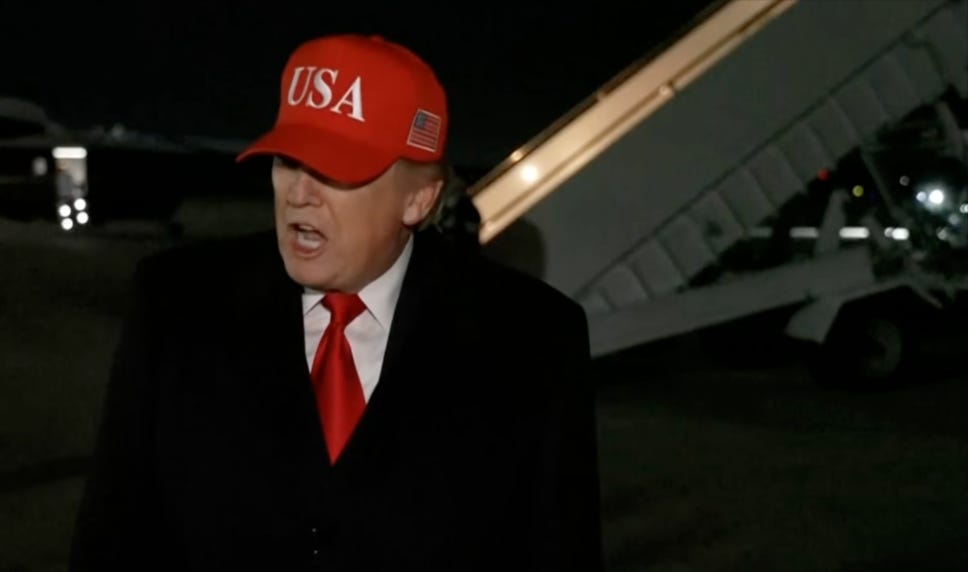
Shortly after 9 pm tonight, the president of the United States carefully gripped the handrail of the stairs of Air Force One as he made his way down onto the tarmac at Joint Base Andrews, before walking straight over to the waiting press. With eyes so swollen they were reduced to slivers beneath his bright red USA baseball cap, he didn’t stay long to answer questions. He spent most of the six minutes awkwardly trying to convince anyone listening that “A lot of very good things are happening with regard to the Strait of Hormuz,” followed shortly by declaring that a blockade of the Strait of Hormuz would begin at 10:00 a.m. Monday. He then pivoted to attacking the Pope, before turning his rage to NATO, lashing out at allies before abruptly ending the exchange altogether by walking away.
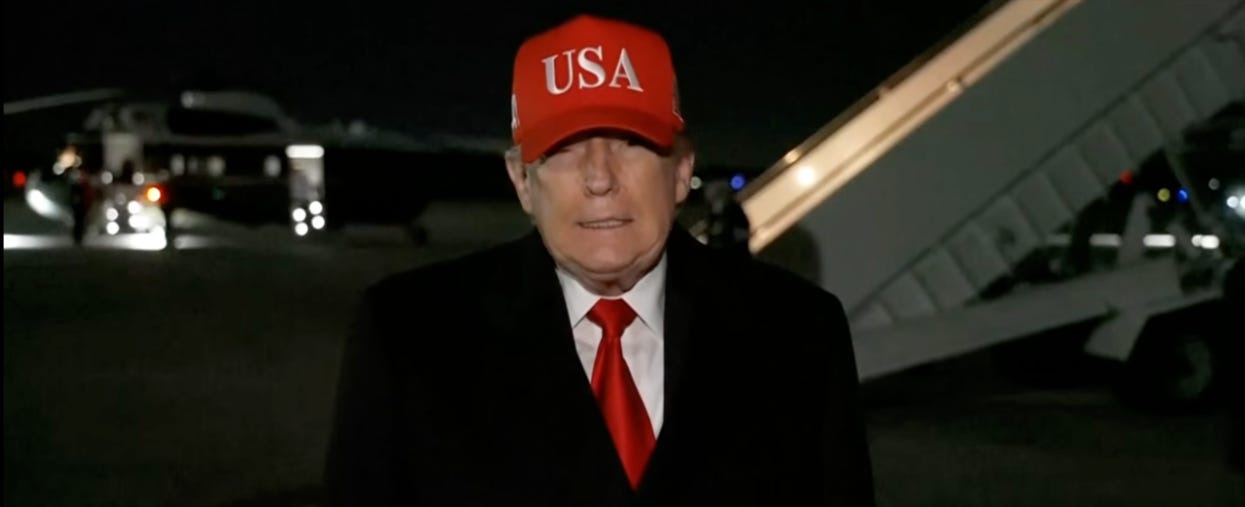
In those six minutes, while standing on a tarmac in the dark, Donald J. Trump said that Iran’s “whole navy is underwater,” and “I don’t care if they come back or not. If they don’t come back, I’m fine” when asked how long he was willing to wait for Iran to come back to the negotiating table. And when a reporter asked him why he attacked Pope Leo on Truth Social, Trump didn’t hesitate. “I don’t think he’s doing a very good job,” he said. “He likes crime, I guess.” He called the Pope “a very liberal person” who “doesn’t believe in stopping crime,” before adding he “says it’s okay to have a nuclear weapon,” and that, “I’m not a big fan of Pope Leo.”
And then, when asked about NATO, the alliance that has held the Western world together for over 75 years, Trump said he was “very disappointed,” that allies “weren’t there for us,” and then delivered a truly reckless comment: “We spent trillions guarding against Russia. I’ve long thought it was a little ridiculous. That’s going to be under very serious examination.” And then he turned around and walked away.
What we saw this weekend was a presidency in the early stages of collapse. He is now on the other side of his own downfall. That doesn’t mean this is over, and it doesn’t mean the damage stops here. There are still people protecting him, systems bending around him, and still real consequences for all of us in the meantime. But something has shifted.
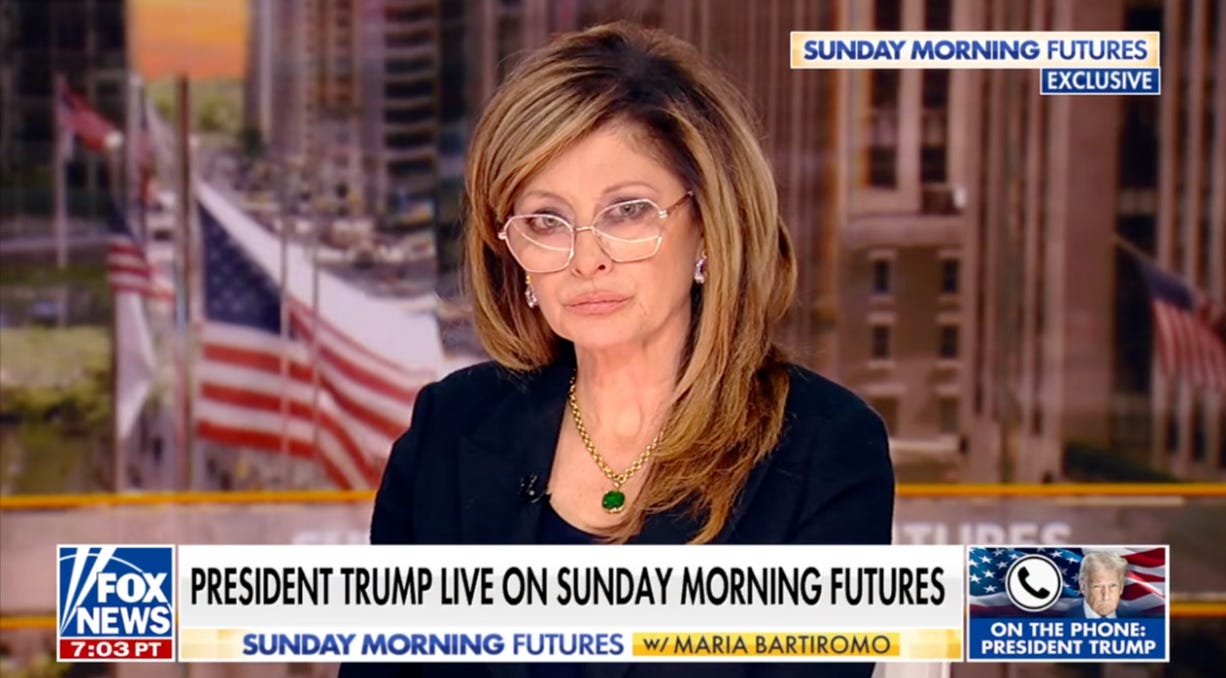
This morning, Donald Trump called into Sunday Morning Futures with Maria Bartiromo on Fox News for a 35-minute phone interview, and what followed was one of the more telling stretches of airtime we’ve seen from him in a while. Not because he said anything new, but because he couldn’t stop talking, couldn’t stay on topic, couldn’t answer a direct question, and eventually had to be cut off, even as a loyalist like Maria tried to redirect him multiple times.
He opened by confirming the naval blockade of the Strait of Hormuz, saying “we’re going to be blockading” and that it would “take a little while, but it’ll be effective pretty soon.” But what came after that was where the interview started to unravel. He described Iran’s negotiators as having “came in like they had the cards, but they don’t have the cards,” and then launched into a long, looping monologue about destroyed ships and mine droppers and obliterated radar and a submarine called the Salamani and “computerized bullets” and lasers that melt drones.
Then Bartiromo asked about oil and gas prices, the question that matters most to the Americans who are paying more at the pump every week because of a war they didn’t ask for. She asked whether prices would come down before the midterm elections. Trump started talking about the stock market hitting 50,000, about how great the economy was before he decided to go after Iran, about how “even if” prices went up, he had to stop Iran from getting a nuclear weapon. And then he said, “So I just have the greatest economy ever.” Bartiromo, to her credit, asked the question again: “So do you believe the price of oil and gas will be lower before the midterm elections?” And this was his answer: “I hope so. I mean, I think so. It could be. It could be or the same or maybe a little bit higher.” While he said those words, Fox News displayed a graphic showing crude oil at $96.57 per barrel and the national average gas price at $4.125 a gallon, up nearly 53 cents from just one month ago. Bartiromo’s eyes widened, and she blinked hard multiple times at his admission.
He also took time, in the middle of a discussion about a current war, to talk about the Gulf of Mexico, or as he calls it, the Gulf of America. He went off on a tangent about how he really wanted to rename it “the Gulf of Trump” before deciding against it. “I think maybe it was a wise… I think that one maybe wouldn’t have worked out,” he said, as Bartiromo tried to steer him back by suggesting he was being facetious, that he was joking. But it’s doubtful that he was joking. And it tells you everything about where his head is that, in the middle of a conversation about blockading a critical waterway and threatening to destroy a nation’s water supply, the president of the United States detoured into whether a body of water should be named after him.
And then, between the infrastructure threats and the Gulf of Trump tangent, he said something that should never be treated as normal, no matter how many times he says it. He called the 2020 election “rigged.” He said, “You know that. I know that. Everybody knows that now, and it’s all come out and it’s coming out.” And Maria Bartiromo, sitting on the set of the network that paid $787.5 million to Dominion Voting Systems for spreading those exact lies, responded: “Yup.”
Toward the end of the interview, Trump launched into a rant attacking NATO and our allies, singling out the United Kingdom and Germany for not supporting the war in Iran. He mocked UK Prime Minister Keir Starmer for offering to send equipment “after the war is over,” comparing it to a “Neville Chamberlain type statement.” Neville Chamberlain, the British Prime Minister, remembered for handing a piece of a sovereign nation to Adolf Hitler in 1938 and calling it peace, the man whose name has been shorthand for nearly 90 years for the catastrophic failure of appeasing an aggressor while the world burns. And Donald Trump is the president who has spent years praising Vladimir Putin. Who said he exchanged what he called “love letters” with Kim Jong Un. Who invited the Taliban to Camp David. Who called Viktor Orbán “a fantastic man” on speakerphone just five days ago. He is also the president who pulled the United States out of the Iran nuclear deal, the agreement that was actually constraining Iran’s nuclear program. That decision set off a chain of events that led us directly to this war. And now, he is invoking Chamberlain against a democratic ally, because that ally won’t help him clean up what he broke. He spent four years in his first term appeasing every strongman on the planet and calling it deal-making. And now, having started a war that his own decisions made inevitable, he is invoking the defining failure of twentieth-century European diplomacy as a weapon.
He is aiming it at the very nations that lived through the consequences of that failure. Nations whose cities were bombed. Whose people were killed. Whose continent was shattered because appeasement didn’t work. He went on to attack Germany for saying, “We didn’t start this.” And then he started talking about Venezuela, boasting that the country is “making more money than they’ve ever made before” after his administration’s kidnapping of its leader in January, and that’s when Bartiromo stepped in. “Mr. President, we want to respect your time,” she said. “I know how busy you are this morning, and I know that we will have part two of this interview this week at the White House.” She pulled the plug on the interview because he just could not stop.
And in the middle of all of that, tucked between the threats of civilizational destruction and attacks on NATO, he called the free press “almost treasonous.” He named CNN, ABC, and NBC directly. He said their reporting on the war was “so sad” and “almost treasonous, actually, if you want to really know that.”
Every single time he does this, I am going to call it out. Every single time. Because when a sitting president labels truthful reporting as treasonous, he is laying the groundwork for suppression. That is the playbook. Discredit the press. Delegitimize the press. And then dismantle the press. It is what Orban did in Hungary. It is what Putin did in Russia. It is what every authoritarian does before the lights go out on a free society, and the fact that he says it so casually, like it’s a throwaway line in a phone interview, does not make it less dangerous. It makes it more dangerous because it means he’s normalized it.
This is why we have to continue supporting independent media. Every time he attacks the media, we need to push forward and support those who are holding the line, with paid memberships, not just to mine, but to your other favorite voices. If you have the means, please identify a handful of people who are putting themselves on the line by sharing what is really happening and support them. Share their work. And lift them up. This is how we make sure that the truth is still reaching the American people, especially as we get closer to the midterm elections.
And we have to wonder if Trump’s erratic phone interview with Maria Bartiromo had anything to do with the lackluster reaction he received the night before at the Kaseya Center in Miami for UFC 327. With Kid Rock blaring over the speakers, Trump walked in with Dana White at his side, Ivanka behind him, and Secretary of State Marco Rubio nearby. This was supposed to be his room. UFC crowds have been his people since day one. In 2025, at UFC 314 in this same building, the arena erupted when he walked in. The energy was electric. It was the kind of moment his team turns into campaign footage. A viral video comparing the two entrances is now circulating, and the contrast is devastating. This time, the reaction was mixed at best. Subdued. Muted. Some witnesses described booing. Multiple observers noted that Trump looked deflated, depressed; the word people kept using was that he looked “like he had been crying.” The swagger that has defined his public appearances for a decade was gone. People in the crowd weren’t making eye contact with his entourage. They were visibly distancing themselves. His people had to look around for someone to shake hands with. This was his first appearance at a sporting event since the Iran war started, and you could feel the shift in the room. Something has changed, and everyone in that arena knew it.
It wasn’t just Trump having a bad night. This is a bad time for Authoritarians. Because we received the results of the election, I have been watching with a knot in my stomach for months.
The Prime Minister of Hungary, Viktor Orban, who has ruled for 16 years, lost the election and quickly conceded defeat earlier today. The election winner and next Prime Minister, Peter Magyar’s Tisza party, also won with a supermajority, securing 138 seats in the 199-seat parliament. Turnout was over 77 percent, the highest in any Hungarian election since the end of Communist rule. In his victory speech, delivered to tens of thousands of supporters gathered along the Danube River in Budapest, Magyar said, “Together we replaced the Orban regime, together we liberated Hungary. We took our country back.” He said the victory was so large it was “visible from the moon and every window in Hungary.” He pledged to reintegrate Hungary into the European Union’s judicial system. He said, “Nobody is labeled for thinking differently than the majority,” and that “Those who betrayed the country will be held accountable.” And the crowd chanted one word: “Europe.”
This is a meaningful victory for Hungary and, just as important, for Europe and the whole world because of what Orban represented. Steve Bannon, one of the original architects of the MAGA movement, once called Orban “Trump before Trump.” He meant it as praise. Orban was the model: consolidate the media, weaken the courts, demonize immigrants, cozy up to Russia, call it “illiberal democracy,” and dare anyone to stop you. The Conservative Political Action Conference, CPAC, held its conference in Budapest. Trump called Orban “a fantastic man” on speakerphone five days ago. Secretary of State Marco Rubio visited Budapest in February and told Orban that “Trump is deeply committed to your success.” Trump offered “the full economic might of the United States” to strengthen Hungary’s economy if Orban won. The vice president of the United States stood on Orban’s stage and begged Hungarian voters to re-elect him just days ago. The full weight of the American government was thrown behind keeping this man in power. And today, the Hungarian people said no. In record numbers.
Authoritarians have always found each other. It is one of the defining patterns of the past authoritarian alliances of the twentieth century. In the 1930s, the alignment that formed between Hitler, Mussolini, and Imperial Japan was not built on shared ideology. Hitler was a racial supremacist. Mussolini was a nationalist strongman who consolidated media and courts. Imperial Japan was driven by expansionism. What bound them together was not a common vision for the world but a common enemy: liberal democracy. They aligned because democratic nations shunned them, because decent countries refused to treat them as legitimate partners, and because they needed each other to survive the isolation that came with their own behavior. And the lessons of the pacts these strongmen form, written or not, are that authoritarian alliances are not about principles. They are about power and convenience, and they will align with anyone, even their supposed ideological opposite, if it serves their interests in the moment.
Now look at the modern alignment. Trump. Orban. Putin. Netanyahu. Bolsonaro before his fall. Milei. They don’t share a coherent ideology. What they share is contempt for democratic institutions, hostility toward a free press, a willingness to use state power against political opponents, and a mutual dependence born of the fact that democratic leaders increasingly refuse to treat them as legitimate partners on the world stage. They find each other because the democratic world of today shuns them, too.
But here is what the 1930s also teach us, and it is the most important lesson of all: authoritarian alliances are inherently brittle. Mussolini fell first. Then Hitler. The Axis did not collapse only because of external military pressure. It collapsed because the internal contradictions of authoritarian rule, the corruption, the overreach, the economic rot, and the isolation from the international community eventually became unsustainable. The people, when given a real choice, chose differently. That is what happened in Hungary tonight.
And maybe the message of what happened today would be best received by our Congress, who are still on the Trump wagon: you are on a sinking ship. Viktor Orban had 16 years of consolidated power. He had captured the media. He had a gerrymandered electoral system built to favor his party. He had the endorsement of the president of the United States. He had the vice president standing on his stage five days ago. And 77 percent of Hungarians still showed up and threw him out in a landslide so decisive that the opposition is projected to rewrite the constitution. This should alarm every Republican in Congress who thinks they can ride this out by staying quiet, by nodding along, by choosing loyalty to one man over loyalty to the country they swore to serve. But the midterms are coming. And Hakeem Jeffries put it plainly tonight: “Far-right authoritarian Viktor Orban has lost the election. Trump sycophants and MAGA extremists in Congress are up next in November. Winter is coming.” Chuck Schumer was just as direct: “Wannabe dictators wear out their welcome. November 2026 can’t come soon enough.”
After seeing Viktor Orban fall today, I felt something I haven’t in a long time. Peace. Knowing that Orban’s time is coming to an end, not through a revolution or a coup, but through a democratic election with the highest turnout in the country’s post-Communist history, means something real. The Hungarian people showed up, and they voted, and they chose democracy. And if the Hungarian people can do it after 16 years of authoritarian rule, after the courts were weakened and the media was captured, and the maps were drawn to favor the incumbent, and the president of the United States personally intervened to keep the strongman in power, then we can do it too. The midterms are coming. The writing is on the wall. And that is why I still have hope for America. And you should, too.
I’ll see you tomorrow,
Heather
PS. You can make a significant difference right now by subscribing to my Substack. Your support helps me cover more ground and keep telling the truth about the lies and destruction unfolding in this country.

This commentary represents my personal opinions and analysis of matters of public concern, informed by publicly available information. Any references to individuals constitute opinion and commentary protected under the First Amendment.
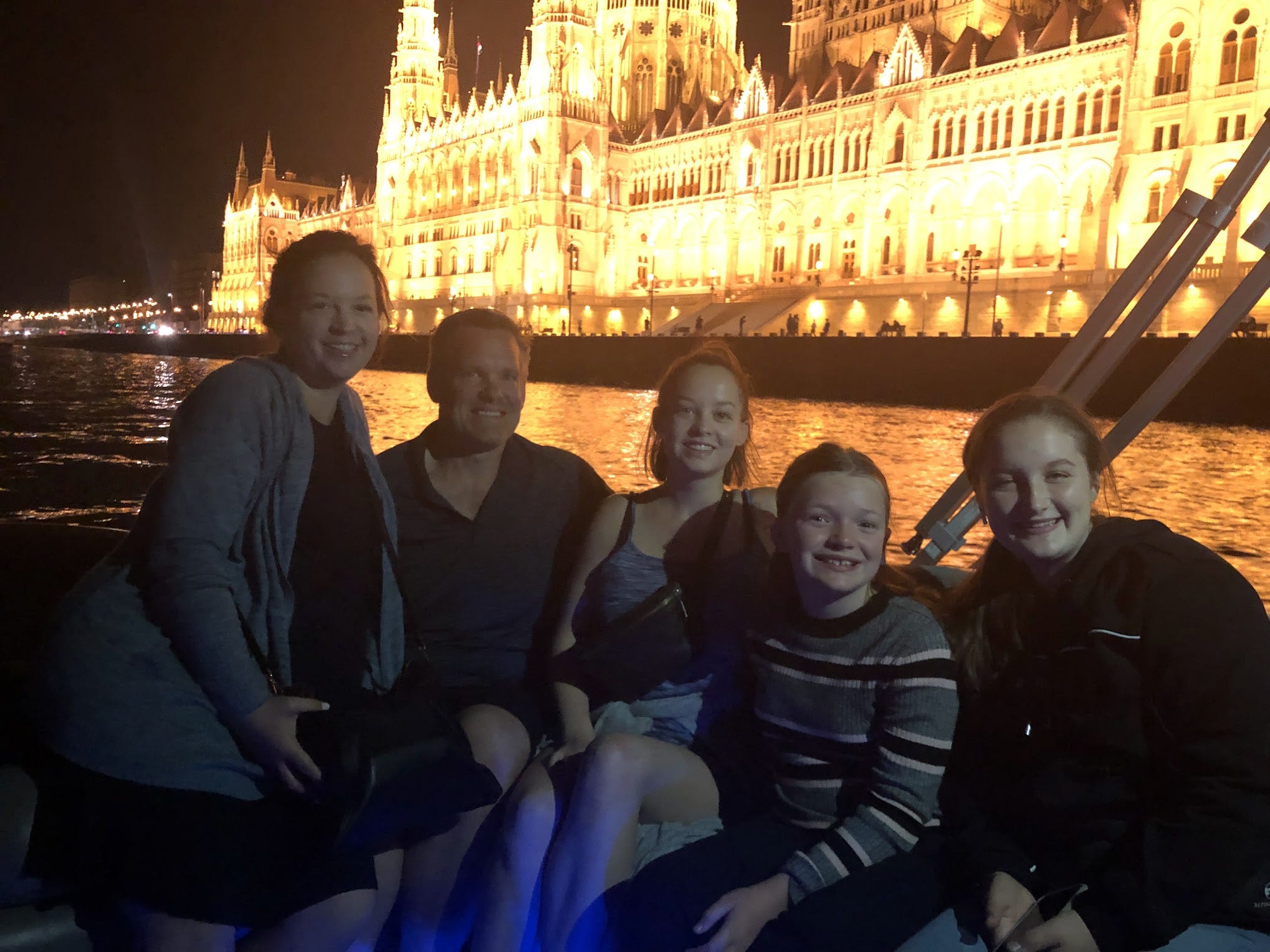
Picture of the day: This photo is from my birthday in the summer of 2019, on a river boat ride along the Danube in Budapest with my family. That golden building behind us is the Hungarian Parliament. Tonight, tens of thousands of Hungarians gathered along that same stretch of river to celebrate the end of 16 years of authoritarian rule. Budapest has always been one of the most beautiful cities I have ever visited, and tonight it is also one of the most hopeful.
Sources:
Bartiromo interview (Fox News): https://www.foxnews.com/video/6392969626112
Donald Trump Talks to Reporters at JBA En Route to White House after Weekend at Mar-a-Lago: Video
https://www.nbcnews.com/world/iran/live-blog/live-updates-us-iran-fail-reach-deal-peace-talks-day-negotiations-rcna315918
https://www.thedailybeast.com/fox-wraps-donald-trump-interview-as-he-spirals-on-iran-war-mess/
https://www.huffpost.com/entry/trump-gas-prices-midterms-fox-news-maria-bartiromo_n_69d7f4d8e4b048dba44c02ff
https://gasprices.aaa.com/
https://www.ibtimes.co.uk/magic-gone-trump-got-usa-chants-ufc-2025-last-night-same-miami-crowd-barely-clapped-1791324 https://www.aljazeera.com/news/2026/4/12/hungary-election-early-results-show-magyars-tisza-ahead-of-orbans-fidesz
https://www.cnn.com/2026/04/12/world/live-news/hungary-election-orban-magyar https://www.cnbc.com/2026/04/07/trump-vance-orban-hungary-iran-war.html https://www.state.gov/releases/office-of-the-spokesperson/2026/02/secretary-of-state-marco-rubioand-hungarian-prime-minister-viktor-orban-at-a-joint-press-availability https://www.aljazeera.com/news/2026/4/12/world-reacts-to-election-defeat-for-viktor-orban-hungarys-longtime-pm
Hi Heather,
I think Tdump, or his backroom strategists, were confident a victory in Iran would both boost his ratings and deflect from the multitude of issues at home. BIG mistake!! Not only is this now a protracted war, it’s contradictory to the majority of Americans and even MAGA base faithfuls. Now, Geo-global attention is lasering in on the disastrous economic fallout, Catholics globally outraged at Tdump’s assault on Pope Leo (an American), not to mention the landslide victory - a real one, unlike Tdump’s claims - in Hungary of a 16yr Authoritarian reign! There reasons to be optimistic, but the pressure needs to be maintained.
Powerful writing. Great job of laying all of this out. I have hope after Orban’s defeat but T is losing it more and more by the minute.