

Bundled tightly in his winter coat, Donald Trump stopped to talk to the press with that familiar mix of slick double-talk and impatience before flying to Fort Bragg. It should have been a moment for the president to explain the stakes of a government shutdown, to reassure the public, and to show even a hint of commitment to bringing both sides together for the good of the country. Instead, he used it to lash out. “The Democrats have gone crazy. They’re radical left lunatics,” he barked, turning a straightforward question about the budget into yet another attack on half the nation he was elected to serve.
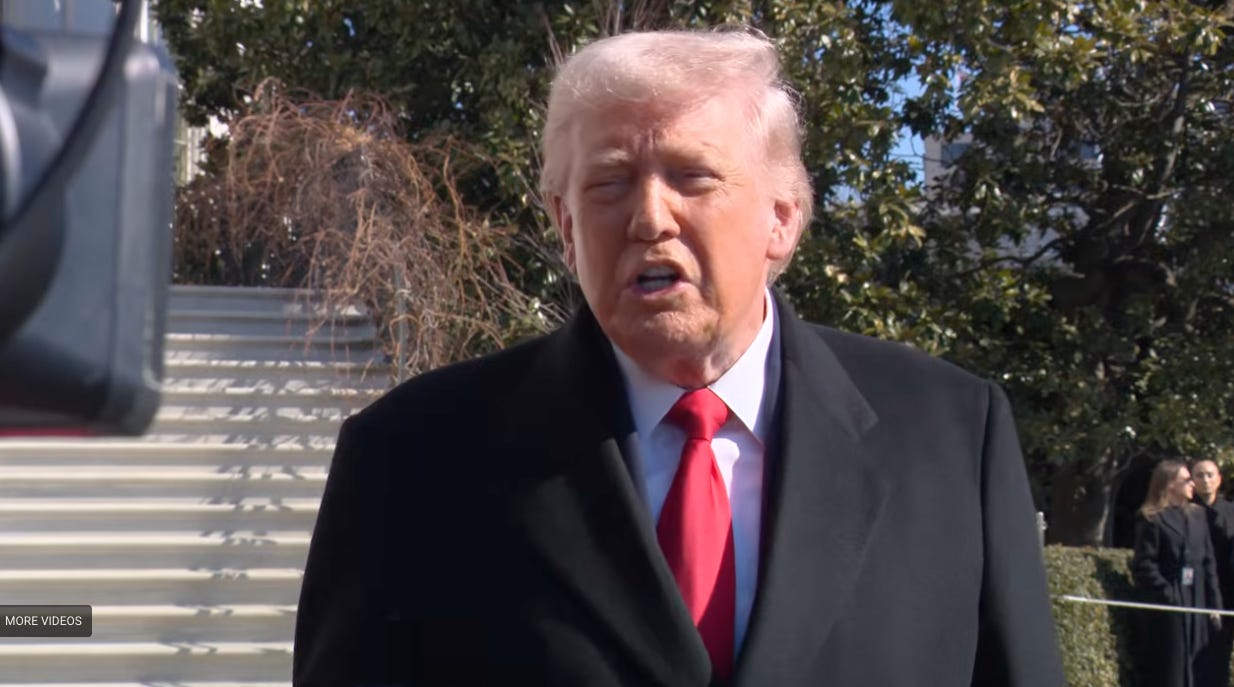
And it set the tone for everything that followed. He spent the rest of the day sowing division, stoking fear among our military, and using the power of his office to campaign for the midterms. It was a desperate attempt to hold onto power as his own approval collapsed, and the GOP slipped further behind in the polls. But more than that, it was a sign of just how far he’s willing to go to tighten his grip on this country, no matter what it takes.
In between shouts from reporters trying to get his attention, he launched into another wild claim, bragging that ICE had “removed” 11,888 murderers and “hundreds of thousands of criminals” through raids that have overtaken communities across the country. Anyone paying attention knows these numbers aren’t real. But that has never mattered to him. The more alarming the truth becomes, the more inflated and bizarre his numbers get, as if he can outrun reality by shouting a bigger lie. What’s terrifying is that there are still people who believe him, even as the gap between what he says and what is actually happening grows wider every day.
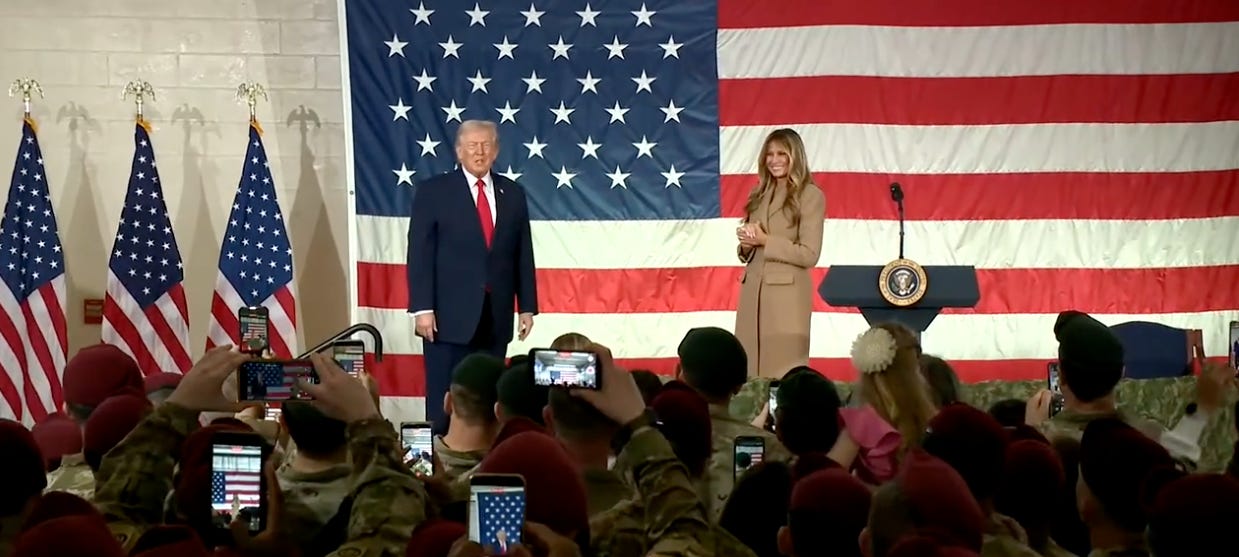
After landing at Fort Bragg, Trump was back on camera with what the White House was trying to frame as a simple visit to celebrate special forces members who ousted Venezuelan President Nicolás Maduro. But just like everything else he touches, it didn’t stay apolitical for long. The moment he walked onto that stage, with his favorite rally music blasting and cameras flashing, it felt less like a commander-in-chief showing respect to service members and more like a campaign stop complete with photo ops and sound bites for his followers.
And that should concern every single American who understands why we have a long-standing tradition in this country of keeping our armed forces free from political influence and pressure. It’s not just about symbolism. It’s about safety and survival. We elect new leadership every four years, sometimes Democrats, sometimes Republicans, and the military must remain apolitical so it can defend the country responsibly, regardless of who is in power. The last thing we want is a president trying to brainwash service members into believing that the opposing party is evil. The word “United” in the United States of America matters even more inside the armed forces, because our stability, and the stability of the world, depends on their unity.
But unity wasn’t what Trump was after in that speech. Even with a well-practiced script in front of him, he couldn’t control himself. He started boasting about how great everyone’s 401(k)s were, even asking the audience how their 401(k)s were doing. The question was met with near-complete silence, because service members don’t have 401(k)s; they have something called the Thrift Savings Plan. When the quiet got to be too much, he laughed it off and said, “Is anybody doing poorly with their 401k? If they were, you’re a pretty bad investor, I’ll tell you that.” It was a moment that showed just how out of touch he is with the people he claims to champion and his complete lack of understanding of how any of this works.
From there, it only got worse. He bragged about the $1,776 payments military families received at the end of last year, acting as if he personally sent them the money with his own money, when it was really from a housing allowance supplement already approved by Congress in the earlier reconciliation bill. “You think the Democrats would have done that? Forget it,” he said, using the troops as props to divide the country and paint his political opponents as the enemy.
He repeated his election lies. He warned that the base’s name would be changed if Republicans lost the midterms. And even though he didn’t say the actual words “vote Republican,” he didn’t need to. The message was clear. Thankfully, most of the soldiers stood still and silent, phones raised to record, refusing to cheer, because they understand the line that should never be crossed, even if he doesn’t. He spent more than thirty minutes lecturing these selfless men and women, turning what should have been a simple moment of gratitude into an embarrassing campaign rally.
And that’s when the historical echoes become deafening. We’ve seen this before. Mussolini held “unity” rallies inside army barracks to bind soldiers to his fascist movement. Hitler blurred the line between the German military and the Nazi Party long before the world understood what he was building. In Argentina, the military junta forced soldiers to sit through speeches painting political opponents as enemies of the state. It always starts this way. A leader steps onto a military base, praises the troops in a performative voice, talks about loyalty, and plants the idea that one party is the true defender of the nation. Slowly, the armed forces stop serving the Constitution and start serving the strongman.
But the military wasn’t the only institution Trump tried to bend toward his political goals today. On Truth Social, he said the quiet part out loud, writing, “We cannot let the Democrats get away with NO VOTER I.D. any longer. It is a CAN’T MISS FOR RE-ELECTION IN THE MIDTERMS, AND BEYOND!” And then came the line that should concern every American who believes in free and fair elections: “There will be Voter I.D. for the Midterm Elections, whether approved by Congress or not!”
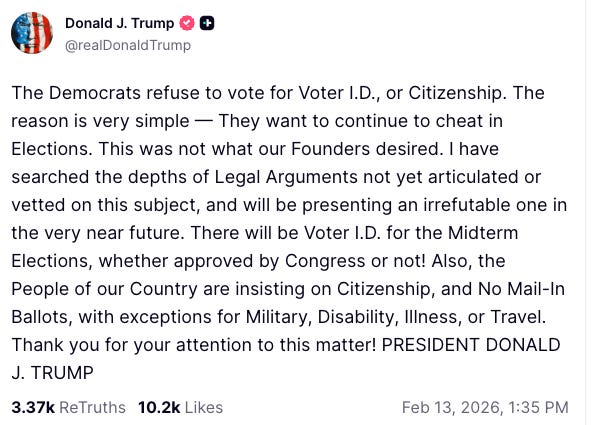
Let’s be very clear about what this means. Presidents do not control elections in this country. States do, with Congress having some limited power in rare circumstances. But Trump is now saying he can override all of that with a single executive order if he doesn’t get what he wants. That is not how our Constitution works. It’s how authoritarian governments work to cement their power. They start by limiting who can vote, creating new barriers for groups that tend to oppose them. They change the rules, tilt the system in their favor, and make sure they never have to face a real contest at the ballot box again. And if he’s willing to say this out loud, imagine what he’s planning behind closed doors.
That same authoritarian instinct was on display in another move his administration made today: revoking passport-processing authority from more than 1,400 nonprofit libraries across the country. For people in big cities, this might not seem like much. But for rural communities, it creates an immense barrier to access. These libraries help families apply for passports without having to travel hours to the nearest official facility. They rely on that small but vital stream of fees to keep their doors open and their shelves stocked. Taking that away doesn’t just make life harder for millions of Americans. It centralizes a basic government function, pulling it out of local hands and placing it under direct federal control at a moment when Trump has shown he’s more than willing to weaponize federal power for his own gain.
And it fits a pattern we see in authoritarian systems around the world. They always find ways to tighten their grip on identification, travel, and documentation. Who gets access, who gets denied, and who is allowed to move freely. It never starts with something dramatic. It starts with small administrative changes that look harmless until you zoom out and realize what they add up to. Taking passport processing away from 1,400 libraries is not an efficiency measure. It’s a power grab. And it’s the kind of step leaders take when they want to control more of people’s everyday lives.
When you put the library decision next to Trump’s attempt to force voter ID by executive order, an even darker picture emerges. If strict ID laws pass, millions of Americans will suddenly need documents they don’t currently have in order to vote. And when the government makes it harder to get those documents by shutting down passport offices, it’s not just an inconvenience. It’s another barrier to the ballot box, and another way to choose who gets to participate in democracy and who gets left out. This is what the early stages of voter suppression look like. Not one big move, but dozens of little ones, each designed to make it harder for certain groups to have a voice.
But nothing today captured the authoritarian drift more clearly than the prosecution of Don Lemon. The veteran journalist pleaded not guilty to federal charges for simply doing his job. He had livestreamed a protest inside a church, not as an organizer or participant, but as a reporter documenting the event for the public. The government claims otherwise. Prosecutors allege Lemon participated in a pre-operation briefing, took steps to maintain secrecy about the target, and physically obstructed congregants trying to leave the church. But a federal magistrate judge initially rejected the charges against Lemon for lack of probable cause, and a Washington Post review of video footage found it contradicts key allegations in the indictment. Yet he was lumped in with the protesters in the indictment, erasing his role as a journalist and ignoring his First Amendment rights.
As Lemon said in his own filing today: “In the United States of America, we do not prosecute journalists for doing their job. That happens in Russia, China, Iran and other authoritarian regimes. And yet the government sold this unconstitutional mess to the grand jury.”
He’s right. This case is a five-alarm fire for press freedom in America. And it’s no accident that Lemon was targeted. He’s a black man, a member of the LGBTQIA+ community, and an independent journalist without the backing of a major network. Even if he’s acquitted, the process itself is a punishment. The cost, the stress, the time it takes away from his ability to report. But even more importantly, it sends a clear message to everyone else who dares to question power in this country: Watch your back. You could be next.
We’ve seen this pattern before, too. In fact, we saw it in Mussolini’s Italy, where the fascist regime’s very first target was the free press. Mussolini didn’t start by shutting down every newspaper at once. He started by going after individual reporters, one by one. Editors who criticized the government lost their jobs. Journalists were censored, then arrested. Anti-fascist publications were closed. The ones that remained were forced to register with the regime and only publish approved content. It was a gradual strangulation of free speech, done slowly enough that much of the public didn’t realize what was happening until it was too late to resist. That’s the same strategy Trump is using now. He’s not revoking every press pass or shutting down every critical outlet overnight. He’s picking them off one at a time, seeing how far he can push before he is stopped.
And that’s why Don Lemon’s case matters so much. Because this isn’t just about one journalist. It’s about the right of anyone to question authority without fear. It’s about the ability of the press to hold the powerful accountable. It’s about the very heart of the First Amendment, which prohibits the government from interfering with the freedom of speech or the freedom of the press. Because without the ability to speak truth, democracy dies in the dark.
That’s why supporting independent media is at the top of my list of priorities in this fight. The reason we know about the ICE raids, the abuse of power, the corruption at the highest levels of our government, is because reporters are still brave enough to document it, even when it puts a target on their backs. They are the thin line between democracy and authoritarianism. Between uncomfortable truth and official lies. And every time this regime tries to silence one of them, it is our moral responsibility to stand up, speak out, and refuse to let them be erased.
So here is my call to action. If you believe in the importance of a free press and you believe that sunlight is still the best disinfectant in a nation sliding toward fascism, then please, support your go-to voices in any way you can. Subscribe to their paid memberships. Donate to their legal defense funds. Share their stories far and wide. Because the more this regime tries to criminalize the truth, the more vital it becomes that we all become defenders of it.
And while our own government continues to attack the free press, the rest of the world is doing what we should have been doing all along: holding the powerful accountable.
The dominoes started to fall in Dubai, where Sultan Ahmed bin Sulayem, the CEO of global ports operator DP World, was forced to resign after his name appeared in the unsealed Epstein files. Most disturbingly, the documents revealed an email chain in which Epstein described Sulayem as a close friend and referenced a “torture video” that was allegedly linked to the executive.
The fallout was swift and severe. As soon as the revelations hit, firms in the UK and Canada began freezing new investments with DP World, publicly demanding “necessary actions” in light of the CEO’s Epstein ties. The message was clear: any association with Epstein’s crimes, no matter how powerful the individual or institution, would not be tolerated.
DP World moved quickly to contain the damage, announcing Sulayem’s replacement and stressing its commitment to ethics and transparency. But the ripple effects kept spreading. At Goldman Sachs, top lawyer Kathryn Ruemmler submitted her resignation after the files exposed her extensive correspondence with Epstein from 2014 to 2019. Emails showed Ruemmler calling Epstein “Uncle Jeffrey,” exchanging intimate sign-offs like “xoxo,” and he even contacted her shortly after his July 2019 arrest.
In each of these cases, the response was immediate and unequivocal. There were no excuses, no claims of persecution, no attempts to bury the story. Meanwhile, our own Justice Department continues to slow-walk the release of Epstein documents, hiding behind redactions and delays while powerful people breathe sighs of relief. The contrast couldn’t be clearer. While other countries are cleaning house and proving that no one is above the law, our leaders are still trying to conceal the truth and protect the complicit. The fact that over 3.5 million pages of Epstein-related files are still being kept from the public only underscores the scale of the cover-up.
But they can’t hide forever. Accountability is coming. And no amount of attacks on the press or abuses of power will stop it in the end. The floodgates have opened, and the truth will come out, even if our own government is the last to acknowledge it. This is a moment of reckoning, not just for the individuals caught in Epstein’s web, but for the entire power structure that enabled him. The cracks are starting to show. The question now is whether we as a society have the courage to keep prying them open and demand the truth, no matter how ugly it gets.
We are living through a moment where the very notion of objective reality is under assault. The President of the United States, directly or indirectly, pressured pollsters to stop releasing numbers about his unpopularity, and they did. He’s standing on stage and lying to our troops’ faces about his own policies. His government is hiding evidence of crimes committed by some of the most powerful people in the country. The cracks in his control are starting to show, but he is responding the way all aspiring dictators do: with more propaganda, attacks on the press, and attempts to rig the system in his favor.
It would be easy to lose hope in the face of all this. Easy to throw up our hands and say the game is too rigged, and the damage too far gone to come back from. But that is what he wants. He wants us demoralized. He wants us numb. And he and his enablers want us to believe that resistance is futile, so we stop resisting at all.
But here’s the thing about truth: it’s stubborn and relentless. And it has a way of breaking through even the thickest walls of power. You can arrest a journalist, but you can’t arrest a story. You can attack the press, but you can’t make the facts disappear. And as long as there are still people brave enough to seek those facts, brave enough to speak them out loud no matter the cost, then this fight is never over.
That bravery is all around us right now. It’s in each of us every time we refuse to let this feel normal. Every time we bear witness to the chaos and cruelty they have unleashed. And every time we decide that the truth is still worth defending.
It’s not going to be easy. There will be more attacks, more arrests, more attempts to bend the very fabric of reality to one man’s will. But there will also be more cracks and moments of clarity. More moments where the light breakthrough the darkness. And as long as we keep shining that light and believing in its power, then I know one thing for certain: the truth will not be silenced. Accountability will come, and justice will have its day.
There is a reason that regimes built on lies are so terrified of the truth. Because deep down, they know it has the power to bring them crashing down. And that is why I still have hope for America, and you should, too.
I’ll see you tomorrow,
Heather
PS. You can make a significant difference right now by subscribing to my Substack. Your support helps me cover more ground and keep telling the truth about the lies and destruction unfolding in this country.
This commentary represents my personal opinions and analysis of matters of public concern, informed by publicly available information. Any references to individuals constitute opinion and commentary protected under the First Amendment.
Hi Heather,
There are so many strands…a cobweb of global and institutional unraveling. It is hard to keep up, but that is the most challenging thing about Fascism, it moves and changes at an alarming pace. Emotionally, my attention is drawn to those most affected…children, families in concentration camps. Deportations. Gaza as well. But instincts tell me to look for what is happening governmentally, globally.
At the Munich conference today, Europe is strongly critical of the move towards Authoritarianism. Trump’s speech to the US troops was like a political call to arms!!
Glad to have discovered your work. Keep up the great articles. 🕊️