

At 2:53 this afternoon, Donald J. Trump walked across a stage inside Dream City Church in North Phoenix, slapping his right upper thigh with each step as he made his way to the podium. He adjusted the microphone, looked out over the crowd, and launched into a nearly hour-long speech at Turning Point Action’s “Build the Red Wall” rally, an event built to indoctrinate young voters ahead of the 2026 midterms into loyal Trump supporters. He covered a lot of grievances over the 60+ minutes he had, attacking NATO, sharing white nationalist conspiracy theories, and declaring, “I’m the peacemaker. I’m the one that settled eight wars,” while in the same breath announcing his plans for his next war: “A new dawn for Cuba. We’re going to help them out with Cuba... watch what happens.”
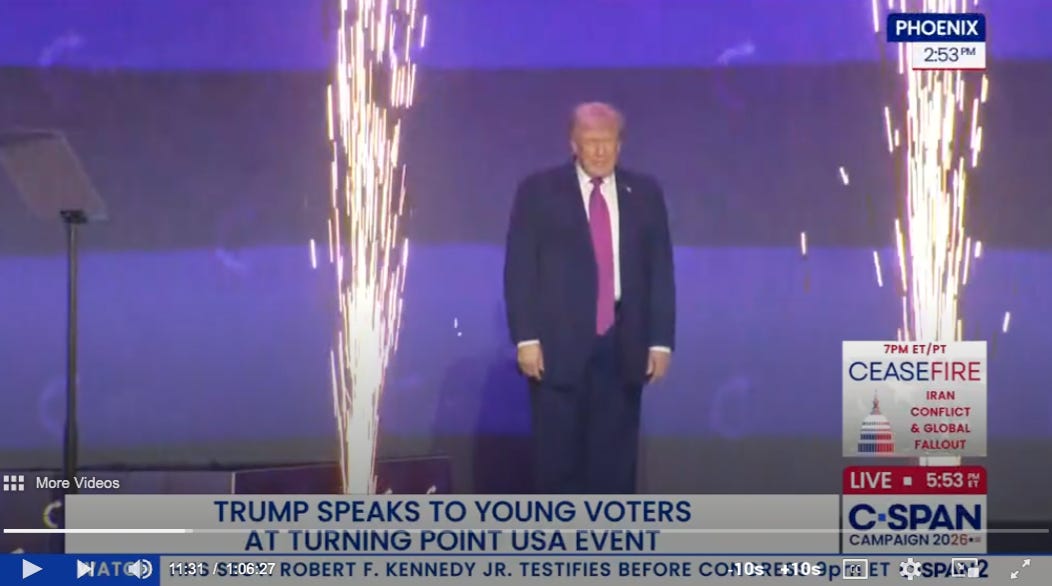
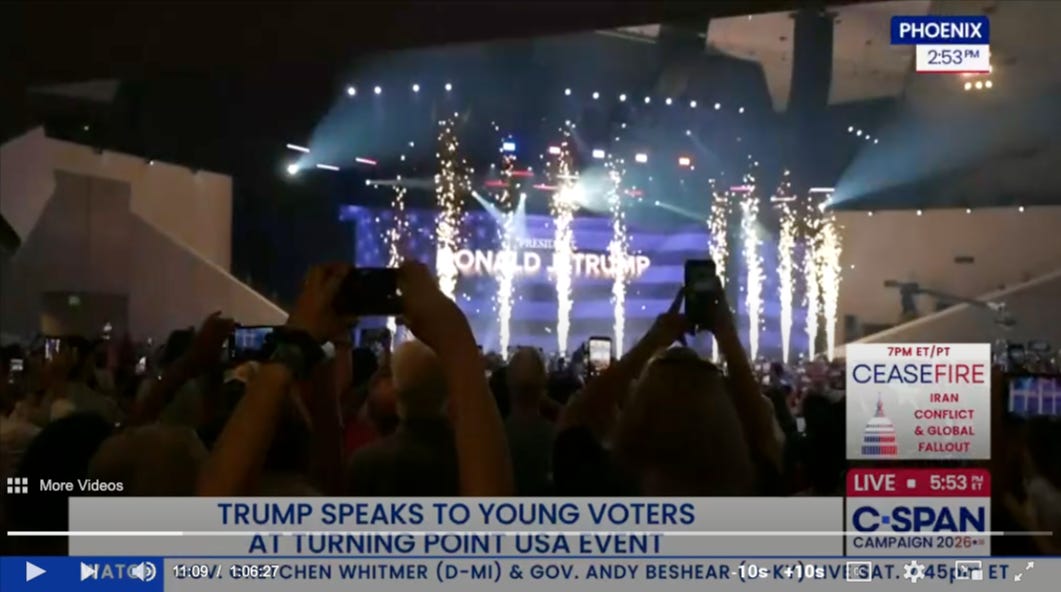
But before any of that, there was the entrance. The lights dropped, and a cinematic montage played across the massive screens, edited like a movie trailer, showing Trump after his attempted assassination, clips of him announcing his presidential campaign, and scenes stitched together to project strength and competence. Then came Erika Kirk, welcoming him onto the stage. They hugged and kissed, and she exited as Lee Greenwood’s “God Bless the USA” began to blare from the speakers, and ten pillars of pyrotechnics erupted from the front of the stage, with sparks raining down inside the megachurch. With the music still playing loudly, he walked to the center of the stage, stopped, and just stood there for nearly two full minutes, slowly twisting his body back and forth. Only after the song ended did he finally reach the podium and begin to speak.
And although they called this an “event,” what we watched today was something else entirely. It was a blueprint. Lessons designed for a generation that is still forming its understanding of power, identity, and truth.
And the first lesson of the blueprint came about halfway through, when he turned his attention to NATO. “Now that the Hormuz situation is almost over, I received a call from NATO asking if we would like some help,” he told the crowd. “And I told them I would have liked your help two months ago, but now I really don’t want your help anymore because they were absolutely useless when we needed them. But actually, we never needed them. They needed us. They need us. They need us so badly.” And then this: “This was just a military excursion. This isn’t the big time.”
This is a seven-week war where American service members are dead, thousands of civilians have been killed, and it has triggered a global energy crisis with gas prices soaring past four dollars a gallon, but to him, it is not a big deal.
A few minutes later, he made it clear what he wants people to take from all of this. “If NATO teaches us any one thing,” he said, “we have to rely on ourselves. We can’t rely on outside countries and outside sources. So do not listen to the craven and cowardly voices who tell you America needs to think small or to shrink from our duties or potential.”
Think small. That’s the phrase that explains everything else he said. Because in his version of the world, anyone who says we should slow down, follow the law, or work with our allies is weak. Anyone who questions whether we should be starting another war is weak. Anyone who believes America should act like part of a global community instead of acting alone is weak.
The only thing he calls strength is pushing forward no matter the cost, taking what we can, breaking what stands in the way, and starting conflicts without restraint. That’s the mindset he is teaching. That’s the permission he is giving to young voters.
And NATO did not betray us. NATO refused to help launch an unauthorized war. Spain denied airspace access. Germany declared it would not participate. Britain refused to send warships to the Strait of Hormuz. Those were not acts of disloyalty. They were acts of restraint and respect for international law.
If NATO breaks and Russia moves on the Baltics or another member, it doesn’t stop there. China moves on Taiwan. Iran rebuilds its networks. North Korea tests again. And suddenly every authoritarian leader in the world is testing how far they can go. Once that kind of deterrence is gone, you don’t just turn it back on. The people cheering today for NATO to be dismantled are cheering for a world where all of us are less safe.
But the fear at the heart of the speech was made explicit from the beginning. “If we don’t have ICE and if we don’t have our great border patrol and if we don’t have our great policemen and people, they’re incredible,” he told the crowd. “They keep our country great. They keep our country safe. And the Democrats want to defund them.”
He followed that with two stories: a Haitian immigrant accused of killing a Florida mother, and a migrant accused of pushing an 83-year-old veteran onto subway tracks in New York. Both are real tragedies. But they were used as props, and neither is representative of what is actually happening across the country.
And then, at the close, he made the pitch explicit. “If you want a poor and weak America, a country that’s riddled with crime and death, disease, and nothing but problems, you should immediately vote Democrat.” And: “We will make America safe again. We’re making your family safe. We’re making [you] safe.”
The entire speech rests on one core claim: that your family is in danger, and only he can protect them. He is telling young voters their safety depends on him, while the reality is that the policies and rhetoric coming from his administration are making families less safe by every measurable standard.
Violent crime has been falling for three years. That decline started before he took office. The murder rate is now at a multi-decade low. And yet he is taking credit for that progress while telling young voters their families will not survive without him.
Because this is what authoritarians always do. They create the conditions for the insecurity they then promise to solve. They make you unsafe and then demand loyalty as the price of safety. The safer you actually were before, the more they have to lie about how dangerous things were, so you believe you need them. We see it with our own eyes. We are living it. And he stood in a sanctuary today and told a room of young voters the opposite, because he knows that once a voter accepts the premise that he is the only thing between them and disaster, they will accept every other thing he tells them. The safety lie is the foundation. Everything else rests on it.
And toward the end of the speech, he named the lineage he wants young voters to see themselves descended from, and the one he clearly wants to be seen as part of himself. “We are descended from the likes of George Washington, Andrew Jackson, Generals Ulysses S. Grant, Douglas MacArthur, General George Patton,” he said. “Our ancestors knew exactly what to do with America’s enemies. Beat them and beat it. That’s what they had to do.”
Most people watching that speech are not going to stop and look those names up. They are going to hear them as a list of American heroes and absorb the message without ever questioning it. These are ours. This is where we come from. This is who we are supposed to be. That is the entire purpose of the move. It slides past quietly, without announcing itself, which is exactly why it matters so much to slow down and look at what he actually said. Because if we are going to rebuild this country on the other side of this moment, it has to be built on the truth of our history, not the softened, cleaned-up version that authoritarian movements depend on to survive.
None of those men were simple figures, and that is what makes this so important. They all did things that shaped this country in lasting ways, and some of those actions are worth understanding and even respecting. But they also made choices that caused enormous harm, and those are the parts we do not get to ignore, especially when they are being used this way. Because this was not a random list of names. It was a carefully constructed signal. On the surface, it sounds like a roll call of strength and leadership, a group of men associated with victory and power. But when you look more closely, a different pattern starts to emerge, one that has less to do with leadership and far more to do with force.
What connects these men is not just that they wore uniforms or led armies. It is that, at critical moments, they used violence against populations defined as enemies and were willing to push past limits when laws, norms, or institutions stood in their way. Andrew Jackson defied the Supreme Court by ignoring its ruling and forcibly removing Native nations from their land. Douglas MacArthur challenged the authority of a sitting president by publicly pushing to expand the Korean War beyond civilian control. George Patton broke the chain of command through repeated insubordination, slapped hospitalized soldiers suffering from what we now recognize as PTSD, and later argued that former Nazis should be kept in positions of authority in postwar Germany. Eisenhower ultimately relieved him of his command of the Third Army over these views. George Washington and Andrew Jackson both oversaw campaigns that devastated Indigenous communities, destroying villages and food supplies and forcing mass displacement. Ulysses S. Grant signed an order expelling Jewish people from a military district. When you strip away the mythology, what remains is a pattern of force, domination, and a willingness to ignore constraints when they became inconvenient.
And just as important as who he named is who he left out. He did not name the people who built the framework of rights and protections that define the best of this country. He did not name Lincoln, who preserved the Union and ended slavery, or Roosevelt, who built the modern safety net, or Eisenhower, who warned us about the dangers of unchecked military power. He did not point to the people who expanded freedom. He pointed to the ones most closely associated with the use of force and the willingness to override limits.
That is the lineage he is offering. That is the identity he is handing to young voters. But it is also something else. It is a signal to the people in that room, and the ones watching from the outside, who already know the full history behind those names. The ones who understand what those men actually did, not just the polished version taught in textbooks, but the parts rooted in force, in conquest, in the willingness to override laws and limits when they stood in the way.
Because to them, this is not just a list of American figures. It is a quiet affirmation. A reminder of what is possible, and what is permissible. It tells them that those actions are not disqualifying, they are defining. That power does not come from restraint, but from the ability to act without it.
And that is what makes it dangerous. Because for those who do not know the history, it sounds like patriotism. But for those who do, it signals something else entirely. A recognition, permission, and a shared understanding of how power is meant to be used.
And in the same passage where he attacked anyone urging restraint before Iran as craven and cowardly, he delivered this line: “Remember I’m the peacemaker. I’m the one that settled eight wars. I settled a war that would have killed 30 to 50 million people India Pakistan. You have to sometimes get involved.” And a few minutes later, from the same stage, he announced the next invasion. The contradiction is not hidden. A man calling himself the peacemaker in a speech where he also told a room of young voters that the correct response to a dangerous world is more war, that diplomacy is cowardice, and that he is about to “help out” Cuba. This is what authoritarian language always does. It inverts meaning. Peace means conquest. Restraint means cowardice. War means peace. After enough repetition, words stop meaning anything, and the audience stops checking.
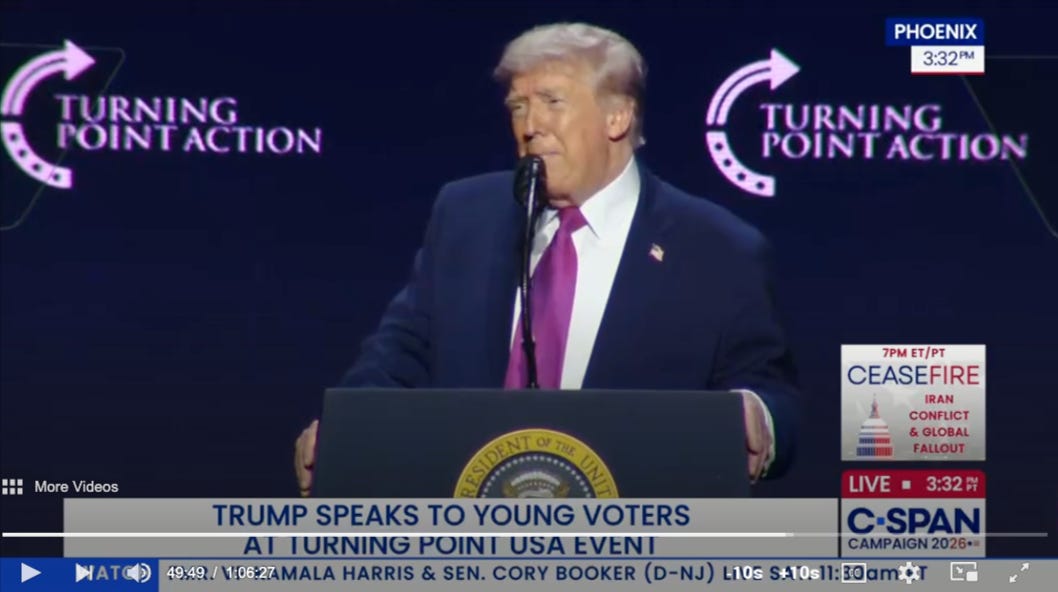
What we saw and heard was a sitting president standing on a church stage, announcing his next war target, before pivoting into white nationalist rhetoric. “They’re being persecuted in South Africa,” he said. “In South Africa there’s a very horrible thing going on. It’s a genocide. It’s a horrible thing. And we made it possible for these people to come into our country. They kill people if they’re white, if you’re a white person. And I’ll tell you what, I did great with the Black vote, the African American vote, and they understand this better than anybody. In South Africa they kill white farmers. And we said you come into our country and we let you come in. You get a green card and you get a passport.”
The claim he is repeating, that there is a “white genocide” happening in South Africa, is not just misleading. It is a well-established white nationalist conspiracy theory. It has been investigated and debunked by South African courts, by international human rights organizations, by journalists who have studied farm violence on the ground, and by the South African government itself. Farm attacks do occur, and they are tragic, but they happen across racial lines in a country with one of the highest overall violent crime rates in the world. White farmers are not being systematically targeted for extermination. Framing it that way is not an accident. It is one of the central pillars of the Great Replacement conspiracy theory, the same ideological framework that has fueled mass violence in places like Buffalo, Christchurch, and El Paso.
And the policy that follows that claim makes the intent even clearer. The refugee program has effectively been shut down for people fleeing documented, ongoing violence, Haitians, Afghans, Syrians, Sudanese, Rohingya. They are denied entry. But white South Africans are being offered a fast track, with green cards and passports. That is not a coincidence. It is not about safety. It is about race. And he said it out loud.
And then there is the line about Black voters, which may be one of the most revealing moments in the entire speech. “I did great with the Black vote, the African American vote, and they understand this better than anybody.” What he is claiming is that Black Americans agree with him that white people are being hunted in South Africa. There is no evidence for that. No polling supports it, no civil rights organization has said it, and no credible source has validated it. He is inventing an agreement that does not exist, and he is doing it for a reason.
Because this is one of the oldest tactics in American racism. You take a racist claim, and you try to legitimize it by saying the people it harms actually agree with you. It is a way of laundering the message so it feels safer to repeat. Jim Crow defenders did it. Apartheid defenders did it. Modern white nationalists still do it. The invocation itself is the strategy. It gives the audience permission to believe and repeat the conspiracy without having to confront what it actually is.
Trump’s new blueprint to hold onto power is already in overdrive, because he knows what is coming. He says it over and over again. “I was going to say that when a president wins, Republican or Democrat, for some reason they lose the midterms, often, most of the time. Doesn’t make sense. Even if you have a president who’s doing a good job… for some reason a president, Republican, Democrat, the party does poorly in the midterms. It doesn’t make sense. I’m still trying to figure it out.” And because he is starting to understand what all the signs are showing him, he keeps reverting to one of the most basic things authoritarians and fascist regimes do. One of the oldest demagogic maneuvers in politics is to offer simple solutions to complex problems. You find people who have been genuinely wronged by a system, and you tell them the people responsible are not the billionaires who took their wages, not the corporations that crushed their unions, not the politicians who deregulated the housing market, not the elites who engineered the debt trap. You tell them the people who wronged them are the ones below them. You point downward. You make them feel powerful by giving them someone they can still step on.
And he also played directly into that fear, insisting that the midterms are existential. He said Democrats would “drag America down, destroy our country, put it into crime poverty and squalor.” He said we would have become a third world nation if he had lost the election. He is right that the midterms are existential. He is just wrong about which direction the existential threat runs. The threat is not Democrats. The threat is his consolidation. The midterms are exactly as high-stakes as he is telling young voters they are. He just named the danger correctly and pointed in the wrong direction.
And last night, while Trump was preparing to fly to Phoenix, a Democrat named Analilia Mejia won a special election in New Jersey’s 11th Congressional District by roughly 20 points. A result that shows the pendulum continuing to swing.
That is not a fluke. That is a pattern. More people are showing up at the ballot box and saying no. And it is the loudest answer we have to everything he said on that stage today. The world is watching. Our allies are watching. They are asking, right now, whether America is still America, whether we are still the country they have relied on for seventy-seven years, whether they can count on us to do the right thing in the end. Every vote we cast is our answer. We are fighting. Do not give up on us yet.
Trump’s event today painted a picture of a country overrun by young people like the ones cheering for him at Dream City Church. And it would be a mistake to pretend that what happened in that room doesn’t matter. Those young voters were not born believing those things. They walked into a megachurch and were given a carefully built story about who they are, who they should fear, and who will protect them. And many of them accepted it, because it was designed to be accepted. It is dangerous, and we cannot afford to ignore it. But it is not the whole story.
Because last night in New Jersey, more people showed up and said no. And they are showing up all over the country in special elections, not because they were pulled in by spectacle or fear, but because they looked at what is happening and decided it was worth fighting.
The future of this country is not going to be decided by the young people who were in that room today. It is going to be decided by the young people who chose not to be there, the ones who still believe in what this country stands for and what it could be. The ones showing up to protest rallies, reminding each other that none of this is normal, and that we do not have to live like this. That is who will decide what comes next. And that is why I still have hope for America. And you should, too.
I’ll see you tomorrow,
Heather
PS. You can make a significant difference right now by subscribing to my Substack. Your support helps me cover more ground and keep telling the truth about the lies and destruction unfolding in this country.
This commentary represents my personal opinions and analysis of matters of public concern, informed by publicly available information. Any references to individuals constitute opinion and commentary protected under the First Amendment.
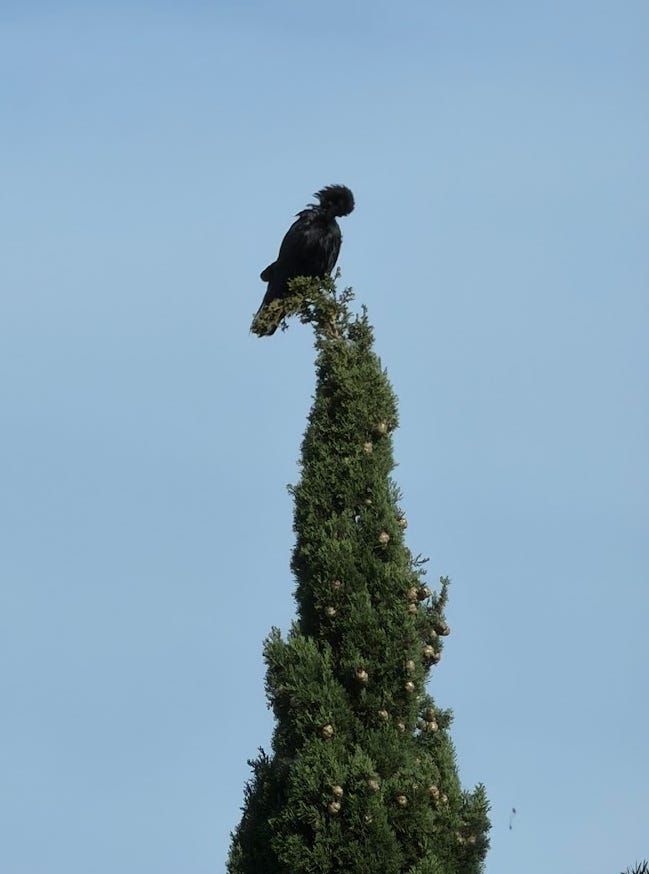
Picture of the day: This crow keeps visiting us on our walks. It looks very healthy, but always has feathers that look like it's in a punk rock band from the 80s or 90s.
Sources:
https://www.newsweek.com/trump-nato-help-rejected-hormuz-ceasefire-iran-talks-11846061
https://www.pbs.org/newshour/world/spain-closes-airspace-to-u-s-planes-involved-in-iran-war
https://www.nbcmiami.com/news/local/cuba/trump-says-a-new-dawn-for-cuba-is-coming-very-soon/3797577/
https://www.cnbc.com/2026/03/31/gas-oil-diesel-price-iran-war.html
https://www.cnn.com/2025/05/21/politics/fact-check-white-farmers-south-africa-trump
https://issafrica.org/iss-today/violent-crime-and-the-myth-of-south-africa-s-white-genocide
https://counciloncj.org/crime-trends-in-u-s-cities-year-end-2025-update/
https://www.npr.org/2025/12/24/nx-s1-5611466/2025-crime-trends-2026-predictions
https://www.cnn.com/2026/04/16/politics/new-jersey-special-election-analilia-mejia-joe-hathaway
https://www.nps.gov/articles/000/ulysses-s-grant-and-general-orders-no-11.htm
Great post. He's using the tactics of a protection racketeer. "You don't want your store burned down, do you? I can protect you if you give me a payment (vote) to insure that doesn't happen"
I can see how younger generations may fall for this speech - especially as books are being banned. Those of us who believe in freedom must find ways to reach young people not by arguing but with respect and reason. Movie makers, media, pop music, athletes, can really help at this dangerous time. I do not see this as a political issue because our lives are at stake. I have hope that at this time both parties will pool their energy to uphold our constitution by using the powers it affords.