

The President of the United States went missing again. After spending the night at the White House, his official schedule showed three meetings: an ambassador credentialing at 2 p.m., a policy meeting at 4 p.m., and another policy meeting at 5 p.m. Three separate opportunities for cameras to capture him performing the visible duties of the presidency, three predictable moments where he could have stood in front of flags, shaken hands, signed papers, and reassured the country that someone steady was at the helm. And yet we saw nothing. No photographs, footage, or brief remarks. This absence is not minor when it comes from a man who continues to demonstrate violent cognitive swings, shifting from brief flashes of alertness to struggling to keep his eyes open during meetings where the fate of not just this country but the world rests in his hands. We are talking about intelligence briefings that determine military posture, economic decisions that affect global markets, diplomatic calculations that could mean war or restraint, and he has repeatedly appeared unable to sustain focus long enough to project basic command of the moment.
This is a man who lives for the camera, who has never willingly stepped away from attention, who builds his days around being seen and praised. And yet, on a day with three scheduled events, there was silence. And then, this evening, almost as if someone realized people would start asking questions, a cryptic video appeared on Truth Social. Trump was seated at a desk in what looked like the Oval Office, wearing a freshly pressed navy suit, a bright red tie perfectly centered, flags behind him, framed photos positioned carefully to project stability. His mouth moved, but his eyes had that familiar vacant look, the expression of someone reading words rather than thinking them. He was marking the fifth anniversary of Rush Limbaugh’s death, but the delivery felt rambling and oddly flat. He described Limbaugh as “somebody that loved our country, loved his family, loved a lot of things,” a strange, hollow sentence that didn’t quite make sense. Even with what appeared to be a teleprompter in front of him, he seemed to struggle to keep a steady rhythm, drifting slightly off script in a way that suggested this took more effort than it should have.
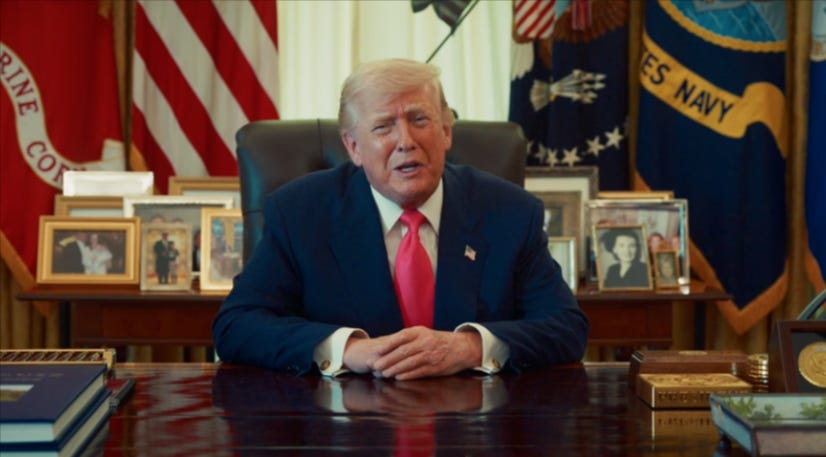
And then there were his hands, once again clasped together on the desk, his left hand placed deliberately over his right, covering it from public view. The same right hand that has appeared bruised so many times over the past year, often on a predictable schedule. The placement did not feel accidental, nor did it look natural. It looked careful and managed, as if someone had thought through exactly how it should appear on camera. That alone is enough to raise questions. And when you pair that with the repeated bruising, it inevitably lends credibility to the growing online chatter about recurring infusions or some form of undisclosed medical treatment. We cannot confirm that, but we also cannot ignore the pattern.
Which leads to the next question: when was this video actually filmed? It could have been recorded earlier today. It could have been recorded days ago. But the timing of its release tells us what matters. Three scheduled events where cameras would normally document his presence, followed by a single controlled recording distributed on his own platform, offered just enough visibility to quiet concern without actually answering the questions those concerns raise.
What we are witnessing follows a pattern that should not be dismissed. He rarely makes public appearances before lunch. Increasing portions of his calendar are closed to the press. Entire blocks of time are labeled vaguely as “policy” with no documentation or imagery attached. This resembles what has occurred in other governments when leaders begin to experience serious medical decline, and public exposure had to be rationed carefully. And in those situations, appearances do not disappear entirely; they are simply controlled. And the rest of the time, his schedule shows days that look full on paper, but in reality may be filled with him sitting in a room in front of a television, where his energy can be rationed, with staff planning around stamina instead of strategy so that when the next appearance happens, there is just enough clarity left to project steadiness, even if only for a short stretch before retreating behind closed doors again.
This is eerily familiar to what happened in the final years of the Soviet Union, when Leonid Brezhnev, followed by Yuri Andropov and Konstantin Chernenko, were all visibly declining while the state continued to function as if nothing was wrong. Public appearances did not stop entirely. They were staged, carefully timed, and tightly controlled. The leaders would disappear for long stretches, and when they resurfaced, they were medicated, propped up, and clearly diminished. The Politburo managed the calendar, controlled the cameras, and reassured the public that stability remained intact. Meanwhile, real authority was shifting quietly behind closed doors. Decisions were being made by those with access and influence, not necessarily by the man whose name was still attached to the office. The image of leadership remained visible, while the actual center of power moved elsewhere.
In Francisco Franco’s final years, Spain followed a similar pattern. Franco was kept alive through extraordinary medical intervention while loyalists governed in his name, preserving the illusion of continuity because the regime depended on it. His portrait still hung on the wall. But the country was being operated by insiders who understood that the man himself was no longer capable of leading. The performance of leadership became more important than leadership itself, because acknowledging weakness would have destabilized the entire tower of power built around him.
And none of this is random. It is part of the playbook. This is how authoritarian systems operate when the man at the center begins to weaken. Whether Trump fully understands that playbook or not is almost irrelevant. It is the same instinct authoritarian regimes have always relied on: preserve the figurehead, protect the power structure behind him, and never admit weakness, because the moment weakness is acknowledged, the entire illusion begins to crack. And that is where the real concern begins.
Because hiding a declining president is only one piece of what they are building. The same machinery being used to control his image is being deployed to control what the rest of us are allowed to see, hear, and know. The censorship is not a separate issue. It is the same project. And it is accelerating. CBS blocked an interview between Stephen Colbert and James Talarico, a Democratic candidate running for Senate in Texas. The network’s lawyers cited FCC equal-time rules that were updated under the Trump administration. Traditionally, those rules require broadcast networks to give comparable access to political candidates in certain formal contexts, like news programming or paid campaign ads, to prevent one candidate from dominating public airwaves. But they have never applied to late-night talk shows or entertainment interviews. Candidates from both parties have appeared on those programs for decades without triggering equal-time obligations.
What changed is how the rule is being interpreted. Under Brendan Carr’s FCC, regulatory language is now being stretched to cover spaces it was never meant to govern. That shift matters, especially in the middle of an election cycle. When a regulatory body expands its authority in a way that conveniently benefits one candidate, it stops looking like neutral oversight and starts looking like political pressure.
The interview was eventually posted on YouTube, where it surpassed a million views within hours. James Talarico shared a clip and called it “the interview Donald Trump didn’t want you to see.” He wasn’t exaggerating. When broadcast pressure keeps something off television but it immediately explodes online, it reveals the effort for what it is: not compliance, but control.
And let’s be honest about why that matters. Talarico represents Texas, a state where Trump’s political dominance depends on tightly controlling the information environment and limiting exposure to credible opposition voices. Putting him on a national late-night stage would have introduced millions of viewers to what competent, thoughtful representation in Congress actually looks like. That kind of contrast is dangerous for an administration that thrives on caricature and distraction. When voters are allowed to see alternatives clearly, they start asking harder questions.
If I lived in Texas, I would be furious. Because this is not about protecting fairness. It is about limiting what Texans are allowed to see and hear about candidates who are running in elections that will directly shape their lives. It is about gatekeeping access to information so that the playing field never truly levels. The message embedded in that decision is unmistakable: we do not trust you with the full picture, so we will curate it for you.
This is exactly what happened in Turkey under Erdoğan. Media outlets that criticized the regime were not shut down for being opposition. They were shut down for “regulatory violations.” They lost broadcast licenses over technicalities that had nothing to do with the actual content of their reporting. The effect was identical: silence without the political cost of admitting you silenced anyone. Under Chávez in Venezuela, independent stations were denied renewal and forced off the air for similar reasons. One by one, critical voices disappeared from the airwaves. Not because they were banned outright, but because the rules themselves were turned into weapons. That is what is beginning here.
And CBS is not just complicit in this; it is becoming a case study in how quickly an institution can hollow itself out from the inside. Anderson Cooper announced this week that he is leaving 60 Minutes after nearly two decades, choosing not to renew his contract. That decision matters. Cooper has built his career on going toward the hard stories, the uncomfortable stories, the places where power would prefer not to be examined. He is not someone who walks away lightly. So when a journalist with that kind of tenure and reputation steps back from a program that once represented the gold standard of American investigative reporting, it signals something deeper than a routine career move. 60 Minutes was not just another news show. For millions of Americans, especially those who do not live online, it was where they encountered the deeper story. It was where policy became human, and corruption had faces. Where complex issues were given time and weight instead of being compressed into a ninety-second segment between commercials. It reached living rooms across generations, and it shaped how people understood the world.
Institutions do not collapse overnight. They erode with compromise. They justify small decisions in the name of survival until one day the thing that made them trusted in the first place is barely recognizable. The journalists with integrity see that shift first. And when they leave, it is rarely random.
And that is why my biggest concern remains the threat to the free flow of information. If we lose that, we lose the ability to distinguish truth from narrative, and once that line blurs, truly free and fair elections become impossible. Democracies do not collapse only through force. They collapse when citizens are systematically cut off from reliable information and fed a steady diet of distortion instead.
We cannot let that happen. Which means we are going to have to get creative about how information is shared, amplified, and protected, especially among communities that are hardest to reach and most heavily targeted by propaganda. It means building parallel channels when traditional ones are compromised. It means having uncomfortable conversations and refusing to let algorithms decide what our neighbors are allowed to see. And it is going to take all of us to protect this space, to safeguard the flow of facts before it narrows any further.
This is exactly why supporting independent media and independent voices is no longer optional. It’s essential. We must make sure they have the financial backing to continue to do the work they do, even under growing pressure from the Trump Regime.
I know that there are a lot of reasons to be very concerned about the future of our country, and it would be easy to shut down, to feel overwhelmed by the constant stream of chaos and cruelty, and just go numb. That is part of the strategy, to overload and exhaust us. To make it all feel too big to confront. But we have to keep pushing through, no matter how much they throw at us. We need to brace for the coming months as their desperation grows and their attacks increase. And we also need to take strength and encouragement from the wins. Because they, too, are growing. I used to struggle to find good news to share with you each night. But lately, I struggle to pick just one.
Just today, we learned that the Department of Homeland Security spokesperson, Tricia McLaughlin, is leaving amid what the Wall Street Journal described as “constant chaos.” When officials begin quietly retiring, resigning, or slipping out the back door, it is rarely random. It signals they can feel the shift, too. Many of them can no longer deny that they are on a sinking ship without a life vest, so they are jumping off before it all goes down. And the signal is even stronger if the departures we are seeing are not of their own choosing. Because the one thing Trump has been very careful to do is not fire loyalists who were chosen specifically to carry out this regime’s agenda. He knows what happens when firings create headlines and bad blood; they boomerang back onto him. So these exits mean something, no matter how they happened. Public pressure is working.
Is victory guaranteed? Absolutely not. That is precisely why we have to stay strong in our pushback. We have proven to ourselves and to each other that we are not stopping. We have been at this for over a year now, and not only have we not fallen for the propaganda, but we are getting louder in spreading the truth and demanding better for ourselves, our children, and our grandchildren. That is why I still have hope for America. And you should, too.
I’ll see you tomorrow,
Heather
PS. You can make a significant difference right now by subscribing to my Substack. Your support helps me cover more ground and keep telling the truth about the lies and destruction unfolding in this country.
This commentary represents my personal opinions and analysis of matters of public concern, informed by publicly available information. Any references to individuals constitute opinion and commentary protected under the First Amendment.
Hmm, so you are saying that we are being led by a mannequin? The greatest country in the world. On the 250th anniversary of us. And we are being lead by a stuffed suit? Well, we already knew he was an empty vessel while he was still functional. So my question is, since there have been regulations (epa) that have been devastated in his name, by equally unscrupulous back benchers, I hope that some of those most important laws can be reinstated after he’s actually been revealed as a mannequin.
When was the last time T**** was seen golfing?