


Yesterday, right as negotiations with our closest ally were collapsing, Donald Trump appeared to have no cares in the world as he posed for glamour shots for his new presidential headshots. In a compilation video posted by “TeamTrump” on social media, the President of the United States wrapped himself around an American flag, pressed a finger against his temple, stared intensely down at a table, and leaned forward with both fists clenched as if he was forcing a bowel movement while a photographer captured him in these different poses and from different angles. Across the video were the words, “Nobody has more aura than President Trump.” The caption underneath asked, “How does he do it?🤣📸”
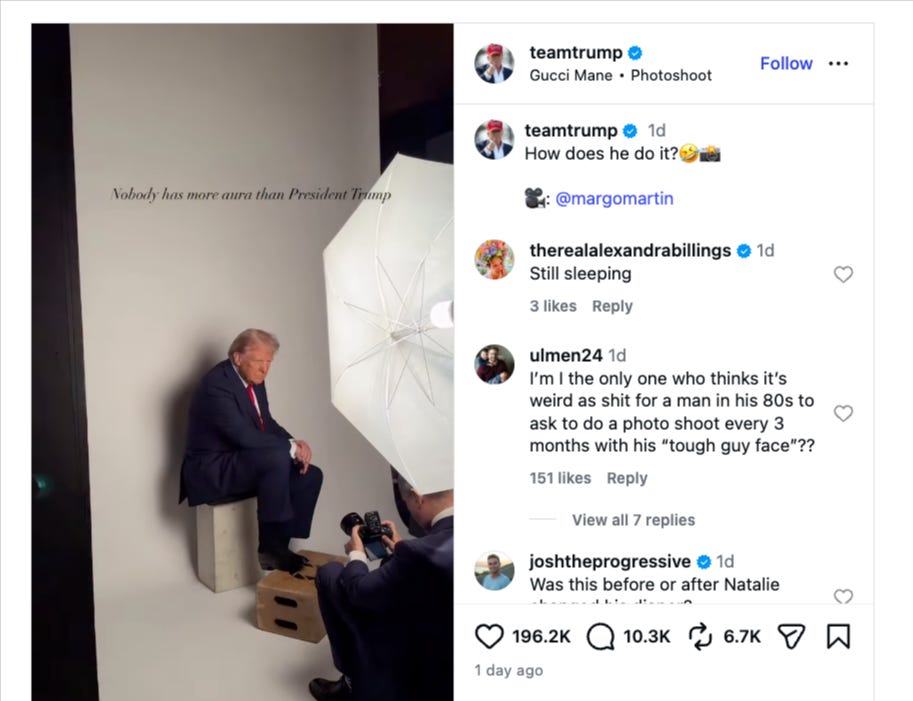


The soundtrack they chose made it even stranger. TeamTrump set the video to Gucci Mane’s “Photoshoot,” a song centered around projecting an image of wealth, status, and power. And maybe that is what makes the entire thing feel so unsettling, because the post itself was centered around projection, too. Not necessarily reality. While one of our closest allies was trying to determine whether the United States could still be trusted to keep its word, the president’s team was busy producing and posting a music video trying to make Donald Trump look powerful.
Around the time that video was posted, the relationship between the United States and Canada had hit its breaking point. Negotiations had collapsed, and Canadian Prime Minister Mark Carney released a devastating late-night statement announcing that he had suspended trade talks and ordered Canada’s negotiators home. “This evening, I have decided to suspend trade negotiations with the U.S. and have directed Canada’s negotiators to return to Ottawa,” Carney said. But how he ended the statement was the really damning part: “Last minute changes in the U.S. proposed terms were unfair, uneconomic, and called into question the reliability of any deal.”
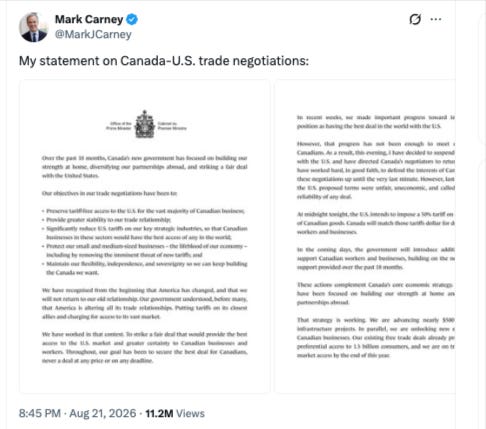
One of our closest geographic, economic, and strategic allies just told the world, in pretty direct language, that the word of the President of the United States cannot be trusted. That even after his government spends days negotiating an agreement, there is no guarantee Donald Trump would even honor it. What he said, and what just happened, is much bigger than tariffs or one failed round of negotiations. It was the confirmation of what we have known since Trump took back office. The word of the United States no longer means what it used to. In fact, it means almost the opposite of what it used to. And now every ally, trading partner, and every government negotiating with us will start asking the same dangerous question Canada just did: Does an agreement with America actually mean anything anymore? Does our word, or our promise, carry any weight at all?
And the answer, based on everything that happened in the last 24 hours, is no. It does not. By midnight on Friday, 50 percent tariffs had taken effect on roughly $20 billion USD worth of Canadian goods. Not just on steel or aluminum, but also on dairy, cement, furniture, building materials, plastics, agricultural products, and so much more. These are the kinds of goods that touch the daily lives of people on both sides of the border. And they were imposed under Section 338 of the Tariff Act of 1930, a provision so old and so extreme that no president in nearly a century had ever used it. That law, better known as Smoot-Hawley, is the one economists and historians have widely blamed for worsening the Great Depression. That is the “tool” Donald Trump reached for against our closest neighbor.
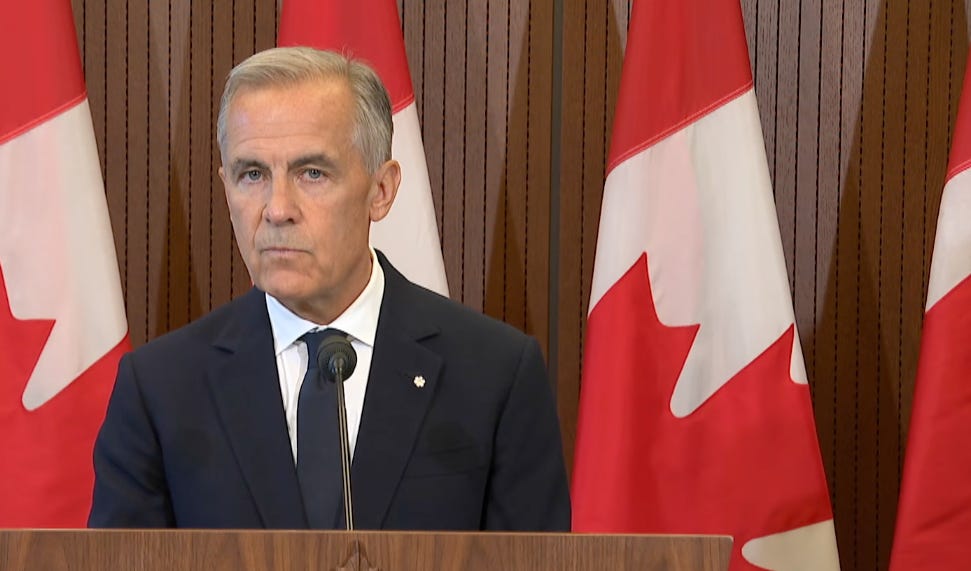
By Saturday morning, Mark Carney was standing at a podium in Ottawa, with his trade minister and chief negotiator by his side. Both were described as stoic and exhausted. He was somber, direct, and calmly furious. “We were attacked,” he said. When a reporter asked why it felt like Canada was going to war, Carney added, “Because we were attacked. You’re at war when you get attacked. We got attacked.”
But it was what he said next that really captured how much damage Trump has done to our relationship with Canada, and to the credibility of the United States itself. “We’ve long understood that the U.S. would use economic integration as a weapon,” Carney said. “We recognize that sometimes its signature was written in pencil.”
What Carney was saying was pretty simple. Canada no longer believes it can trust the United States to keep its word. A deal can be negotiated, agreed to, and signed, and Trump can still change the terms whenever he wants. That is what he meant when he said our signature is written in pencil. Nothing is permanent anymore. Our promises can and have been broken on the whim of Donald Trump. And our closest allies are now planning for a world where they can no longer count on us.
And then he said this: “We set our own course. We make our own weather.” That is the sound of an ally walking away. Not temporarily or as a negotiating tactic, actually walking away because they no longer believe they can depend on us. And once a country like Canada starts rebuilding its supply chains, redirecting its trade corridors, and finding new trading partners outside the United States, much of that doesn’t just reverse itself when the next president shows up with better manners. Those new relationships take root, and the influence that used to flow through the American economy starts flowing somewhere else. To Europe, Asia, and across the Pacific, even to China. We aren’t just hurting an ally. We are helping an adversary grow even stronger.
That is the part of this story that far too few people are talking about. What Trump is doing is not just repulsive, he is strategically destroying one of the most important advantages America has spent generations building. For decades, the United States held an extraordinary position in the world, not just because of the size of our military or economy, but because other countries needed us and knew they could depend on us. Canada sends the vast majority of its exports to the United States. That kind of economic interdependence is not just a trade statistic. It is a relationship, and it is also leverage. It gives both countries a reason to work together. We cooperate on border security, and we share intelligence. We coordinate on defense and stand together on foreign policy because our futures are deeply connected. When two countries are that intertwined, there is a built-in reason to resolve disputes, compromise, and be good neighbors. And without saying that this imbalance is inherently good or bad, being needed has also given the United States an enormous amount of influence. When that influence is used responsibly, it benefits us in ways that tariffs never could. To be needed is power. To be trusted with that power is something even more valuable. There is a reason to get along. And that stability benefits both of us.
But Trump does not see interdependence as strength. He sees it as weakness. He sees a good relationship as something to exploit, not something to protect. He sees a neighbor willing to negotiate as a target, not a partner. And so he bullies and threatens them. He changes terms at the last minute. He treats the most consequential economic relationship in the Western Hemisphere like a shakedown. And then, when the other side finally says enough, he acts like they are the ones being unreasonable.
And what makes this even more dangerous is that presidents are not supposed to make decisions like this alone. They are surrounded by economists, trade experts, diplomats, national security officials, and career professionals whose entire job is to understand the consequences of decisions before they are made. But Trump has spent years attacking expertise, pushing out people who challenge him, and surrounding himself with people willing to tell him what he wants to hear. So we are left with an increasingly isolated president making enormously complicated economic decisions based on his own deeply flawed understanding of how trade and power actually work, while many of the people who should be stopping him are either gone, ignored, or too afraid to tell him no.
While Carney was standing at that podium telling the world that Canada could no longer depend on the United States, we learned something else. On Wednesday night, just two days before the negotiations collapsed, Vice President J.D. Vance was at a private fundraiser in Southampton, New York. Leaked audio obtained by The Canadian Press captured him mocking Canada’s democratically elected leaders. He called Prime Minister Carney “a very sweet guy” and dismissed Conservative leader Pierre Poilievre as “this guy Pierre Poilievre or something,” calling him “a non-entity.” He bragged about his longtime Yale friendship with Conservative MP Jamil Jivani, saying Jivani had been “quietly inserting himself” into the negotiations. And Vance admitted that he had been more involved than usual in negotiations with Canada because of that personal relationship. That is who is running things.
Donald Trump is drawn to the people who threaten and intimidate, while treating the countries that have stood beside us for generations like they are weak enough to abuse. Vladimir Putin threatens nuclear escalation and gets invited onto an American airbase. Kim Jong Un launches missiles and gets love letters. Viktor Orbán dismantles democratic institutions and gets called “a true friend, a winner, a fighter.” But Canada, the country that took in 6,500 stranded passengers on September 11, that fought beside us in two world wars, that shares the longest undefended border on earth, gets tariffs, mockery, and a Vice President laughing about them at a cocktail party in the Hamptons. We did not lose an ally, Donald Trump threw one away.
Ontario Premier Doug Ford, a conservative, said he was glad the deal fell through. “It was a bad deal for Ontario. It was a bad deal for the auto sector, the steel sector, and manufacturing sector.” He backed Carney without hesitation: “Tariff for tariff. Dollar for dollar.” And when asked about fighting back, he said, “We never started this fight, but I can assure we’re going to win this fight.”
Carney and Ford are from different parties. They do not agree on quite a lot of things. But in this moment, they are standing together. Because this is not about politics in Canada anymore. It is about sovereignty, dignity, and most importantly about whether a country will allow itself to be bullied into submission by a deteriorating and hollow man. What Trump did, which will end up hurting him more than he can even imagine, is that he united much of Canada together against a shared enemy.
I’ve felt what I can only describe as ill all day. Not the kind that comes from a virus or an injury, but the kind that makes you want to crawl out of your own skin because everything about the moment feels wrong. I find myself actually hoping other countries push back against my own. Quietly cheering when Canada draws a line. Feeling relieved when Europe diversifies, when our allies stand up to Trump. And I hate that. I hate even writing those words. Because I love this country deeply. I love what America is supposed to be, and I still believe in what it can be again. I want us to be the country our friends trust, the country people want standing beside them, the country whose word means something. I want America to succeed and to prosper. I want my children and future grandchildren to inherit a country they are proud to call home. And it breaks my heart to realize that, at least for now, wanting those things may require hoping the rest of the world refuses to cooperate with what our government has become.
Maybe one of the hardest parts of loving a country is accepting that sometimes things have to get worse before they can get better. That protecting America does not always mean defending what America is doing. Sometimes it means wanting the people abusing its power to fail, and it means accepting consequences we desperately wish we could avoid because allowing this to continue unchecked would cost us so much more in the end. Maybe that is part of what true patriotism actually is. Not blindly cheering for our country no matter what it does, and not pretending that harming other countries somehow makes ours stronger. It is loving America enough to want it stopped when it is doing something wrong. Loving it enough to endure the humiliation of watching our allies stand up to us because we know they should. And loving it enough to believe that even after everything Trump has broken, we can still become a country worthy of their trust again.
Every summer for years now, my family has traveled to British Columbia. It became one of our traditions, something my daughters looked forward to all year. We spend time going for long walks, visiting the same small coffee shops, breathing in the air, and just slowing down. And over the years, it has started to feel like a second home. A place we all love.
Last year, when Trump was in the middle of his 51st state nonsense, I nearly canceled the trip. I wasn’t worried that Canadians would be unwelcoming. I would have understood if they were. But I almost canceled because I felt embarrassed. It felt wrong to cross their border as an American tourist, smiling and enjoying their beautiful country, while the president of mine was publicly threatening to conquer it, treating their sovereignty like some kind of joke. But Canadians friends encouraged us to come. They told us the people we see every year would be happy to have us back, and reminded us that these communities depend on tourism. So we went, and we had an amazing time.
But we also had conversations that were very different from the ones we had in years before. We spent hours talking with Canadians about the rise of their own far right, “Maple MAGA,” and about the deep and growing anger toward Donald Trump and what he was doing to the relationship between our countries. What struck me most was that their anger wasn’t really directed at us. They understood the difference between the American people and the man occupying the White House. There was still warmth there and friendship. Still this sense that whatever insanity was happening politically, the relationship between ordinary Americans and Canadians was bigger than Donald Trump.
This year was different. My daughter started school this past week, and for the first summer since 2020, we did not go. Part of it was practical. With the midterms right around the corner, I didn’t feel like I had the time to spare. The research and writing take nearly all day now, often stretching into the early morning hours. But part of it was something harder to explain, and maybe harder to admit. I am not comfortable leaving the country right now and coming back in. That is a sentence I never imagined writing as an American citizen. But that is where we are.
The White House has fallen. Not to an enemy or to a siege. What took it down was vanity and corruption. It fell to a man who turned the Rose Garden into a version of his private club, demolished the East Wing for a ballroom, and spent one of the most critical weeks of trade negotiations in recent memory showing off a granite helipad and signed a piece of it like he was giving out autographs to fans. The White House may still be standing, but so much of what it was supposed to represent is gone. There is almost nothing recognizable left of the American presidency.
To my Canadian readers, please know that I have seen your messages. I feel your pain and your rage. I want you to know that millions of Americans are watching what your country just did with admiration, not resentment. When your prime minister stood at that podium and said, “we were attacked,” he was telling the truth. When he called the terms unfair, he was right. And when your country chose dignity over submission, you reminded us what it looks like when a government stands up for its people.
I can only imagine what the last year and a half has felt like for you. You deserved better. And someday, when this is over, I hope we have the opportunity to earn back some of the trust he has destroyed not just with you all in Canada, but the entire world. Please do not give up on us yet. We have not given up on ourselves.
We may not be able to undo every contract that moves somewhere else or immediately rebuild every relationship Trump has broken. Trust does not just come back because we ask for it. We will have to earn it. But first we have to show the world that there are still enough of us here who understand what America is supposed to stand for, and who are willing to fight to become that country again. We have that opportunity in November, and we are going to use it. That is why I still have hope for America. And you should, too.
I’ll see you tomorrow,
Heather
PS. You can make a significant difference right now by subscribing to my Substack. Your support helps me cover more ground and keep telling the truth about the lies and destruction unfolding in this country.
This commentary represents my personal opinions and analysis of matters of public concern, informed by publicly available information. Any references to individuals constitute opinion and commentary protected under the First Amendment.
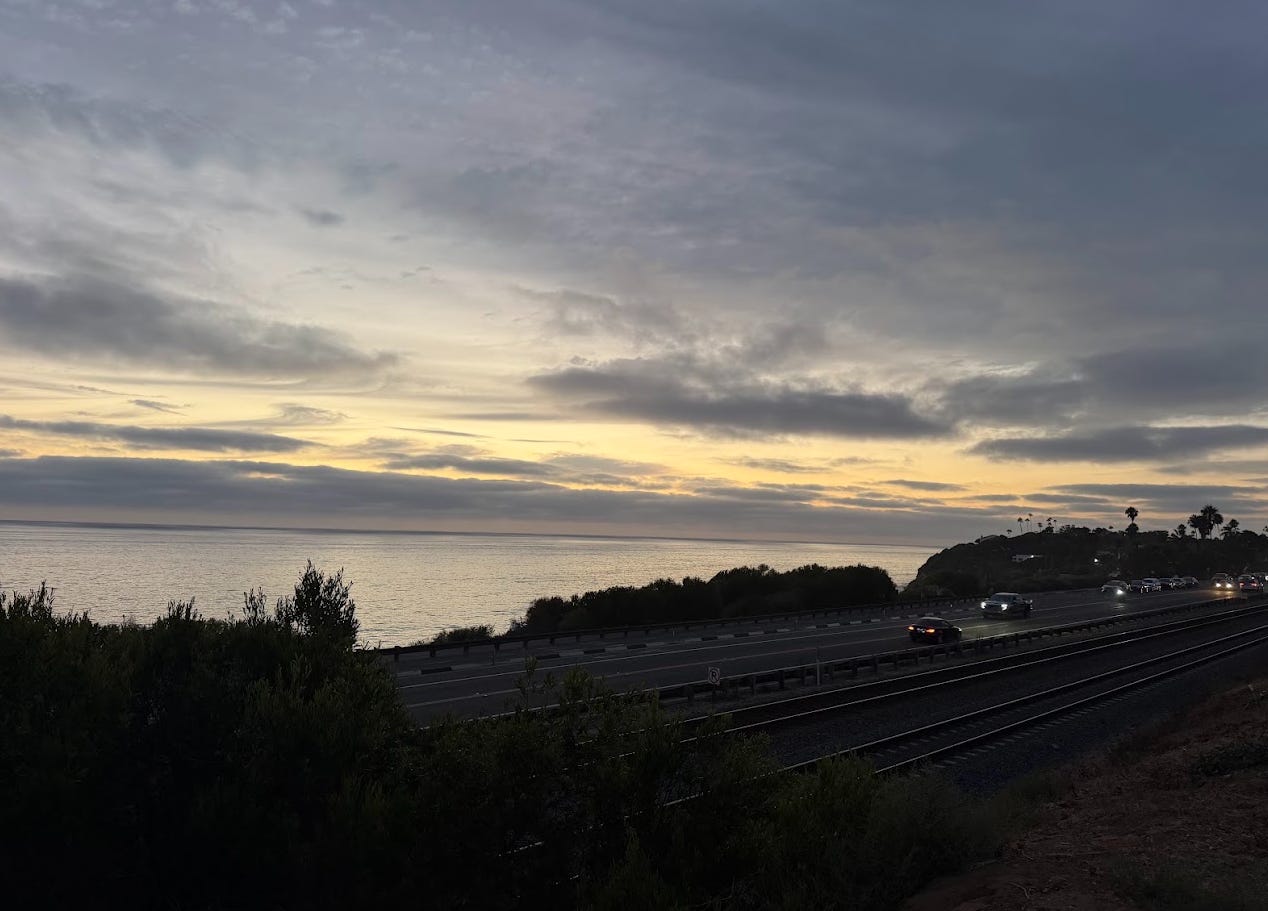
Picture of the day: Loving these late summer night sunsets. This picture doesn’t do it justice.
Sources used in the writing of this post:
FULL SPEECH | Carney explains why Canada suspended trade talks with U.S.: YouTube Video
https://www.npr.org/2026/08/22/nx-s1-5941584/us-canada-tariffs
Heather, you are great! Your relentless, considered commentary together with your source links are outstanding. Thank you for your work, and your commitment to your country.
Well, trump IS a pathological liar and CAN’T be trusted, we know that, so- good on you, Canada. 💕