

At 10:34 Eastern Time this morning, the Supreme Court released one of the most consequential constitutional decisions of our lifetime. For months, America had been waiting to see whether one of the oldest promises in our Constitution would survive, or whether Donald Trump’s Supreme Court would give in to his demands and fundamentally rewrite who gets to be an American.
For nearly two hours after the ruling came down, Donald Trump was nowhere to be found. His schedule was closed to the press. There were no cameras. No remarks about it. For a man who has spent years demanding an end to birthright citizenship, and who rarely misses an opportunity to attack after a political loss, that silence spoke volumes.
Then, at 12:23 p.m., he finally broke his silence, posting on Truth Social: “The Supreme Court upheld Birthright Citizenship, which is too bad for our Country, but we can easily make it up in Congress through Legislation, with the support of the President, that has now been determined during this process. No long and unwieldy Constitutional Amendment is necessary! Congress should start TODAY to work on ending expensive and unfair to our Country, Birthright Citizenship. They will have my Complete and Total Support! President DONALD J. TRUMP”
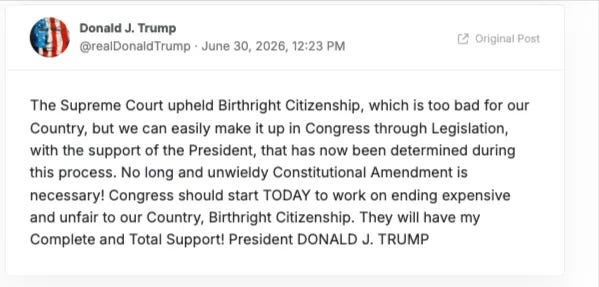

Followed nearly an hour later by, “I would like to congratulate President Xi, and the Great Country of China, on their massive Birthright Citizenship WIN! President DONALD J. TRUMP”
In just those few sentences, Donald Trump told us exactly how he views the Constitution. It isn’t the highest law of the land to him; it’s just an obstacle to get around. Five justices had just ruled that birthright citizenship is protected by the Fourteenth Amendment, and hours later he was telling the country Congress could simply overrule them with ordinary legislation. This was the President of the United States announcing that if the Constitution stands in the way of what he wants, then the Constitution doesn’t matter anyway. Because in Donald Trump’s mind, there is no law higher than Donald Trump.
The ruling itself was clear. Chief Justice John Roberts, writing for the majority, traced birthright citizenship from the English common law through the founding era, through the abolitionists, through the ratification of the Fourteenth Amendment, and arrived at a conclusion that should have surprised no one. “Citizenship, then and now, was the right to have rights, to freely participate in our political community,” Roberts wrote. “The Framers of the Fourteenth Amendment extended that promise to every free-born person in this land. We keep that promise today.” The court affirmed its own landmark ruling from 1898, United States v. Wong Kim Ark, which held that a man born in San Francisco to Chinese immigrants was a citizen by birth. For 128 years, it was settled.
Today, three justices said it should not be. Justice Clarence Thomas wrote a 91-page dissent arguing that the Fourteenth Amendment was only ever intended to apply to freed slaves and their descendants. Justice Samuel Alito called the majority ruling “a serious mistake” and said it saddles the country with what he called a “medieval rule” that even the United Kingdom has abandoned. Justice Neil Gorsuch joined both of their dissents. And then there was Justice Brett Kavanaugh, who voted to strike down Trump’s executive order but refused to join Roberts on the constitutional question. Kavanaugh wrote that the order violated a federal statute, not the Constitution, and that Congress could, consistent with the Fourteenth Amendment, pass new legislation creating exceptions to birthright citizenship. That means on the question that actually matters, whether the Constitution itself protects birthright citizenship, the vote was five to four.
One vote was the difference between every child born in this country being an American and a president deciding which ones count. The Fourteenth Amendment is not ambiguous. It does not require creative interpretation. It says that all persons born in the United States, and subject to the jurisdiction thereof, are citizens of the United States. That language was chosen deliberately by people who had just fought a civil war over who counts as a human being in this country. They wrote it broadly on purpose, rejecting every attempt to narrow it, because they understood that the whole point of the amendment was to make citizenship something that could never again be taken away by the powerful from the vulnerable. And yet four sitting justices looked at those words and said they do not mean what they say. Justice Jackson, in her concurrence, responded to Thomas directly, pointing out that despite his longstanding endorsement of a colorblind Constitution, he was now arguing that the Citizenship Clause was a race-conscious remedial measure that applied only to one group of people. Roberts himself noted that the arguments embraced by the dissenters are the same ones the losing side made in 1898, writing that “this view commanded only a dissent” then, “and neither time nor circumstance has changed the fact it is not the law.”
But here is what should trouble all of us. The next time this question comes before the court, it only takes one justice changing sides. One retirement. One appointment. One shift. Kavanaugh has already written the roadmap. He told Congress exactly how to do it. He told them they could pass a statute, and he would uphold it.
And right before that ruling, the Supreme Court handed down another one that will reshape the next election and every election after it. In a six to three decision along ideological lines, the court struck down federal limits on how much political parties can spend in coordination with their own candidates, overturning restrictions that have been in place since the Watergate era. The case was originally brought by the National Republican Senatorial Committee, the National Republican Congressional Committee, and J.D. Vance, who was then a Senate candidate. Justice Kavanaugh wrote the majority opinion. Justice Kagan, in dissent, warned that with no limits on coordinated expenditures, a party can essentially serve as a candidate’s personal checking account, allowing donors to funnel up to $500,000 to political campaigns through the party, far exceeding the $7,000 limit on direct contributions to individual candidates.
Trump’s response was immediate. At 10:56 a.m., he posted: “The Supreme Court just took restrictions off political spending! A BIG WIN FOR REPUBLICANS and, more importantly, The First Amendment! President DONALD J. TRUMP”

So on the same morning, the same president who told the country the Supreme Court does not matter when it ruled against him turned around and celebrated the court when it ruled in his favor. The Constitution is an obstacle when it protects the citizenship of immigrant children. The First Amendment is sacred when it opens the floodgates for Republican donors. And the timing of this ruling is important. Republicans entered this election year with a massive cash-on-hand advantage over Democrats. They hold the House by five seats. And the court just removed one of the last structural limits on how much money can be poured into defending those five seats.
It’s long been reported that Vice President J.D. Vance rose politically due to the financial backing of Peter Thiel, the billionaire tech investor whose name appears in the Epstein files and whose company Palantir powers ICE and government surveillance. Vance has never hidden his ambition to be the heir to the MAGA throne, and Thiel has never hidden his ambition to reshape the American political system to serve the interests of a small group of men with enormous wealth. This was their project. It took four years to reach the Supreme Court, which tells you how far back the planning goes and how deliberate the execution has been. There is a network of people who have spent years building the legal, financial, and political infrastructure for what we are watching unfold right now, and this ruling was one of the biggest levers they were waiting to pull.
To understand why, we have to go back to how the money used to work and what just changed. Under the old rules, an individual donor could give a maximum of $7,000 directly to a candidate’s campaign. They could also give larger amounts to national party committees, but those committees faced strict limits on how much they could spend in coordination with the candidate, meaning working together on messaging, strategy, and ad placement. The party could still spend unlimited money on a candidate’s behalf independently, but independent spending is inherently less effective because the campaign and the party cannot talk to each other about how to use it. The candidate runs one message and the party might run a different one, and neither side can pick up the phone to fix it. That inefficiency was the point. It was the guardrail. It meant that even though massive sums of money were flowing into politics after Citizens United, there was still a wall between the biggest donors and the candidates themselves.
That wall is gone now. After today’s ruling, a national party committee can spend unlimited amounts in direct coordination with its candidates. A single donor can give hundreds of thousands of dollars through the party, and the party and the candidate can sit in the same room, design the same ads, target the same voters, and deploy that money together as if the contribution limits do not exist. We saw in 2024 what unlimited outside money could do even when it could not be coordinated. Groups like MAGA Inc. spent hundreds of millions on Trump’s behalf, and that flood of cash was one of the major reasons he won. Now imagine that same flood of money, but with the candidate directing every dollar of it. That is what this ruling just made legal.
We are a country of slim margins right now. Not just with the Fourteenth Amendment holding on by a single vote on the constitutional question, but also with the war in Iran. Trump’s schedule was closed to the press for the entire day, even with three landmark Supreme Court rulings that were dropped. The Wall Street Journal reported that this might have had something to do with Trump having held multiple conversations in recent days with Secretary of Defense Pete Hegseth and Chairman of the Joint Chiefs of Staff General Dan Caine about returning to all-out war with Iran. The conversations, according to U.S. officials, centered on whether Washington should abandon negotiations and resume full-scale attacks, what some officials described as “finishing the job.” The Journal reported that Trump decided to stick with diplomatic talks for now. But the reporting also noted something that deserves more attention: some officials acknowledged that resuming the conflict would be a tacit admission that the much-touted Iran deal failed.
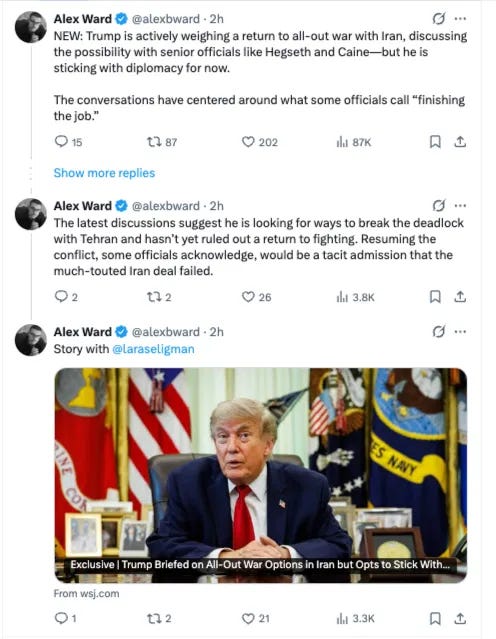
That is the part he cannot admit and doesn’t want to be asked about. The deal he signed was supposed to be the triumph. The dealmaker’s masterpiece. And it is falling apart. Iran’s chief negotiator said today that Tehran will not enter into any further negotiations until the terms of the memorandum of understanding are implemented. The United Kingdom raised its maritime security threat level for the Strait of Hormuz to “substantial.” The deal is not working. And the man who built his entire political identity on being the world’s greatest negotiator is now sitting behind closed doors, hidden from the press, weighing whether to send Americans back to war because his negotiation failed.
I hope that he stays with diplomacy. I hope that whatever is said in those rooms leads to a path that does not cost more American lives. But I do not think we are in a place anymore where we can pretend that the timing of any military decision this president makes is separate from his political survival. And the reason I say that is because Donald Trump himself told us so.
In November 2011, Trump posted on Twitter: “In order to get elected, @BarackObama will start a war with Iran.” In a video blog that same month, he said: “Our president will start a war with Iran because he has absolutely no ability to negotiate. He’s weak and he’s ineffective. So the only way he figures that he’s going to get reelected, and as sure as you’re sitting there, is to start a war with Iran.” He did not stop there. Throughout 2012, he kept going. On Fox News, he said: “I think Obama will go to war with Iran because I think he views it as good politically. I think he views that as a positive from a political standpoint, and I think he’s just waiting for the right moment.” In October 2012, as Obama’s poll numbers dipped, Trump wrote: “Now that Obama’s poll numbers are in tailspin, watch for him to launch a strike in Libya or Iran. He is desperate.” And then a warning to his own party: “Don’t let Obama play the Iran card in order to start a war in order to get elected, be careful Republicans!”
He described it all. The desperation. The inability to negotiate. The political calculation. The willingness to wait for the right moment. The willingness to waste lives for political survival. He told us not what Obama would do, but what he would do. And he has already started when he first launched his military actions. He wrote his own playbook. The midterms are four months away. And he is considering exactly what he said Obama would do but didn’t.
Whether that escalation comes as a calculated October surprise, or as a desperate reaction to collapsing negotiations, or as a manufactured justification for emergency powers, or not at all, I do not know. I hope it does not happen. But we have to be honest about where we are. This is a president who has shown us, in his own words, that he believes a war can be timed to an election. And he is now in the exact position he once described: desperate, declining, unable to negotiate, and watching his numbers fall.
And while he was behind those closed doors today, the U.S. Office of Government Ethics released his annual financial disclosure. It is 927 pages long. For context, Barack Obama’s final disclosure was eight pages. Joe Biden’s was eleven. Donald Trump’s is 927.
In a single year, Trump reported nearly $1.2 billion in revenue from cryptocurrency ventures alone. He collected $635 million in royalties from the $TRUMP meme coin, a token he launched three days before taking office that has no utility, function, or value beyond paying Donald Trump. It peaked at $75 per token and now trades at $1.67, a 98 percent collapse. For every dollar in trading fees the creators of that coin collected, investors lost twenty. More than one million investors have collectively lost $2.3 billion. Many of them are his own supporters. An early group of investors who got in at dirt-cheap prices cashed out within days, pocketing nearly $700 million, including one account created just hours before the coin launched that walked away with $109 million. The terms of the offering prohibit buyers from joining any class-action lawsuits. The fine print labels the coin as “artwork.” And the president of the United States pocketed $635 million from it while the people who trusted him lost everything.
He also reported more than $500 million from World Liberty Financial, the crypto venture co-founded by Trump, his sons, and Steve Witkoff, the man who simultaneously serves as his Middle East envoy, the man negotiating with the very governments that are pouring money into Trump’s businesses. World Liberty sends 75 percent of its net revenue directly to the Trumps. A member of the Emirati royal family purchased a 49 percent stake in the company for $500 million just four days before the inauguration. Months later, the Trump administration approved the transfer of advanced AI chips to the UAE.
The filing also shows that Trump purchased Amazon stock worth between $500,000 and $1 million on September 23, the same day a trial began in Seattle federal court for an FTC lawsuit against the company. That trial ended two days later when Amazon agreed to settle. He purchased between $1 million and $5 million in Axon Enterprise stock roughly two weeks before ICE moved to solicit a five-year, $220 million Taser contract with specifications that experts said effectively excluded any bidder other than Axon. In just the first three months of 2026, he reported more than 3,600 buy and sell orders worth between $220 million and $750 million, in companies like Nvidia, Microsoft, Amazon, Meta, Oracle, Broadcom, Bank of America, and Goldman Sachs. Nearly all of them are companies whose fortunes he directly controls through his own policy decisions. Many, if not all, are also donors of his.
And then there are the foreign property deals. Tens of millions in new licensing fees from developments in Saudi Arabia and the UAE, countries he was simultaneously negotiating with over arms sales, tariffs, and AI chip transfers. At least 22 overseas developments are in progress, at least five announced since his inauguration. The man who fought all the way to the Supreme Court to prevent anyone from seeing his tax returns, who broke a half-century of precedent by refusing to release them during either campaign, who promised in 2016 that he would release them after his audit and then walked away from that promise the moment he took office, that man just filed 927 pages. Not because he has become transparent. Because he believes he is untouchable. Because he has decided that the sheer scale of it is not a vulnerability but a display of power. Because in his mind, there is no one left who can hold him accountable.
These are all pieces of the same project, and the project is holding power. Because losing the House in November does not just mean a political setback for this president. It means subpoena power for Democrats. It means investigations into the crypto ventures, the stock trades, the foreign deals, the war. It means potential impeachment. It means the ability to block legislation and demand answers. For a president who is simultaneously running a war, running a financial empire from the Oval Office, and telling the country that the Supreme Court does not matter, losing the House is not a setback. It is the end of the operation. Every margin he is trying to hold, the war, the money, the courts, the elections, they are all the same margin. And they are all slim.
So what do we do? We make the one margin we control so wide that it overwhelms everything else. I think a lot about 2020. The system held after that election, but not because the institutions were strong enough on their own. The fake electors were organized. The pressure campaign on the vice president was executed. The mob was sent to the Capitol. The machinery of overturning the result was built and deployed. But the numbers were too big. Biden won by enough, in enough states, by wide enough margins, that the lies could not close the gap. The system held because the people made it hold, by showing up in numbers that were too large to steal. That is what this moment requires again. Not a narrow win. Not a win that can be litigated in court or drowned in claims of fraud. A win so large that it overwhelms the infrastructure of denial.
We are already seeing exactly that. The Brookings Institution has been tracking every special election in the 2025 and 2026 cycle, and what the data shows is remarkable. In every single one of them, Republicans have performed worse than they did in 2024. Not most of them. All of them. Even in districts they held. Even in deep red seats where no one expected a fight. A Democrat won the Florida state house seat that covers Trump’s own Mar-a-Lago, defeating a candidate he personally endorsed. Democratic Senate candidates are raising the kind of money that used to be reserved for presidential campaigns. James Talarico brought in $27 million in a single quarter in Texas, a state Trump carried by nearly 14 points. The top five Democratic Senate candidates had a combined $80 million on hand heading into April. And the DCCC has identified more than 40 Republican-held House districts where they believe they can compete. That is not wishful thinking. That is organizing. That is money. That is people showing up, race after race, in places where the old maps said they should not bother. The energy is real. And it is building.
The margins are slim on every front right now. The Constitution held today by a single vote. The distance between a ceasefire and a ground invasion is one conversation. The House majority is five seats. A president’s financial corruption is documented across 927 pages and no one with the power to stop it has stopped it. But the response to those slim margins has been anything but slim. Millions of people are giving, organizing, knocking on doors, showing up in districts that were never supposed to be competitive, and building the kind of movement we need to stop the takeover of our country. The margin that matters most is the one we control. That margin is ours to build. And we are already building it. That is why I still have hope for America. And you should, too.
I’ll see you tomorrow,
Heather
PS. You can make a significant difference right now by subscribing to my Substack. Your support helps me cover more ground and keep telling the truth about the lies and destruction unfolding in this country.
This commentary represents my personal opinions and analysis of matters of public concern, informed by publicly available information. Any references to individuals constitute opinion and commentary protected under the First Amendment.

Picture of the day: This is from the OrcaLab channel on YouTube, and one of my favorite things during the summer is having this playing on the TV in my house when the cameras come back on for the season. I am not just a bird watcher these days. Over the past few years, I have become an orca watcher, too.
Sources:
https://www.supremecourt.gov/opinions/25pdf/25-365_4hdj.pdf
https://www.npr.org/2026/06/30/nx-s1-5839358/birthright-citizenship-decision-scotus-trump
https://www.cnn.com/2020/01/03/politics/kfile-trump-obama-2012-iran-war-reelection
https://www.cnbc.com/2026/06/30/trump-financial-disclosure-released.html
https://www.ms.now/opinion/trump-crypto-meme-coin-profit-losses
https://abcnews.com/Politics/white-house-faces-questions-uae-royals-investment-trump/story?id=129774262
https://finance.yahoo.com/markets/stocks/articles/trump-bought-axon-stock-ice-111400416.html
https://www.citizensforethics.org/reports-investigations/crew-reports/trump-foreign-property-income-is-set-to-explode-in-his-second-term/
https://www.brookings.edu/articles/what-do-special-elections-mean-for-the-midterm-elections/
https://www.notus.org/money/democrats-fundraising-house-senate-election-2026-congress
This year may be one in which values, not money, decides the outcome. Trump will be defeated because he is so evidently corrupt (not to mention insane, stupid, incompetent, and surrounded by sycophants with variants of those) and such a terrible President, and the voting public is learning about it thanks to journalists like Heather.
Sorry to say this America but it kinda looks like you’re fucked. UNLESS there is a massive movement by those of you who value your country, yourselves and your families lives and livelihoods. Get out and vote, and encourage others, in the midterms like your life depends on it.
Because it does. IT REALLY DOES.
If Trump prevails - you are going to be well and truly fucked, for ever.