

At 1:20 p.m. this afternoon, the White House press pool entered the Oval Office, where the President of the United States was already seated behind the Resolute Desk. As the cameras zoomed in, he fiddled with his fingers and stared past the people standing in front of him with a blank look on his face. Seconds later, he looked toward someone off camera and asked, “You all set?” Almost instantly, he went into performance mode, launching into prepared remarks about how amazing the economy is before abruptly changing course. “Uh, I guess the purpose of this more than anything else is we’re going to be changing the name of Lake Ontario, effective immediately, to Lake America.”
The President of the United States of America assembled the press, brought cameras into the Oval Office, and held an official presidential event so he could announce that he was changing the name of a lake.
Beside him stood Interior Secretary Doug Burgum, Stephen Miller, and Deputy White House Staff Secretary Ben Moss, whose role is to help oversee America’s trade policy and negotiations with other countries. Behind Trump were two large display maps with “Lake America” stamped across Lake Ontario in bold red letters. When it came time to explain the order he was signing, Trump did not explain it himself. Instead, he turned to Ben and let them do the talking. Ben claimed that because the deepest parts of Lake Ontario are supposedly located in United States territory, it should be called an American lake. Except more than half of Lake Ontario is on the Canadian side of the border. The majority of the lake is not ours. And the name Trump decided to erase is not ours to erase either. “Ontario” comes from the Wendat word Ontari’io, meaning “the lake is beautiful, the lake is big.” It is a name that has been used for hundreds of years. Grand Chief Pierre Picard of the Wendat Nation in Quebec responded to Trump’s announcement by saying, “President Trump is trying to erase our history.” He said he was outraged, appalled, and shocked, and it is not difficult to understand why. Donald Trump decided that a name used by an Indigenous people for more than four centuries should be replaced with one he chose to cause chaos and cruelty. And everyone standing around him simply went along with it.
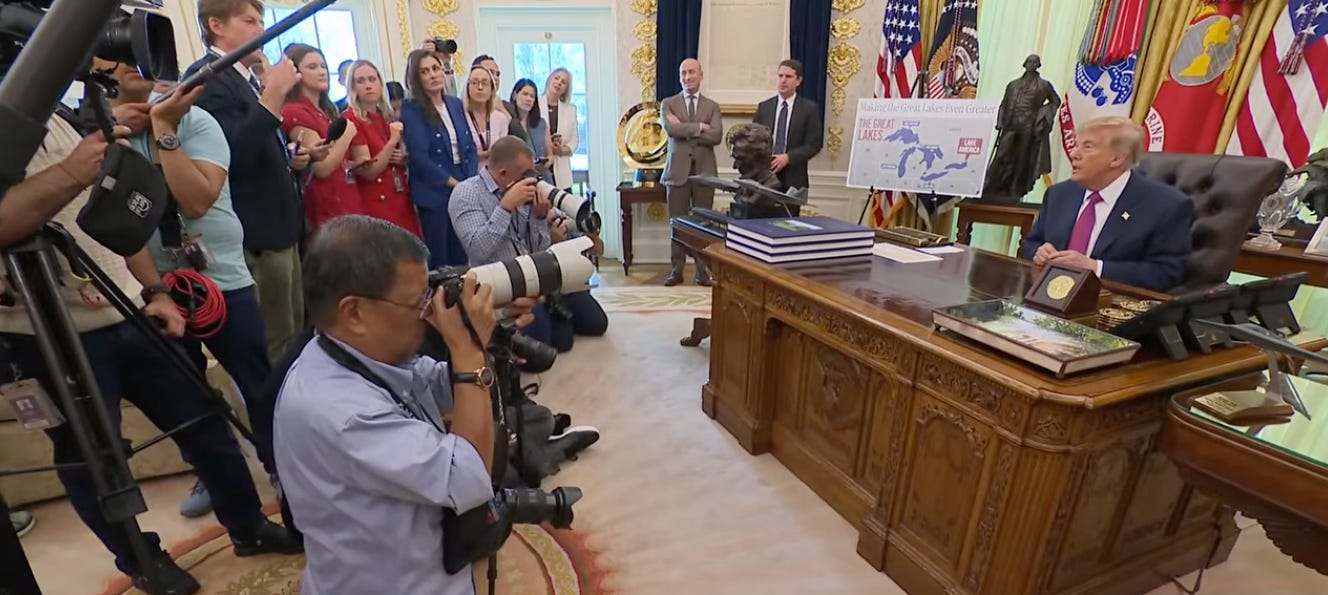
A few moments later, Trump took it even further. After signing the order, he looked up and said, “We have a gulf and we have a lake. Now, all we need is an ocean. So maybe we’ll have to change the name of the Atlantic and/or the Pacific. Maybe we’ll change them both.” As he said this, Stephen Miller stood off to the side of him, with his arms folded across his chest and grinned. He looked delighted. He stood there smiling as the President of the United States casually talked about renaming the Atlantic and Pacific Oceans as though they belonged to him. For all the attention we give Trump, none of this happens with Trump alone. It requires people standing behind him who encourage it, people who turn his impulses into policy, and people who have decided that their job is to tell him that whatever he wants to do can and should be done. Stephen Miller was not standing beside Trump today wondering how far this president might go. He was smiling because he wants to go there with him.
This is not just about pettiness, although it is staggeringly petty. Trump has spent nearly his entire time back in office attacking Canada and its leaders, using the economic power of the United States to punish one of our closest allies for refusing to bow down to him. With the deepening trade war between the United States and Canada hanging over all of this, Trump was asked today what message he was sending to Canada by renaming Lake Ontario. He said, “No message,” before immediately making it clear that there was one. “Canada has been ripping us off for a long time on trade,” he said. He called Canadian officials “nasty people.” He said they “feel entitled.” And then he said something that should not be overlooked: “I don’t think their representatives do an appropriate job. Maybe they’ll change.” Maybe they’ll change. What exactly does that mean? Does he mean he expects Canada’s elected representatives to change what they are doing, or does he mean he would like Canadians to change who represents them? We do not know, and I am not going to pretend we do. But we do know that Trump has repeatedly talked about Canada becoming our 51st state, claiming Canada wants the benefits of being a state without actually being one.
So at some point, we have to ask what the larger objective is here. Canada is not our enemy. It is a sovereign country, our neighbor, our ally, and one of our closest trading partners. There is no reason for an American president to spend this much time threatening them, insulting their leaders, economically squeezing their industries, questioning their representatives, and now erasing the name of a lake we share with them simply because their government will not give him what he wants. Is he trying to make Canada economically weaker and politically more vulnerable because he still believes he can somehow force them into becoming part of the United States? I am certainly not suggesting the Canadian people would ever allow that to happen. But after everything Trump himself has said about making Canada our 51st state, we would be foolish not to at least ask the question. Because picking an unnecessary fight with one of our closest friends, damaging a relationship generations of Americans and Canadians spent building, and using the enormous economic power of the United States to attack them is not normal diplomacy.
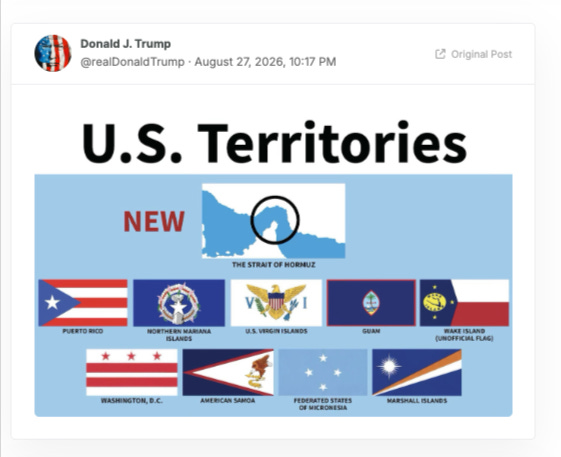
We cannot look at what Trump is doing to Canada in isolation either. He has made it clear over and over again that he believes the United States is entitled to take what he wants from other countries simply because he thinks we are more powerful than they are. He has repeatedly talked about making Canada our 51st state. He has spent more than a year trying to gain control of Greenland. He has threatened and bullied Mexico. And now he is deliberately picking a fight with one of our closest allies. There is no mechanism inside Trump that tells him when he has gone too far.
Before Trump made his big name chance announcement, he spent the first several minutes of the event talking about what he says is a booming American economy. He said the stock market had reached an all-time high for the 81st time in what he called “a brief one and a half years.” He boasted about 401(k)s being at record levels. He claimed factories were moving to the United States from Mexico, Canada, Japan, South Korea and Germany. Listening to him speak, we were supposed to believe that Americans everywhere are thriving. But what about the millions of Americans who do not have a 401(k)? What about the families who do not have money invested in the stock market, who do not own retirement accounts, and who could not care less what the Dow closed at because they are trying to figure out how to pay for groceries, rent, electricity, childcare, and prescriptions? He did not talk about what life actually costs for the Americans who are struggling to make it from one paycheck to the next. So when a reporter asked him directly whether his escalating trade war with Canada could hurt affordability for American families heading into the midterms, his answer was exactly as expected. “Ultimately, it’s going to be very good for us,” he said.
Senator Bernie Sanders was quick to respond. “No, President Trump. The American people don’t want to rename Lake Ontario Lake America. They want affordable healthcare, childcare, housing, education, nutrition assistance, all of which you have massively cut in order to pay for your $1 trillion tax break to the top 1%.” Public Citizen, the consumer advocacy group, added, “We’d really prefer affordable healthcare.”
What made the event even more revealing was listening to who Trump chose to attack and who he chose to praise. During the short event, he found time to call Annie Andrews, the Democratic nominee for Senate in South Carolina, “a radical left lunatic.” Annie Andrews is a pediatrician who has spent more than fifteen years caring for children in South Carolina and works at a children’s hospital. That is the woman the President of the United States chose to disparage.
A few minutes later, he turned his attention to Texas, repeatedly calling Democratic Senate nominee James Talarico “Telefreako” before describing him as “a little freaky” and saying he is “not a man that represents the value of Texas.” Except the man Trump flew to Texas tonight to campaign for is Ken Paxton, who was impeached by the Republican-controlled Texas House on charges that included bribery, corruption and abuse of office, and was later acquitted by the Republican-controlled state Senate. Paxton’s former chief of staff testified under oath that Paxton admitted to an extramarital affair, and Paxton was accused of using his office to help a campaign donor who later hired the woman with whom Paxton was having that affair. His own wife, a Texas state senator, filed for divorce last year citing “biblical grounds.” Yet this is the man Trump has decided represents the values of Texas, while the pediatrician who spent fifteen years caring for sick children is a “radical left lunatic” and James Talarico is somehow too “freaky” to represent his state. That tells us everything about what Trump means when he talks about values.
We got another glimpse of it when he praised newly seated South Carolina Senator Darline Graham by saying she had “good genetics.” Trump has returned to that language before. In 2020, speaking to a nearly all-white crowd in Minnesota, he told them they had “good genes” and invoked what he called the “racehorse theory.” Just last week, he again used the language of “good genetics” while talking about a blonde teenager at a White House event. At some point, we have to stop treating these words as random things that fall out of his mouth. When the President of the United States repeatedly talks about some people having “good genes,” while attacking others as lunatics, freaks, and people who do not represent American values, it is worth paying very close attention to what he is telling us about the way he sees people and what he plans to do next. Language about good genes and superior bloodlines has been used before to divide human beings into those considered desirable and those considered inferior, and history has already shown us where that kind of thinking can lead when it is embraced by people with political power. It helped provide the justification for eugenics programs, forced sterilizations, racial laws, and eventually some of the worst atrocities of the twentieth century. We do not have to claim that history is repeating itself exactly to recognize language that history has already taught us to take seriously.
The most dangerous moment of the entire 12 minutes had nothing to do with the lake. It came when a reporter asked whether Trump would punish Russia for continuing to do business with Iran. He said, “It depends.” He said he thought Russia had “behaved quite well.” And then he said something that no sitting president should ever say on camera: “Somebody was saying about China. What about China? We hear they’re spying. We spy on them too. It’s the way it goes.”
The President of the United States, sitting in the Oval Office, casually admitted that America conducts espionage against other nations as though he were talking about something completely ordinary. But he did not bring it up because he suddenly wanted to have an honest conversation about American intelligence operations. He brought it up to create a false equivalence between what the United States does and what China is doing, to normalize it, excuse it, and convince us that none of it really matters because everybody does it. We have watched Trump do this over and over again. If everyone is corrupt, then his corruption does not matter. If every country spies, then Chinese espionage does not matter. If everyone lies, then his lies do not matter. If everyone is guilty, then no one can be held accountable. It is one of the ways he takes something that should alarm us and makes it seem so normal that eventually we stop paying attention.
One reporter asked the question that had been hanging over the entire event: “Why are you so focused on doing things like this towards America’s allies instead of doing things that target adversaries?” He deflected and didn’t actually answer. It was a simple question, but it went straight to the heart of it all. Why is the President of the United States spending his time picking fights with Canada and changing the name of a lake we share with them while some of the countries that actually threaten American interests are treated with far more restraint? And why is nobody with the power to stop him doing so?
This is not how a president leads what many would call the most powerful nation on Earth. This is not how someone who understands the gravity of the office conducts himself in the Oval Office. Trump’s bad decisions do not mean a hotel room goes unbooked or a golf course loses money. His bad decisions get people killed. They destroy relationships between countries that took generations to build. They weaken alliances that have helped keep us safe for decades. Yet he seems to have no understanding of the enormous consequences that come with the power we have given him.
The entire event finished quickly, and when it was over, Trump thanked the press, sat back in his chair, and that same blank look we saw at the beginning came over his face once again. The performance was over, and the energy disappeared just as quickly as it had appeared. Within seconds, the press was being rushed from the Oval Office. None of what we watched today should surprise us anymore. Donald Trump has spent years showing us exactly who he is. What should concern us now are the people still standing behind him, smiling, defending it when it is over, and using the power of their own positions to make sure there is no one left in the room willing to tell him no.
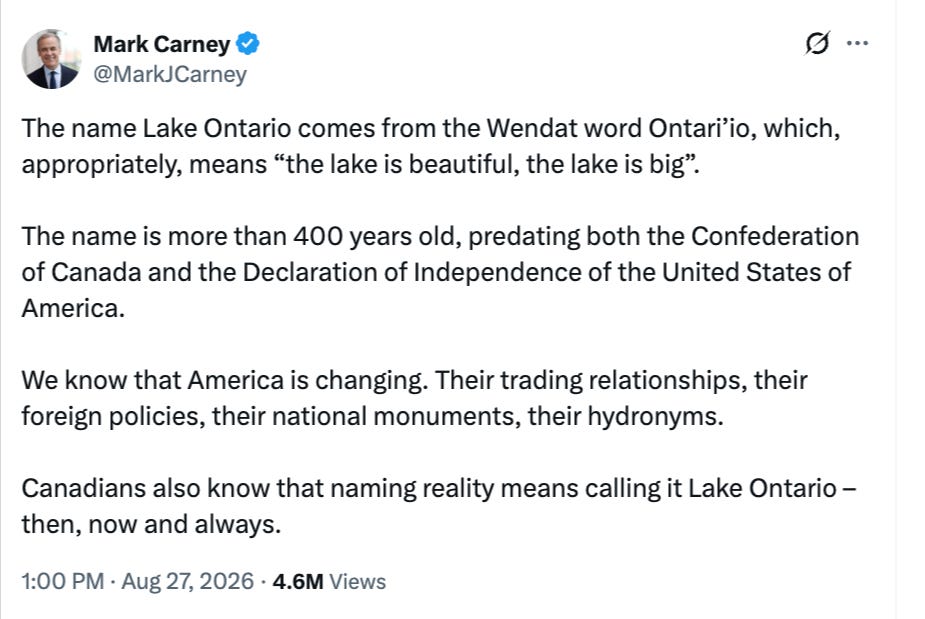
Canadian Prime Minister Mark Carney responded to the renaming with a dignity that only deepened the contrast: “The name Lake Ontario comes from the Wendat word Ontari’io, which, appropriately, means ‘the lake is beautiful, the lake is big.’ The name is more than 400 years old, predating both the Confederation of Canada and the Declaration of Independence of the United States of America. We know that America is changing. Their trading relationships, their foreign policies, their national monuments, their hydronyms. Canadians also know that naming reality means calling it Lake Ontario, then, now and always.”
Nova Scotia Premier Tim Houston’s reply was just as impactful: “We’re into some real foolishness now. It’s Lake Ontario, buddy.”

And across the United States, governors also responded. New York Governor Kathy Hochul, whose state actually borders the lake, said flatly, “New York won’t be calling it that.” Wisconsin Governor Tony Evers posted a video of himself inside a McDonald’s, signing a napkin that read “Lake Wisconsin,” and wrote, “And I just renamed Lake Michigan Lake Wisconsin. See, I can sign napkins that say things, too.” Illinois Governor JB Pritzker posted a photo of Trump’s Chicago tower with the name crossed out and replaced with “Natalie,” referencing the ongoing Natalie Harp controversy, and wrote, “EFFECTIVE IMMEDIATELY: Trump Tower is renamed to NATALIE TOWER!” And Vermont’s Republican Governor Phil Scott called the order “petty and disappointing,” adding, “We should be at the negotiating table, finding a path forward that strengthens both the U.S. and Canadian economies. Further escalating tensions does nothing to help American or Canadian families and businesses.”
Yet the men in the Oval Office said nothing. Miller grinned. Burgum adjusted his jacket. Nobody stopped this from happening. These men, the enablers who surround him, are not patriots. They do not love this country. If they did, they would be preserving the things that make it ours, not erasing a 400-year-old Indigenous name so a declining president can feel powerful for 12 minutes. They are pillagers. They take, and they destroy for their own personal gain.
I have been thinking about this all day. What keeps coming back to me is not Trump. It is them. The people standing behind him. Politics in this country has never been perfect. It has been dirty, unfair, unequal, and often cruel. I have never had any illusions about that. But before all of this, before the second Trump presidency, I believed something that I think most Americans believed, even if we never said it out loud. We believed that no matter how bitter the disagreements became, or how ugly the campaigns got, there was still something underneath all of it. Some baseline. Some floor. Some fundamental commitment to the country itself. A belief that the people in the room, even the ones we disagreed with, might fight us on policy, might infuriate us with their positions, and might put party over principle far more often than they should, but if the country were truly in danger, if a president lost his grip on reality or began dismantling our democracy in front of the world to see, someone in his own party would eventually stand up and say enough.
We now know this is no longer true. When I try to understand how we lost that, I keep thinking about the people who once proved it was possible.
In 1950, Senator Margaret Chase Smith of Maine stood on the Senate floor and delivered what she called a “Declaration of Conscience.” She was a Republican. Joseph McCarthy was at the height of his power, and members of her own party were benefiting from the fear and accusations he was spreading across the country. Smith stood up anyway and called it what it was. She said the Senate had been “debased to the level of a forum of hate and character assassination.” She was among the first in her party to say it publicly, knowing there could be a political price for doing it. But she did it anyway because there was still something more important to her than protecting herself or protecting her party. There was the country.
In January of 1961, President Dwight Eisenhower used his farewell address, his final moments speaking to the country as president, to issue a warning. He was a Republican. He was a five-star general. He could have used that speech to celebrate himself and everything he had accomplished. Instead, he warned the American people about the growing power of what he called the “military-industrial complex,” and the danger that concentrated economic and political power could have on our democracy if Americans stopped paying attention. More than 65 years later, that warning is just as, if not more, relevant today than it was when he said it. Power is not something we are supposed to worship simply because our side controls it. Power is something we are supposed to watch, question, and restrain before it becomes something none of us can control.
In August of 1974, three Republicans, Barry Goldwater, Hugh Scott, and John Rhodes, walked into the White House and told Richard Nixon it was over. They did not leak it to the press or issue a carefully worded statement expressing concern. They went to the White House, looked the president of their own party in the face, and told him the political support he needed to survive was gone. Nixon announced his resignation the next day. Three Republican leaders were willing to tell a Republican president something nobody standing behind Donald Trump today seems willing to tell him: no.
Three moments when someone was willing to choose truth over loyalty, country over party, conscience over comfort. Every one of those people is gone now, and I find myself wishing they were still here. Wishing there were still people like them anywhere near that building. Wishing there were people inside the Republican Party who understood that loyalty to a president is not the same thing as loyalty to the country, and that sometimes loving this country requires standing in front of the most powerful person in your own party and telling him he cannot go any farther. Because the people standing behind Trump in the Oval Office today were not doing that. They just stood there and smiled. They have every opportunity to be Margaret Chase Smith. They have every opportunity to walk into that office the way Goldwater, Scott, and Rhodes did. Instead, they have chosen to stand behind him and, worse, enable him. History will remember that choice too.
Even through all of this, I still do not feel like I am documenting the end of our country. I feel like I am documenting her greatest comeback. James Talarico is leading in several polls against Ken Paxton in Texas, the state Trump is visiting in a panic. A Republican governor called the president petty and disappointing. Democratic governors are using some of his own medicine to humiliate his authoritarianism with satire and jokes.
But here is the thing that stays with me most from today. When Trump signed that order, millions of people did something he did not expect. They went looking for the name he tried to erase. They searched for it, and they read about it. They learned that Ontari’io is a Wendat word that has been spoken on the shores of that lake for longer than either of our countries has existed. Because of what he did, more people heard that word today than have heard it in years.
He tried to erase it, and instead, he amplified it and helped people on both sides of the border honor a past they might not have known about. That is what happens when you try to silence something true. It gets louder. The truth always comes out. Trump may have the power to change what the United States government calls a lake, but he does not have the power to change where that name came from, what it means, or the people who have carried it for generations. That 400-year-old word will outlast every executive order this president will ever sign. And so will we. This is why I still have hope for America. And you should too.
I’ll see you tomorrow,
Heather
PS. You can make a significant difference right now by subscribing to my Substack. Your support helps me cover more ground and keep telling the truth about the lies and destruction unfolding in this country.
This commentary represents my personal opinions and analysis of matters of public concern, informed by publicly available information. Any references to individuals constitute opinion and commentary protected under the First Amendment.

Picture of the day: It was grooming day, and she came home with pompoms. It was the most adorable and ridiculous thing I’ve seen in a long time. I needed that laugh!
Sources used in the writing of this post:
President Trump Participates in Signing Time, Aug. 27, 2026: YouTube Video
https://www.cnn.com/2026/08/27/politics/trump-canada-lake-ontario-america
https://www.cnbc.com/2026/08/27/trump-canada-lake-america-ontario.html
https://www.washingtonpost.com/politics/2026/08/27/trump-signs-order-changing-name-lake-ontario/
https://www.thecanadianencyclopedia.ca/en/article/lake-ontario
Trump is hopeless, of course. While it's good to continue chronicling his decline, it is excellent to focus on the enablers around him. They are not insane—they have no excuses.
The way things are going here in the United States, maybe we'd be better off is Canada made us her 11th province.